
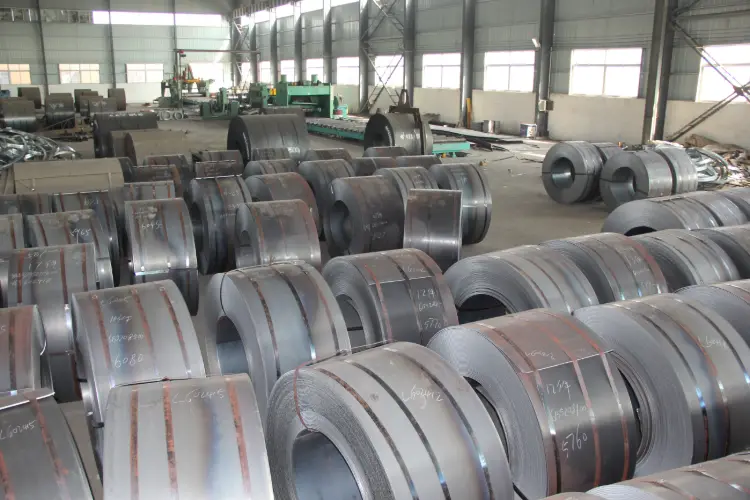
DNV D40 Shipbuilding Steel Coil
DNV D40 Shipbuilding Steel Coil: High-Strength Marine Grade for Arctic & Offshore Structures
Comprehensive technical data for DNV D40 shipbuilding steel coil: chemical composition, mechanical & thermal properties, global equivalents (ABS DH40, LR DH40, CCS DH40) and typical applications in ship hulls and offshore platforms.
Hot rolling, normalizing (N), thermo-mechanical controlled processing (TMCP), quenching and tempering (Q&T) if agreed, welding, cold forming (within limits), laser/plasma cutting
- Phone : +8618037372205
- Email : [email protected]
- WhatsApp: Contact via Whtsapp
- WeChat: +8618037372205
DNV D40 Shipbuilding Steel Coil Introduction
DNV D40 is a high-strength normalized or thermo-mechanically controlled processed (TMCP) steel for welded ship structures, certified by DNV (Det Norske Veritas). With a minimum yield strength of 390 MPa (40 kg/mm² grade) and guaranteed Charpy impact toughness at -20°C, it combines excellent weldability with robust low-temperature performance. The grade is primarily delivered as hot-rolled coils or plates and is widely adopted for hulls, decks, and offshore modules operating in cold marine environments. Its fine-grained microstructure ensures superior resistance to brittle fracture, fatigue, and lamellar tearing, making it a preferred choice for critical structural components in ice-class vessels and Arctic offshore projects.
DNV D40 Shipbuilding Steel Coil Chemical Composition
The chemical composition of DNV D40 is controlled to ensure high strength, excellent weldability, and fine-grain microstructure. All elements are in line with DNV rules. Microalloying elements (Nb, V, Ti) are added for grain refinement and precipitation strengthening. The carbon equivalent (CE) is limited to a maximum of 0.40% to avoid cold cracking during welding.
| Element | Standard Value (%) | Remarks |
|---|---|---|
| Carbon (C) | ≤ 0.20 | Base strength contributor |
| Silicon (Si) | ≤ 0.50 | Deoxidizer |
| Manganese (Mn) | 0.90 - 1.60 | Strength and toughness improvement |
| Phosphorus (P) | ≤ 0.025 | Impurity, controlled for toughness |
| Sulfur (S) | ≤ 0.025 | Impurity, low for lamellar tearing resistance |
| Aluminium (Al) | ≥ 0.015 (acid soluble) | Grain refiner |
| Niobium (Nb) | ≤ 0.05 | Microalloy for grain refinement |
| Vanadium (V) | ≤ 0.10 | Microalloy for precipitation strengthening |
| Titanium (Ti) | ≤ 0.02 | Nitride former, grain refinement |
| Chromium (Cr) | ≤ 0.20 | Hardenability element, limited |
| Nickel (Ni) | ≤ 0.40 | Toughness at low temperature |
| Copper (Cu) | ≤ 0.30 | Weathering resistance, may be residual |
| Molybdenum (Mo) | ≤ 0.08 | Hardenability, limited for weldability |
| Nitrogen (N) | ≤ 0.012 | May be bound by Ti/Al |
| Carbon Equivalent (CE) | ≤ 0.40 | CE = C+Mn/6+(Cr+Mo+V)/5+(Ni+Cu)/15 |
DNV D40 Shipbuilding Steel Coil Thermal & Electrical Physical Properties
Physical properties are applicable to the quenched-and-tempered or normalized condition of structural steel and are intended for design calculations. These values may vary slightly depending on the actual chemical composition and heat treatment condition. Data compiled from recognized references for carbon-manganese structural steels.
| Property | Standard Value | Unit | Test Condition / Remarks |
|---|---|---|---|
| Density (ρ) | ~ 7850 | kg/m³ | At 20°C |
| Young's Modulus (E) | ~ 205 | GPa | At 20°C |
| Shear Modulus (G) | ~ 80 | GPa | Calculated from E and ν |
| Poisson's Ratio (ν) | ~ 0.30 | – | Elastic range |
| Thermal Expansion Coeff. (α) | ~ 12.0 | 10⁻⁶/K | 20-100°C range |
| Thermal Expansion Coeff. (α) | ~ 13.0 | 10⁻⁶/K | 20-200°C range |
| Thermal Expansion Coeff. (α) | ~ 14.0 | 10⁻⁶/K | 20-400°C range |
| Thermal Conductivity (λ) | ~ 50 | W/(m·K) | At 20°C |
| Specific Heat Capacity (cₚ) | ~ 460 | J/(kg·K) | At 20°C |
| Electrical Resistivity (ρ_e) | ~ 0.22 | μΩ·m | At 20°C |
DNV D40 Shipbuilding Steel Coil Mechanical Properties
Mechanical properties are determined from tensile and Charpy V-notch impact tests on transverse or longitudinal specimens from normalized or TMCP coils. Values apply to thicknesses up to 100 mm. Impact energy is guaranteed at -20°C; in case of dispute, longitudinal testing prevails. All values are minimum unless a range is stated.
| Property | Standard Required Value | Unit | Test Condition / Thickness |
|---|---|---|---|
| Upper Yield Strength (ReH) | ≥ 390 | MPa | Thickness ≤ 50 mm, transverse |
| Upper Yield Strength (ReH) | ≥ 370 | MPa | 50 < Thickness ≤ 100 mm, transverse |
| Tensile Strength (Rm) | 510 - 650 | MPa | All thicknesses |
| Elongation after fracture (A) | ≥ 20 | % | Thickness ≤ 50 mm, gauge length 5.65√S₀ |
| Elongation after fracture (A) | ≥ 19 | % | 50 < Thickness ≤ 100 mm |
| Charpy Impact Energy (KV) | ≥ 27 (longitudinal) | J | -20°C, standard V-notch specimen |
| Charpy Impact Energy (KV) | ≥ 20 (transverse) | J | -20°C, transverse specimen if required |
| Bend Test (through 180°) | No cracks or defects | – | Mandrel diameter = 3×thickness (t≤25mm) or 4×t (t>25mm) |
DNV D40 Shipbuilding Steel Coil Exact Equivalent Material Standards and Substitutable Grades
| Country / Region | Standard | Grade Designation | Remarks |
|---|---|---|---|
| International (IACS) | UR W11 | DH40 | Common IACS high-strength ship steel; D = -20°C, H40 = 390 MPa YS |
| USA | ABS Rules | ABS DH40 | American Bureau of Shipping |
| UK / International | LR Rules | LR DH40 | Lloyd's Register |
| France | BV Rules | BV DH40 | Bureau Veritas |
| China | CCS Rules | CCS DH40 | China Classification Society |
| Japan | NK Rules | NK KD40 | ClassNK |
| Korea | KR Rules | KR DH40 | Korean Register |
| Italy | RINA Rules | RINA DH40 | Registro Italiano Navale |
| Russia | RS Rules | RS D40 | Russian Maritime Register of Shipping |
| India | IRS Rules | IRS DH40 | Indian Register of Shipping |
DNV D40 Shipbuilding Steel Coil Application Introduction
DNV D40 steel coil is engineered for heavy-duty marine and offshore construction where high strength, low-temperature toughness, and excellent weldability are mandatory. It is typically cut into plates and formed into structural components, stiffeners, and shells. Typical products range from entire ship hulls to individual flanges and gusset plates.
Product Applications: Ship hull outer shell, inner bottom, side shell, Weather deck and strength deck plating, Longitudinal and transverse stiffeners, stringers, Bulkhead and deep tank structures, Wind turbine transition pieces and monopiles, Offshore module main frames, crane pedestals, helideck support structure
Processed into products: Hull plates (keel, bottom, side, deck) – cut from coil into plates, T-beams, angle bars, bulb flats – hot-rolled sections of equivalent D40 or welded from strip, Stiffeners, web frames, brackets, floor plates, Flanges for pipe columns and bracing members in jackets, Gusset plates, shear panels, connection nodes, Cable trays and pipe supports (secondary steel)
Application industries: Shipbuilding & Ship Repair (commercial, naval, ice-class), Offshore Oil & Gas (fixed platforms, jack-up rigs, FPSO topsides), Marine Renewable Energy (wind turbine foundations, tidal structures), Polar & Arctic Engineering (ice breakers, LNG carriers), Heavy Steel Construction (bridges, lock gates if marine-approved steel is required)
DNV D40 Shipbuilding Steel Coil Similar / Closely Related Alternative Materials
| Country / Region | Standard | Grade Designation | Remarks |
|---|---|---|---|
| Norway (DNV) | DNV Rules | DNV E40 | Higher toughness: impact at -40°C, otherwise identical mechanical properties |
| Norway (DNV) | DNV Rules | DNV D36 | Lower yield strength (355 MPa), same toughness class; D = -20°C |
| Norway (DNV) | DNV Rules | DNV D47 | Higher strength (460 MPa) variant for reduced weight designs |
| EU (EN) | EN 10025-4 | S420ML/ S420M | Structural steel with minimum 420 MPa yield; TM or TMCP condition |
| EU (EN) | EN 10025-3 | S420N/NL | Normalized structural steel; comparable strength but different toughness regime |
| Japan (JIS) | JIS G 3106 | SM490YA/SM490YB | Weldable structural steel with mild impact properties; yield ~365 MPa |
Notes:
Welding Considerations: DNV D40 exhibits low carbon equivalent (≤0.40) and good weldability; preheating is generally not required for thicknesses below 50 mm, but low-hydrogen processes are recommended. Post-weld heat treatment (PWHT) is not normally required, but may be applied for heavy sections. Z-quality (through-thickness tensile properties) can be certified according to EN 10164 or DNV rules if specified. The material may be supplied with DNV-WT mark (weldability test) when required.
- Share



