
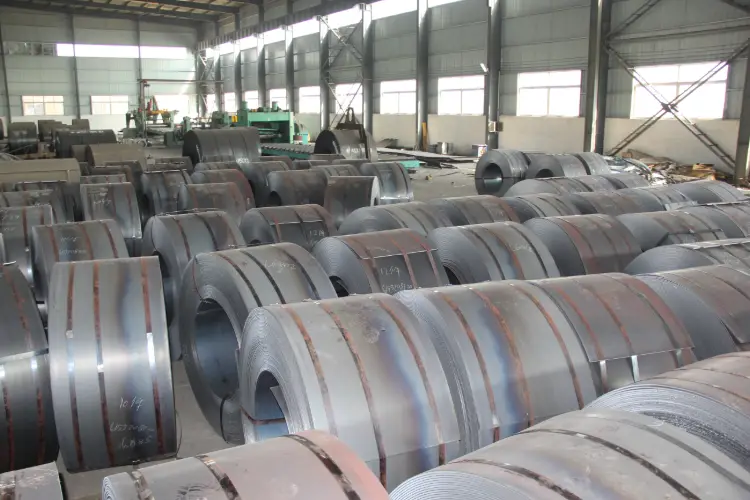
DNV E40 Shipbuilding Steel Coil
DNV E40 Shipbuilding Steel Coil: High-Strength Structural Steel for Marine Applications
DNV E40 is a high-strength structural steel for shipbuilding, compliant with Det Norske Veritas (DNV) rules. Offering minimum yield strength of 390 MPa and excellent low-temperature impact toughness down to -40°C, it is designed for critical hull and offshore structures.
Hot rolling, Normalizing, TMCP, Cutting, Welding, Bending, Forming
- Phone : +8618037372205
- Email : [email protected]
- WhatsApp: Contact via Whtsapp
- WeChat: +8618037372205
DNV E40 Shipbuilding Steel Coil Introduction
DNV E40 steel coil is a normalized or thermomechanically rolled (TMCP) structural steel grade primarily used in shipbuilding and offshore engineering. It complies with the Det Norske Veritas (DNV) rules for classification of ships and offers a minimum yield strength of 390 MPa, high tensile strength, and superior notch toughness at -40°C. The steel is characterised by:
- Excellent weldability and cold formability
- High resistance to brittle fracture in low-temperature marine environments
- Strictly controlled chemical composition, especially low sulfur and phosphorus content, and microalloying elements (Nb, V, Ti) for grain refinement
Typical delivery condition is normalized or TMCP, with ultrasonic testing available upon request. DNV E40 is widely used in the construction of deck plates, hull shells, bulkheads, and offshore platform components.
DNV E40 Shipbuilding Steel Coil Chemical Composition per DNV Rules
The chemical composition of DNV E40 is strictly controlled to ensure high strength, good weldability, and low-temperature toughness. Microalloying elements (Nb, V, Ti) are optional but typically added for grain refinement. Total aluminium is usually required to ensure fine grain practice. Carbon equivalent (CEV) is limited to guarantee weldability: typically CEV ≤ 0.38% (ladle analysis).
| Element | Standard Value (wt.%) | Remarks |
|---|---|---|
| Carbon (C) | ≤ 0.18 | |
| Silicon (Si) | 0.10 – 0.50 | |
| Manganese (Mn) | 0.90 – 1.60 | Higher Mn may be agreed |
| Phosphorus (P) | ≤ 0.025 | |
| Sulfur (S) | ≤ 0.025 | |
| Nitrogen (N) | ≤ 0.009 (≤ 0.012 if Al present) | |
| Aluminium (Acid soluble Al) | ≥ 0.015 | Minimum for fine grain practice |
| Niobium (Nb) | 0.02 – 0.05 | Optional microalloy |
| Vanadium (V) | 0.05 – 0.10 | Optional microalloy |
| Titanium (Ti) | ≤ 0.02 | Optional microalloy |
| Copper (Cu) | ≤ 0.35 | |
| Chromium (Cr) | ≤ 0.20 | |
| Nickel (Ni) | ≤ 0.40 | |
| Molybdenum (Mo) | ≤ 0.08 |
DNV E40 Shipbuilding Steel Coil Physical and Thermal Properties
The following physical properties are typical for this class of carbon-manganese structural steel and can be used for design calculations. Actual values may vary slightly depending on exact composition and heat treatment. Thermal conductivity and thermal expansion are essential for welding and fire engineering.
| Property | Typical Value | Unit | Test Condition / Remarks |
|---|---|---|---|
| Density (ρ) | 7.85 | g/cm³ | Room temperature |
| Modulus of Elasticity (E) | 210 | GPa | Room temperature |
| Shear Modulus (G) | 81 | GPa | Room temperature |
| Poisson's Ratio (ν) | 0.3 | - | Room temperature |
| Thermal Expansion Coefficient (α) | 11.8 × 10⁻⁶ | K⁻¹ | 20 – 100°C |
| Thermal Expansion Coefficient (α) | 12.6 × 10⁻⁶ | K⁻¹ | 20 – 200°C |
| Thermal Expansion Coefficient (α) | 13.5 × 10⁻⁶ | K⁻¹ | 20 – 400°C |
| Thermal Conductivity (λ) | 50 | W/(m·K) | 20°C |
| Thermal Conductivity (λ) | 47 | W/(m·K) | 200°C |
| Thermal Conductivity (λ) | 40 | W/(m·K) | 400°C |
| Specific Heat Capacity (c) | 460 | J/(kg·K) | 20°C |
| Electrical Resistivity (ρ_e) | 0.20 – 0.25 × 10⁻⁶ | Ω·m | Room temperature |
DNV E40 Shipbuilding Steel Coil Mechanical Properties
Mechanical properties are determined on transverse or longitudinal test pieces according to DNV requirements. Impact test temperature is -40°C for E-grade. Yield and tensile strength depend slightly on product thickness; the table shows the guaranteed minimum values for thickness ≤ 50 mm. Elongation is measured on a gauge length of 5.65√S₀. All tests are carried out in the delivery condition (N or TMCP).
| Property | Standard Requirement | Unit | Test Condition |
|---|---|---|---|
| Yield Strength (ReH) | ≥ 390 | MPa | Transverse, room temperature (t ≤ 50 mm) |
| Tensile Strength (Rm) | 510 – 650 | MPa | Transverse, room temperature (t ≤ 50 mm) |
| Elongation (A) | ≥ 20 (longitudinal) | % | Gauge length = 5.65√S₀, room temperature |
| Elongation (A) | ≥ 18 (transverse) | % | Gauge length = 5.65√S₀, room temperature |
| Impact Energy (KV₂) | ≥ 34 (average of 3 specimens) | J | -40°C, longitudinal, V-notch |
| Impact Energy (KV₂) | ≥ 24 (individual min.) | J | -40°C, longitudinal, V-notch |
| Bend Test | D = 3a (180°) | - | t ≤ 50 mm, no cracks; a = specimen thickness |
DNV E40 Shipbuilding Steel Coil Fully Equivalent Materials
| Country / Society | Standard / Rule | Grade | Remarks |
|---|---|---|---|
| International (IACS) | UR W11 | EH40 | All IACS classification societies |
| American Bureau of Shipping | ABS Rules | EH40 | Identical mechanical and impact requirements |
| Lloyd's Register (UK) | LR Rules | EH40 | - |
| Bureau Veritas (France) | BV Rules | EH40 | - |
| China Classification Society | CCS Rules | EH40 | - |
| ClassNK (Japan) | NK Rules | EH40 | - |
| Korean Register | KR Rules | EH40 | - |
| RINA (Italy) | RINA Rules | EH40 | - |
| Russian Maritime Register | RS Rules | E40 | Direct equivalent, often marked as E40 |
DNV E40 Shipbuilding Steel Coil Application Introduction
DNV E40 steel coil is specifically designed for welded structures in shipbuilding and offshore engineering. Its high yield strength allows weight reduction while maintaining structural integrity in low-temperature environments. It can be processed into various components through cutting, cold forming, welding, and machining. Key application sectors:
Product Applications: Hull plates and stiffeners, Deck and bulkhead panels, Superstructure components, Longitudinal and transverse frames, Web frames and girders, Double-bottom structures, Hat stiffeners, Collision bulkheads
Processed into products: Brackets and knees, Rudder horns and pintle plates, Keel plates, Chain locker walls, Engine room structural parts, Hatch coamings and corner pieces, Offshore crane pedestals, Helicopter deck support beams
Application industries: Shipbuilding (commercial vessels, naval ships), Offshore oil & gas platforms (jackets, decks, modules), Marine equipment (crane booms, winch foundations), Port and harbour construction (sheet piles, mooring structures), Renewable energy (offshore wind turbine foundations, transition pieces)
DNV E40 Shipbuilding Steel Coil Similar / Alternative Grades for Consideration
| Country / Society | Standard / Rule | Grade | Remarks |
|---|---|---|---|
| DNV | DNV Rules | DH40 | Lower impact test temperature (-20°C) – suitable for less severe conditions |
| DNV | DNV Rules | FH40 | Higher toughness: impact test at -60°C for critical arctic service |
| DNV | DNV Rules | E36 | Lower yield strength (355 MPa min) – may be considered where E40 is over-specified |
| EN (Europe) | EN 10025-6 | S460QL / S460QL1 | Quenched and tempered structural steel with similar strength, needs separate approval for marine use |
| ASTM (USA) | ASTM A131 / A131M | EH40 | Direct equivalent for shipbuilding, same strength and -40°C impact |
| JIS (Japan) | JIS G 3106 | SM490YA / SM490YB | Comparable strength but impact toughness must be specified separately |
Notes:
Welding: The steel is designed for all common welding techniques (SMAW, SAW, GMAW, FCAW). Preheating may be required for thick sections (>50 mm) depending on CEV and hydrogen control. Ultrasonic testing: In accordance with DNV rules, plates for critical applications may be subjected to ultrasonic inspection according to EN 10160 or equivalent. Certification: All material is supplied with DNV certificate 3.1 or 3.2 as per EN 10204. Corrosion protection: Standard marine coatings or cathodic protection systems should be applied as the steel does not possess inherent atmospheric corrosion resistance.
- Share



