
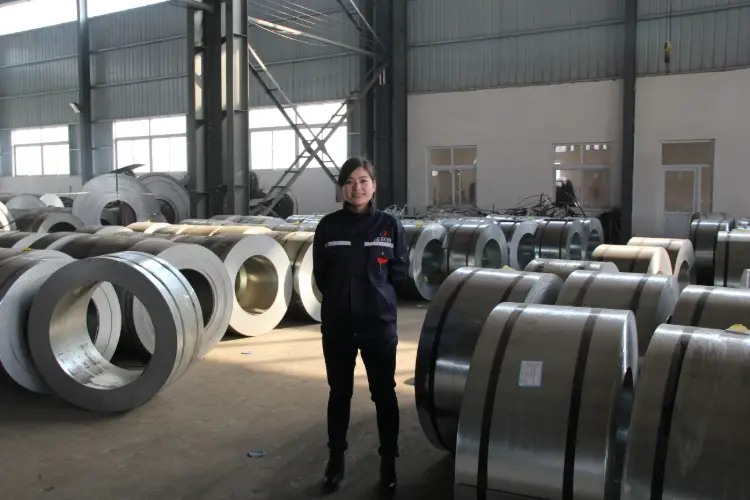
DNV D420 Shipbuilding Steel Coil
DNV D420 Shipbuilding Steel Coil: High Strength for Marine Engineering
Discover DNV D420, a high-strength shipbuilding steel with minimum yield strength 420 MPa, excellent toughness at -20°C, and full compliance with DNV classification rules for ship and offshore structures.
Hot rolling, Thermomechanical Controlled Processing (TMCP), Normalizing, Controlled rolling
- Phone : +8618037372205
- Email : [email protected]
- WhatsApp: Contact via Whtsapp
- WeChat: +8618037372205
DNV D420 Shipbuilding Steel Coil Introduction
DNV D420 is a high-strength structural steel grade certified by DNV (Det Norske Veritas), specifically designed for welded ship and offshore structures. With a minimum yield strength of 420 MPa, it belongs to the group of thermomechanically rolled or normalized fine-grain steels. The grade offers excellent weldability, good low-temperature toughness (guaranteed Charpy energy at -20 °C), and high strength-to-weight ratio, which enables lighter structural designs without compromising safety. It is typically delivered in plates or coils and finds extensive use in hulls, decks, and offshore platforms. The designation "D" indicates the impact test temperature of -20°C, while "420" refers to the specified minimum yield strength in MPa. Compliance with DNV Rules for Classification of Ships ensures reliable performance under harsh marine conditions.
DNV D420 Shipbuilding Steel Coil Chemical Composition
The chemical composition of DNV D420 conforms to the DNV rules for high strength steels. The values below are maxima unless a range is given. Fine-grain practice shall be applied through the addition of grain-refining elements such as Al, Nb, V, and Ti. The carbon equivalent (CEV) is limited to ensure good weldability.
| Element | Value (wt%) | Remarks |
|---|---|---|
| C (Carbon) | ≤ 0.21 | Ladle analysis |
| Mn (Manganese) | 0.90 – 1.70 | If Carbon equivalent allows, upper limit can be adjusted |
| Si (Silicon) | 0.10 – 0.55 | Ladle analysis |
| P (Phosphorus) | ≤ 0.030 | |
| S (Sulphur) | ≤ 0.030 | |
| Al (Aluminium, total) | ≥ 0.020 | Fine grain practice; Acid soluble Al≥0.015 if used |
| Nb (Niobium) | ≤ 0.05 | |
| V (Vanadium) | ≤ 0.10 | |
| Ti (Titanium) | ≤ 0.03 | |
| Cu (Copper) | ≤ 0.35 | |
| Cr (Chromium) | ≤ 0.25 | |
| Ni (Nickel) | ≤ 0.80 | |
| Mo (Molybdenum) | ≤ 0.08 | |
| N (Nitrogen) | ≤ 0.009 | For Al-treated steels or when Nb/V/Ti added |
| Ceq (Carbon equivalent) | ≤ 0.40 (t≤50 mm) | Ceq = C+Mn/6+(Cr+Mo+V)/5+(Ni+Cu)/15 |
| Ceq (Carbon equivalent) | ≤ 0.43 (50| For thicker sections | |
DNV D420 Shipbuilding Steel Coil Physical Properties
The following physical data are representative for high-strength low-alloy carbon-manganese steels similar to DNV D420. They are not mandatory requirements but provide useful engineering references.
| Property | Value | Unit | Test Condition |
|---|---|---|---|
| Density (ρ) | 7.85 | g/cm³ | At 20 °C |
| Modulus of Elasticity (E) | 205 | GPa | At 20 °C |
| Shear Modulus (G) | 79 | GPa | At 20 °C, calculated from E and ν |
| Poisson's Ratio (ν) | 0.3 | — | At 20 °C |
| Thermal Expansion Coefficient (α) | 11.5 × 10⁻⁶ | K⁻¹ | 20–100 °C |
| Thermal Conductivity (λ) | 50 | W/(m·K) | At 20 °C |
| Specific Heat Capacity | 460 | J/(kg·K) | At 20–100 °C |
| Electrical Resistivity (ρₑ) | 0.14 × 10⁻⁶ | Ω·m | At 20 °C |
DNV D420 Shipbuilding Steel Coil Tensile and Impact Properties
Mechanical properties are determined on transverse or longitudinal test pieces in accordance with DNV rules. The stated values correspond to TMCP or normalized delivery condition. Impact tests are performed on Charpy V-notch specimens at -20 °C. The requirements vary with product thickness.
| Property | Value | Unit | Test Condition |
|---|---|---|---|
| Yield Strength (ReH) | ≥ 420 | MPa | t ≤ 50 mm, transverse |
| Yield Strength (ReH) | ≥ 400 | MPa | 50 < t ≤ 100 mm, transverse |
| Tensile Strength (Rm) | 530 – 680 | MPa | t ≤ 50 mm, transverse |
| Tensile Strength (Rm) | 500 – 650 | MPa | 50 < t ≤ 100 mm, transverse |
| Elongation (A) | ≥ 19 | % | Gauge length 5.65√S₀, t ≤ 50 mm, longitudinal |
| Elongation (A) | ≥ 18 | % | 50 < t ≤ 100 mm, longitudinal |
| Bend Test (Mandrel diameter) | d = 3a (180°) | — | No cracks; a = specimen thickness; all thicknesses |
| Charpy V-notch Impact Energy (KV₂) | ≥ 27 (average) | J | At -20 °C, longitudinal, t ≤ 50 mm |
| Charpy V-notch Impact Energy (KV₂) | ≥ 27 (average) | J | At -20 °C, longitudinal, 50 < t ≤ 100 mm |
DNV D420 Shipbuilding Steel Coil Fully Equivalent Grades from Other Classification Societies
| Country/Region | Standard | Grade | Remarks |
|---|---|---|---|
| International | ABS Rules | ABS EH420 | Same min. yield 420 MPa, impact at -20 °C |
| International | BV Rules | BV EH420 | Equivalent high strength grade |
| International | LR Rules | LR EH420 | Same strength and toughness class |
| Japan | NK Rules | NK KE420 | Equivalent shipbuilding steel |
| Korea | KR Rules | KR EH420 | Equivalent high strength grade |
| Italy | RINA Rules | RINA EH420 | Same mechanical requirements |
| China | CCS Rules | CCS EH420 | Equivalent grade for marine structures |
DNV D420 Shipbuilding Steel Coil Application Introduction
DNV D420 steel is specifically tailored for demanding marine and offshore applications where high strength, good weldability, and resistance to brittle fracture at low temperatures are essential. Its TMCP delivery condition ensures a fine microstructure with balanced properties. Typical thicknesses range from 6 to 100 mm. The material can be formed, welded, and machined using standard practices for high-strength structural steels. Pre-heat and interpass temperature control should follow recommended guidelines to avoid cold cracking.
Product Applications: Ship hulls and superstructures, Decks, bulkheads, and side shells, Offshore platform legs, braces, and helidecks, Wind-turbine monopiles and transition pieces, Strength members in floating production storage and offloading (FPSO) units
Processed into products: Longitudinal and transverse stiffeners, Web frames and girders, Bracket plates and insert plates, Padeyes and lifting lugs, Deck flooring panels, Reinforcement plates for welded joints
Application industries: Shipbuilding (commercial and naval vessels), Offshore oil & gas (platforms, jack-ups, modules), Marine engineering (floating docks, pontoons, wind turbine foundations), Bridge construction (where DNV approval is accepted), Heavy machinery and structural fabrication
DNV D420 Shipbuilding Steel Coil Near-Equivalent or Similar Substitutes
| Country/Region | Standard | Grade | Description / Differences |
|---|---|---|---|
| International | ABS/BV/LR/etc. | EH40 (390 MPa) | Lower yield strength; still suitable if design allows. Impact temperature -40 °C for EH40 is better, but yield is only 390 MPa. |
| International | DNV | DNV FH420 | Same yield strength but Charpy temperature at -60 °C (higher toughness class for low-temperature service). |
| Europe | EN 10025-6 | S690QL | Much higher strength (690 MPa) quenched and tempered steel, used for heavy offshore structures; requires careful welding procedures compared to D420. |
| International | API | API 2W Grade 50 (345 MPa) | Different strength; used for offshore structural tubulars. Not a direct substitute for 420 MPa yield. |
Notes:
Welding: The steel is suitable for all conventional welding processes. Low hydrogen electrodes and proper preheat (typically 75–150 °C depending on thickness) are recommended. Post-weld heat treatment (PWHT): Not normally required for thicknesses up to 50 mm; for thicker sections, PWHT can be applied if agreed. Surface condition: Material is usually supplied with a hot-rolled surface, but can be shot-blasted and shop-primed. Certification: DNV material certificates (inspection certificate type 3.1 or 3.2) are issued with each consignment.
- Share



