
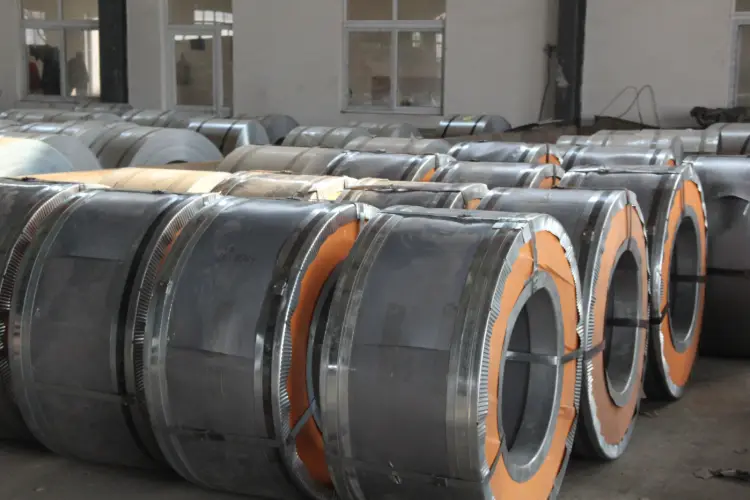
DNV A420 Shipbuilding Steel Coil
DNV A420 Shipbuilding Steel Coil - High-Strength Hull Structural Steel (420 MPa Yield)
Technical data sheet for DNV A420 shipbuilding steel coil: chemical composition, mechanical properties, thermal & electrical physical parameters, equivalent grades, and application guidance.
Hot rolling, TMCP, normalising, cutting, cold forming, welding, shot blasting
- Phone : +8618037372205
- Email : [email protected]
- WhatsApp: Contact via Whtsapp
- WeChat: +8618037372205
DNV A420 Shipbuilding Steel Coil Introduction
DNV A420 is a high-strength, fine-grain structural steel for ship hulls and marine applications, certified by DNV in accordance with IACS UR W11. The grade designation 'A' denotes a minimum impact energy of 41 J at 0 °C (longitudinal), while '420' refers to the guaranteed minimum yield strength of 420 MPa for thicknesses ≤ 50 mm.
Produced by thermo-mechanical controlled rolling (TMCP) or normalising rolling, this steel offers an excellent combination of high strength, good toughness and weldability. The material typically exhibits a fine-grained ferritic-pearlitic microstructure with micro-alloying additions (Nb, V, Ti) for grain refinement and precipitation hardening.
DNV A420 steel coils are widely used for critical structural members in ships, offshore platforms and other marine structures where weight savings and high load-bearing capacity are essential. The coil form allows efficient processing into long profiles, stiffeners and deck plates through slitting, cutting and cold forming.
DNV A420 Shipbuilding Steel Coil Chemical Composition
Ladle analysis according to IACS UR W11 for grade A420. The steel is fully killed and fine-grain treated with sufficient aluminium or other grain-refining elements. Micro-alloying with Nb, V and/or Ti is allowed to achieve the specified mechanical properties. The carbon equivalent Ceq is usually controlled to ≤ 0.40 % to ensure good weldability.
| Chemical Element | Standard Value (%) | Remarks |
|---|---|---|
| C | ≤ 0.21 | Ladle analysis |
| Mn | 1.00 – 1.70 | Depending on thickness |
| Si | ≤ 0.55 | – |
| P | ≤ 0.035 | – |
| S | ≤ 0.035 | – |
| Al (acid soluble) | ≥ 0.015 | Fine-grain practice |
| Nb | ≤ 0.05 | Optional grain refiner |
| V | ≤ 0.10 | Optional grain refiner |
| Ti | ≤ 0.02 | Optional grain refiner |
| Ceq (IIW) | ≤ 0.40 (typical) | For welding assessment |
DNV A420 Shipbuilding Steel Coil Thermal and Electrical Physical Properties
The following values are typical for low-carbon, micro-alloyed structural steels similar to DNV A420 at room temperature, unless otherwise noted. They are not part of the classification rule but serve as a guide for engineering design.
| Property | Typical Value | Unit | Test Condition |
|---|---|---|---|
| Density (ρ) | 7850 | kg/m³ | 20 °C |
| Elastic modulus (E) | 205 | GPa | 20 °C |
| Shear modulus (G) | 80 | GPa | 20 °C |
| Poisson's ratio (ν) | 0.30 | – | 20 °C |
| Thermal expansion coefficient (α) | 12.0 | 10⁻⁶/K | 20–100 °C |
| Thermal expansion coefficient (α) | 13.5 | 10⁻⁶/K | 20–200 °C |
| Thermal conductivity (λ) | 50 | W/(m·K) | 20 °C |
| Thermal conductivity (λ) | 45 | W/(m·K) | 100 °C |
| Specific heat capacity (cp) | 460 | J/(kg·K) | 20 °C |
| Electrical resistivity (ρe) | 0.22 | μΩ·m | 20 °C |
DNV A420 Shipbuilding Steel Coil Mechanical Properties
Tensile and impact properties as required by IACS UR W11 for grade A420. Testing is performed on longitudinal specimens taken from the coil/plate. Impact test temperature is 0 °C for A420. Values may differ for product thickness above 100 mm (subject to agreement).
| Property | Standard Requirement | Unit | Test Condition |
|---|---|---|---|
| Yield strength (ReH) | ≥ 420 | MPa | t ≤ 50 mm |
| Yield strength (ReH) | ≥ 400 | MPa | 50 < t ≤ 70 mm |
| Yield strength (ReH) | ≥ 390 | MPa | 70 < t ≤ 100 mm |
| Tensile strength (Rm) | 530 – 680 | MPa | all thicknesses |
| Elongation (A) | ≥ 18 | % | t ≤ 50 mm, gauge 5.65√So |
| Elongation (A) | ≥ 17 | % | 50 < t ≤ 70 mm |
| Elongation (A) | ≥ 17 | % | 70 < t ≤ 100 mm |
| Charpy impact (KV) | ≥ 41 (avg.), ≥ 28 (single) | J | Longitudinal, 0 °C |
| Charpy impact (KV) | ≥ 27 (avg.), ≥ 20 (single) | J | Transverse, 0 °C (optional) |
| Bend test | No cracks | – | 180° bending, former dia. = 3a (a=thickness) |
DNV A420 Shipbuilding Steel Coil Fully Equivalent Material Standards & Recommended Substitution Grades
| Country / Region | Standard | Grade | Remarks |
|---|---|---|---|
| IACS (International) | IACS UR W11 | A420 | Base standard for all IACS members |
| Norway / DNV | DNV Pt.2 Ch.1 | NV A420 | Original certification |
| USA / ABS | ABS Rules | ABS AQ420 | Equivalent impact and strength class |
| UK / LR | Lloyd's Register Rules | LR A420 | Identical requirements |
| France / BV | Bureau Veritas Rules | BV A420 | Identical requirements |
| China / CCS | CCS Rules | CCS A420 | Identical requirements |
| Japan / NK | ClassNK Rules | NK KA420 | Identical requirements |
| Korea / KR | Korean Register Rules | KR A420 | Identical requirements |
| Italy / RINA | RINA Rules | RINA A420 | Identical requirements |
| Russia / RS | RMRS Rules | RS A420 | Identical requirements |
DNV A420 Shipbuilding Steel Coil Application Introduction
DNV A420 shipbuilding steel coil is engineered for heavy-load marine structures where high strength, excellent weldability and guaranteed low-temperature toughness are mandatory. The coil form favours continuous processing of long beams, stiffeners and deck plates.
Typical applications include:
Product Applications: Hull plates and shell plating, Decks, bulkheads, stringers and stiffeners, Welded profiles (T-beams, L-profiles, bulb flats), Cold-formed sections for lightweight construction, Structural components of floating production storage and offloading (FPSO) units
Processed into products: Longitudinal girders and transverse frames, Stiffening ribs and brackets, Deckhouse panels and hatch covers, Crane pedestals and lifting lugs, Truss members of jack-up rigs
Application industries: Shipbuilding (merchant ships, naval vessels, cruise ships), Offshore oil and gas platforms (jack-up legs, topsides, flare booms), Marine engineering (lock gates, mooring equipment, floating docks), Renewable energy (offshore wind turbine foundations, transition pieces)
DNV A420 Shipbuilding Steel Coil Similar or Alternative Material Recommendations
| Country / Region | Standard | Grade | Remarks |
|---|---|---|---|
| EU | EN 10025-4 | S420M / S420ML | Thermo-mechanically rolled, yield 420 MPa; impact temperature differs (ML: -50 °C); requires additional agreement for marine service |
| USA | ASTM A131 / API 2H | EH42 / Grade 50 | Higher-sulphur offshore structural steel; may need supplementary toughness testing |
| Japan | JIS G 3106 | SM490YA | Yield 365 MPa, lower strength; suitable for less demanding marine structures |
| China | GB/T 712 | A420 | Same IACS specification; often interchangeable directly |
Notes:
Welding considerations: The carbon equivalent Ceq is typically kept ≤ 0.40 %. Low hydrogen welding processes (SMAW, SAW, FCAW, GMAW) with matching strength electrodes are recommended. Preheating is normally not required for thin sections (< 30 mm) but may be applied (50–100 °C) when humidity is high or plate thickness exceeds 40 mm to avoid hydrogen cracking. Post-weld heat treatment (PWHT) is usually unnecessary.
Formability: The steel can be cold bent to moderate radii; minimum recommended bending radius is 2–3 times thickness. Hot forming should be followed by normalising or TMCP simulation as applicable.
Corrosion protection: As a structural steel, DNV A420 is not inherently corrosion resistant and must be protected in marine environments by coatings (epoxy-based systems), cathodic protection or zinc spraying.
Certification: Coils are supplied with DNV (or mutually recognised class) test certificates (3.1 or 3.2 in accordance with EN 10204). All test reports verify compliance with IACS UR W11 and the customer's additional requirements if any.
- Share



