
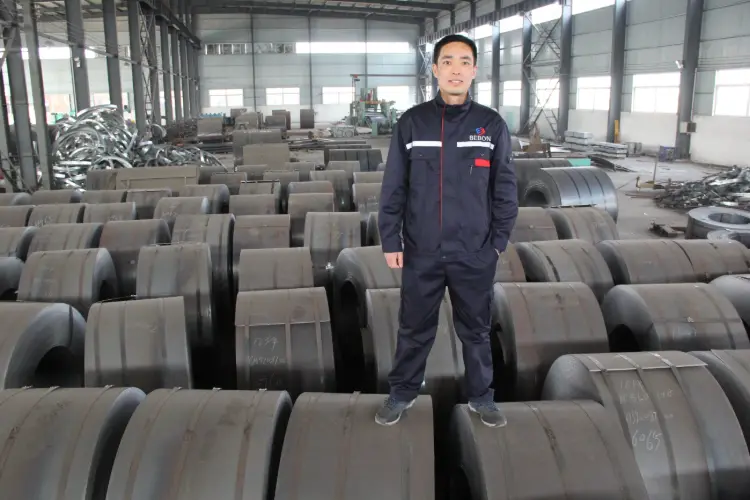
DNV E420 Shipbuilding Steel Coil
DNV E420 Shipbuilding Steel Coil - High Strength Marine Steel Data
Complete material data for DNV E420 (EH420) shipbuilding steel coil: chemical composition limits, mechanical properties across thickness ranges, typical physical properties, international equivalent grades, application guidelines, and processing recommendations.
Hot rolling, Thermomechanical Controlled Processing (TMCP), normalizing, welding fabrication
- Phone : +8618037372205
- Email : [email protected]
- WhatsApp: Contact via Whtsapp
- WeChat: +8618037372205
DNV E420 Shipbuilding Steel Coil Introduction
DNV E420 (EH420) is a high-strength hull structural steel approved by the DNV classification society (now DNV GL). Designed for critical marine and offshore applications, it guarantees a minimum yield strength of 420 MPa and excellent low-temperature toughness with impact testing at -40°C. The steel is delivered in coil form, typically through hot rolling and thermomechanical controlled processing (TMCP), which refines the grain structure and optimises strength-ductility-weldability balance. Microalloying with Nb, V and Ti contributes to strength while maintaining a low carbon equivalent, ensuring good weldability and resistance to cold cracking. DNV E420 conforms to DNV Rules for Classification of Ships or DNV-OS-B101 and satisfies IACS UR W11 requirements for EH420 grade, making it a globally accepted material for building hulls, decks, bulkheads, and offshore structures.
DNV E420 Shipbuilding Steel Coil Chemical Composition
The chemical composition of DNV E420 is designed to achieve a yield strength of 420 MPa with good low-temperature toughness and weldability. All values are maximum limits (except aluminium which has a minimum) and comply with DNV rules for high-strength hull steels. Nb, V and Ti are added for grain refinement and precipitation hardening. Carbon equivalent (CEV) is controlled to prevent hardening in the heat affected zone during welding.
| Chemical Element | Standard Value (wt%) | Remarks |
|---|---|---|
| Carbon (C) | ≤ 0.18 | Max |
| Silicon (Si) | ≤ 0.50 | Max |
| Manganese (Mn) | 0.90 – 1.65 | Range |
| Phosphorus (P) | ≤ 0.025 | Max |
| Sulfur (S) | ≤ 0.025 | Max |
| Aluminium (Altot) | ≥ 0.015 | Min (acid soluble) |
| Niobium (Nb) | ≤ 0.05 | Max |
| Vanadium (V) | ≤ 0.10 | Max |
| Titanium (Ti) | ≤ 0.02 | Max |
| Niobium + Vanadium + Titanium (Nb+V+Ti) | ≤ 0.12 | Combined max |
| Chromium (Cr) | ≤ 0.25 | Max |
| Nickel (Ni) | ≤ 0.80 | Max |
| Molybdenum (Mo) | ≤ 0.30 | Max |
| Copper (Cu) | ≤ 0.35 | Max |
| Carbon Equivalent (CEV) | ≤ 0.45 (t ≤ 50 mm); ≤ 0.47 (50 < t ≤ 100 mm) | CEV = C + Mn/6 + (Cr+Mo+V)/5 + (Ni+Cu)/15 |
DNV E420 Shipbuilding Steel Coil Thermal and Electrical Physical Properties
The following physical properties are typical for high-strength low-alloy structural steel of this grade, not specified in the DNV product standard. They serve as general engineering references for design and thermal analysis. Values vary with temperature and are provided for common conditions.
| Property | Typical Value | Unit | Test Conditions |
|---|---|---|---|
| Density (ρ) | 7.85 | g/cm³ | Room temperature |
| Elastic modulus (E) | 205 | GPa | Room temperature |
| Shear modulus (G) | 80 | GPa | Room temperature (calculated) |
| Poisson's ratio (ν) | 0.3 | – | Room temperature |
| Thermal expansion coefficient (α) | 11.5 | 10⁻⁶ /K | 20 – 100°C |
| Thermal expansion coefficient (α) | 12.0 | 10⁻⁶ /K | 20 – 200°C |
| Thermal expansion coefficient (α) | 12.5 | 10⁻⁶ /K | 20 – 300°C |
| Thermal conductivity (λ) | 52 | W/(m·K) | At 20°C |
| Thermal conductivity (λ) | 48 | W/(m·K) | At 200°C |
| Specific heat capacity (cp) | 460 | J/(kg·K) | At 20°C |
| Specific heat capacity (cp) | 500 | J/(kg·K) | At 200°C |
| Electrical resistivity (ρe) | 0.22 | μΩ·m (×10⁻⁶ Ω·m) | At 20°C |
DNV E420 Shipbuilding Steel Coil Mechanical Properties
Mechanical tests are carried out on transverse specimens in accordance with DNV specifications. The yield strength ReH, tensile strength Rm, elongation A, and impact energy KV are guaranteed. Impact tests are performed at -40°C for the E420 (E) grade. Bend tests confirm formability without cracking.
| Property | Standard Requirement | Unit | Test Conditions |
|---|---|---|---|
| Yield strength (ReH) | 420 | MPa | Thickness t ≤ 50 mm |
| Yield strength (ReH) | 420 | MPa | 50 < t ≤ 70 mm |
| Yield strength (ReH) | 400 | MPa | 70 < t ≤ 100 mm |
| Yield strength (ReH) | 380 | MPa | 100 < t ≤ 150 mm |
| Tensile strength (Rm) | 530 – 680 | MPa | All thicknesses |
| Elongation (A, 5.65√So) | ≥ 18 | % | t ≤ 50 mm |
| Elongation (A, 5.65√So) | ≥ 17 | % | 50 < t ≤ 70 mm |
| Elongation (A, 5.65√So) | ≥ 16 | % | 70 < t ≤ 100 mm |
| Elongation (A, 5.65√So) | ≥ 15 | % | 100 < t ≤ 150 mm |
| Impact energy (KV, transverse) | ≥ 27 | J | t ≤ 50 mm, -40°C (10×10 mm specimen) |
| Impact energy (KV, transverse) | ≥ 31 | J | 50 < t ≤ 70 mm, -40°C |
| Impact energy (KV, transverse) | ≥ 36 | J | 70 < t ≤ 100 mm, -40°C |
| Impact energy (KV, transverse) | ≥ 40 | J | 100 < t ≤ 150 mm, -40°C |
| Bending test (180°) | d = 3a | – | t ≤ 35 mm (d = bend diameter, a = thickness) |
| Bending test (180°) | d = 4a | – | 35 < t ≤ 100 mm |
DNV E420 Shipbuilding Steel Coil Fully Equivalent Material Standards and Grades
| Country / Region | Standard | Grade | Remarks |
|---|---|---|---|
| International | IACS UR W11 | EH420 | Common technical rule for shipbuilding steels |
| USA | ABS Rules | EH420 | American Bureau of Shipping – identical grade |
| United Kingdom | LR Rules | EH420 | Lloyd's Register |
| France | BV Rules | EH420 | Bureau Veritas |
| China | CCS Rules | EH420 | China Classification Society |
| Japan | NK Rules | EH420 | ClassNK (Nippon Kaiji Kyokai) |
| Korea | KR Rules | EH420 | Korean Register |
| Italy | RINA Rules | EH420 | Registro Italiano Navale |
| Norway / Germany | DNV GL Rules | EH420 | Updated designation after merger – identical to E420 |
DNV E420 Shipbuilding Steel Coil Application Introduction
DNV E420 coil is intended for primary structural components in shipbuilding and offshore engineering. Its combination of high strength and guaranteed low-temperature toughness makes it suitable for hull plating, decks, and stiffening members subjected to high static and dynamic loads. The material can be formed, welded, and cut using conventional fabrication techniques, provided preheating and interpass temperature recommendations are followed based on CEV and thickness.
Product Applications: Hull shell and bottom plating, Main deck and strength deck panels, Transverse bulkheads and longitudinal girders, Hatch coamings and covers, Jacket legs, braces, and topside modules for offshore platforms
Processed into products: Cut and shaped plates, strips from coil, Stiffeners, frames, and web frames, Brackets, tripping brackets, and connection plates, Longitudinal and transverse stiffening profiles produced by cold forming, Welded built-up sections (T-beams, girders)
Application industries: Shipbuilding and marine transportation, Offshore oil & gas platform construction, Naval and defence vessel structures, Port equipment and heavy lifting structures, Wind turbine installation vessels and service operation vessels
DNV E420 Shipbuilding Steel Coil Similar / Alternative Materials
| Country / Region | Standard | Grade | Remarks |
|---|---|---|---|
| European Union | EN 10025-4 | S420M / S420ML | Thermomechanical rolled structural steel with min. 420 MPa yield (t ≤ 16 mm). Slightly different thickness bounds and CEV. M and ML grades differ by impact temperature (ML at -50°C). |
| European Union | EN 10025-6 | S420Q / S420QL | Quenched and tempered structural steel, min. 420 MPa yield, may be chosen if higher strength or alternate processing needed. |
| USA | ASTM A572 | Grade 60 | HSLA steel with 415 MPa min yield (60 ksi). Not exact 420 MPa; used where DNV certification is not mandatory. |
| USA | ASTM A709 | Grade 50W (345 MPa) | Lower strength; not directly comparable but often used in bridge building. |
Notes:
For through‑thickness properties (Z‑grade), supplementary testing per DNV‑OS‑B101 can be specified (e.g., Z15, Z25, Z35). The coil's surface condition and tolerances shall comply with EN 10051 or the equivalent standard. Welding consumables and procedures must match the steel grade; preheating may be required for thicknesses above 30 mm depending on carbon equivalent and hydrogen control. The material is delivered with inspection certificates (3.1 or 3.2) according to EN 10204.
- Share



