
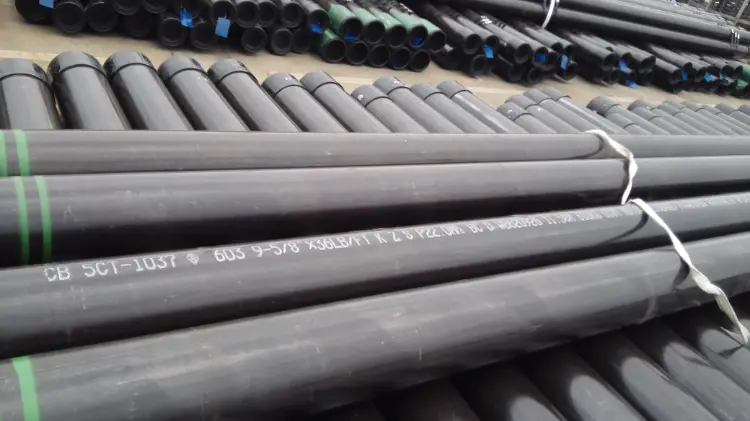
DIN 17400 1.4833 Heat Resistant Stainless Steel Pipe
DIN 17400 1.4833 Heat Resistant Stainless Steel Pipe - X12CrNi25-21 Data Sheet & Properties
Complete material datasheet for DIN 17400 grade 1.4833 (X12CrNi25-21) stainless steel pipe: chemical composition, mechanical properties at room temperature, thermal and electrical physical properties, international equivalents, and application guidelines.
Hot forming, cold forming, machining, welding (using matching or over-alloyed filler), solution annealing followed by rapid cooling
- Phone : +8618037372205
- Email : [email protected]
- WhatsApp: Contact via Whtsapp
- WeChat: +8618037372205
DIN 17400 1.4833 Heat Resistant Stainless Steel Pipe Introduction
1.4833 (X12CrNi25-21) is an austenitic, heat-resistant stainless steel originally covered by the historical German standard DIN 17400 and now fully incorporated into DIN EN 10095. It offers excellent oxidation resistance up to approximately 1050°C (1920°F) in continuous service and up to 1100°C for intermittent exposure, thanks to its high chromium (24–26%) and nickel (19–22%) content. The increased carbon level (max. 0.15%) improves creep strength compared to low-carbon variants, making it suitable for load-bearing components at elevated temperatures. Typical delivery condition is solution annealed and quenched.
- Good strength at high temperatures
- Excellent resistance to scaling and oxidation
- Commonly supplied as seamless or welded pipes, tubes, sheets/plates, bars
DIN 17400 1.4833 Heat Resistant Stainless Steel Pipe Chemical Composition according to EN 10095
The following table lists the chemical requirements for grade 1.4833 (X12CrNi25-21). The values are in weight percent and comply with DIN EN 10095, which has replaced the former DIN 17400. Nitrogen is intentionally controlled to ensure austenitic structure.
| Element | Normative Value (wt.%) | Remarks |
|---|---|---|
| Carbon (C) | ≤ 0.15 | Max |
| Silicon (Si) | ≤ 2.00 | Max; higher Si improves scaling resistance |
| Manganese (Mn) | ≤ 2.00 | Max |
| Phosphorus (P) | ≤ 0.045 | Max |
| Sulfur (S) | ≤ 0.015 | Max |
| Chromium (Cr) | 24.00 – 26.00 | Range |
| Nickel (Ni) | 19.00 – 22.00 | Range |
| Nitrogen (N) | ≤ 0.11 | Max |
DIN 17400 1.4833 Heat Resistant Stainless Steel Pipe Thermal and Electrical Physical Properties
Typical physical property data for grade 1.4833 (X12CrNi25-21) in the solution-annealed condition. These values are indicative and may vary depending on exact composition and processing history. Thermal conductivity and expansion are critical for high-temperature design.
| Property | Typical Value | Unit | Test Condition / Temperature Range |
|---|---|---|---|
| Density (ρ) | 7.9 | g/cm³ | 20°C |
| Modulus of elasticity (E) | 200 | GPa | 20°C |
| Shear modulus (G) | 77 | GPa | 20°C (calculated) |
| Poisson's ratio (ν) | 0.30 | - | 20°C |
| Mean thermal expansion coefficient (α) | 16.0 | 10⁻⁶/K | 20 – 200°C |
| Mean thermal expansion coefficient (α) | 17.5 | 10⁻⁶/K | 20 – 400°C |
| Mean thermal expansion coefficient (α) | 18.0 | 10⁻⁶/K | 20 – 600°C |
| Mean thermal expansion coefficient (α) | 18.5 | 10⁻⁶/K | 20 – 800°C |
| Mean thermal expansion coefficient (α) | 19.0 | 10⁻⁶/K | 20 – 1000°C |
| Thermal conductivity (λ) | 15 | W/(m·K) | 20°C |
| Thermal conductivity (λ) | 19 | W/(m·K) | 500°C |
| Thermal conductivity (λ) | 21 | W/(m·K) | 600°C |
| Thermal conductivity (λ) | 24 | W/(m·K) | 800°C |
| Specific heat capacity (cₚ) | 500 | J/(kg·K) | 20°C |
| Electrical resistivity (ρₑ) | 0.85 | Ω·mm²/m | 20°C |
DIN 17400 1.4833 Heat Resistant Stainless Steel Pipe Mechanical Properties at Room Temperature
The mechanical properties listed below apply to solution-annealed products with a thickness up to 75 mm, according to DIN EN 10095. For pipes, slightly lower guaranteed values may apply depending on the specific pipe standard (e.g., EN 10216-5); consult the testing certificate for actual results.
Typical hardness: approx. 180 HBW / 200 HV.
| Property | Normative Requirement (min. or range) | Unit | Test Condition |
|---|---|---|---|
| 0.2% proof strength (Rp0.2) | ≥ 210 | MPa | Room temperature, longitudinal |
| Tensile strength (Rm) | 500 – 750 | MPa | Room temperature, longitudinal |
| Elongation after fracture (A) | ≥ 35 | % | Original gauge length L0 = 5.65√S0, transverse |
DIN 17400 1.4833 Heat Resistant Stainless Steel Pipe Fully Equivalent International Standards and Replaceable Grades
| Country/Region | Standard | Designation / Grade | Remarks |
|---|---|---|---|
| Germany (superseded) | DIN 17400 | 1.4833 | Original designation, replaced by EN 10095 |
| Europe (current) | EN 10095 | X12CrNi25-21 (1.4833) | Fully equivalent heat-resistant steel |
| International (ISO) | ISO 4955 | X12CrNi25-21 | Identical composition, same application |
| France (NF) | NF A35-572/578 | Z 15 CNS 25.21 | Old French equivalent |
| UK (BS) | BS 1449 Pt.2 | 310S24 | Approximate, close match |
| Italy (UNI) | UNI 6900 | X12CrNi25-21 | Direct EN adoption |
| China (GB) | GB/T 1221 | 2Cr25Ni21 | Compositionally similar (C 0.15-0.25%) |
DIN 17400 1.4833 Heat Resistant Stainless Steel Pipe Application Introduction
1.4833 (X12CrNi25-21) is selected where high-temperature oxidation resistance and moderate strength are required. Its higher carbon content provides better creep resistance than low-carbon grades like 1.4845 or 310S, making it preferred for stressed components operating between 600°C and 900°C.Typical end uses:
Product Applications: Seamless and welded stainless steel pipes/tubes for high-temperature process fluids, Hot-rolled and cold-rolled plates/sheets for fabricated furnace liners, Round bars and forgings for machined high-temperature fasteners and shafts, Wire for springs and wire mesh belts used in high-temperature conveyors
Processed into products: Radiant tubes and U-bends for indirect gas-fired furnaces, Furnace retort vessels and lids, Pyrolysis tubes for ethylene cracking furnaces, Support beams and structural parts inside heat treatment ovens, Heat exchanger tubes in flue gas environments, Corrugated expansion bellows in exhaust systems, Welded fabrication parts such as burner cups and flame holders
Application industries: Industrial furnaces (furnace rolls, radiant tubes, burner nozzles, retorts), Petrochemical and refining (furnace tubes, pigtails, header boxes), Power generation (superheater and reheater tubes in boilers, heat recovery steam generators), Heat treatment equipment (baskets, grids, muffles, conveyor belts), Cement and incineration plants (thermocouple protection tubes, burner components)
DIN 17400 1.4833 Heat Resistant Stainless Steel Pipe Similar / Closely Related Alternate Materials
| Country/Region | Standard | Designation / Grade | Remarks |
|---|---|---|---|
| Europe | EN 10095 | X8CrNi25-21 (1.4845) | Lower carbon (≤0.08); slightly lower strength but similar scaling resistance. Often used for similar furnace parts where lower creep strength is acceptable. |
| USA | ASTM A240/A312 | 310S (UNS S31008) | Classic 25Cr-20Ni grade with ≤0.08% C. Wider availability, can replace 1.4833 in many oxidation-resistant applications but has lower carbon-related creep strength. |
| USA | ASTM A240/A312 | 310 (UNS S31000) | Carbon ≤0.25% gives higher hot strength; can be a substitute for high-load applications at temperature. |
| Japan | JIS G4304/4305/3459 | SUS 310S | Equivalent to 310S, readily available in pipe form. |
| China | GB/T 1221 | 0Cr25Ni20 (06Cr25Ni20) | Ultra-low carbon variant; suitable for corrosive high-temp environments but lower strength. |
Notes:
Welding: 1.4833 has good weldability by common methods (GTAW, GMAW, SMAW). Preheating is generally not required; post-weld heat treatment is usually solution annealing (1050–1150°C) to restore corrosion resistance. Filler metals with matching or slightly over-alloyed composition (e.g., ER 310 or 25 20 type) are recommended.
Scaling temperature: Service life strongly depends on atmosphere. In dry air, scaling resistance extends to about 1050°C. In carburizing or sulfidizing environments, maximum temperature is significantly reduced.
- Share



