
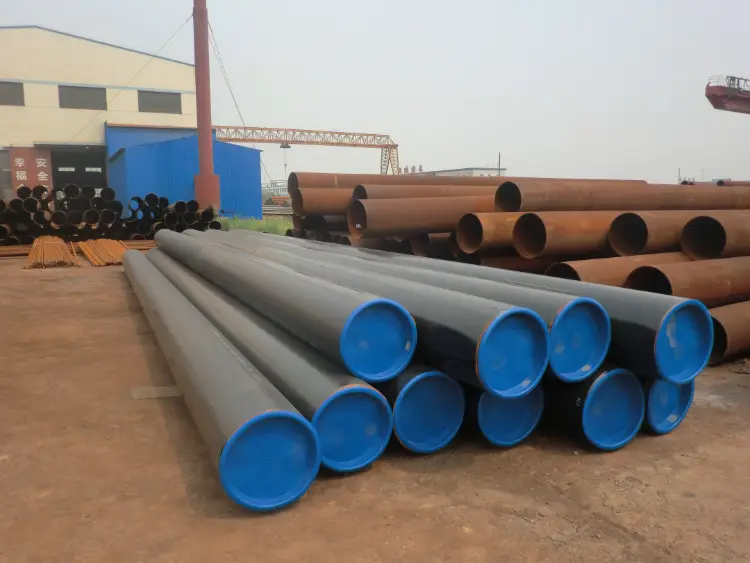
DIN 17400 1.4306 Stainless Steel Pipe
DIN 17400 1.4306 Stainless Steel Pipe: Chemical, Mechanical & Physical Properties & Equivalent Grades
Complete material data for DIN 17400 1.4306 stainless steel pipe, including chemical composition, mechanical properties, physical properties, international equivalents, and application guidelines.
Hot forming, cold forming, machining, welding, solution annealing
- Phone : +8618037372205
- Email : [email protected]
- WhatsApp: Contact via Whtsapp
- WeChat: +8618037372205
DIN 17400 1.4306 Stainless Steel Pipe Introduction
1.4306 is an austenitic low‑carbon stainless steel grade defined in DIN 17400, designated X2CrNi19-11 under EN 10088. It is the low‑carbon variant of 1.4301 (304), providing enhanced resistance to intergranular corrosion after welding or slow cooling, without the need for post‑weld heat treatment.
- Excellent corrosion resistance in a wide range of atmospheric, chemical, food and textile environments.
- Good formability and weldability.
- Non‑magnetic in the solution‑annealed condition.
- Used extensively for pipes, tubes and pressure components.
DIN 17400 1.4306 Stainless Steel Pipe Chemical Composition
Chemical composition according to DIN 17400 and aligned with EN 10088-1. The low carbon content ensures insensitivity to intergranular corrosion. Nitrogen may be present as a residual or alloying element controlled to maintain strength and corrosion balance.
| Element | Standard Value (wt.%) | Remarks |
|---|---|---|
| Carbon (C) | ≤0.030 | Low carbon for improved intergranular corrosion resistance |
| Silicon (Si) | ≤1.00 | Deoxidizer, contributes to scaling resistance |
| Manganese (Mn) | ≤2.00 | Austenite stabilizer, aids hot workability |
| Phosphorus (P) | ≤0.045 | Residual element |
| Sulfur (S) | ≤0.030 | Residual element; lower value for better formability |
| Chromium (Cr) | 18.0 – 20.0 | Primary element for corrosion resistance |
| Nickel (Ni) | 10.0 – 12.0 | Austenite former, improves ductility and toughness |
| Nitrogen (N) | ≤0.11 | Strengthener; typically residual |
DIN 17400 1.4306 Stainless Steel Pipe Typical Thermal & Electrical Physical Properties
Physical properties at room temperature unless otherwise stated. Data are typical for austenitic grade 1.4306 in the solution‑annealed condition, sourced from EN 10088-1 and standard references. Thermal conductivity increases with temperature, while electrical resistivity is nearly constant over the service range.
| Property | Typical Value | Unit | Test Condition |
|---|---|---|---|
| Density (ρ) | 7.9 | g/cm³ | 20 °C |
| Modulus of Elasticity (E) | 200 | GPa | 20 °C |
| Shear Modulus (G) | 77 | GPa | 20 °C |
| Poisson's Ratio (ν) | 0.30 | – | 20 °C |
| Thermal Expansion Coefficient (α) | 16.0 | 10⁻⁶/K | 20–100 °C |
| Thermal Expansion Coefficient (α) | 16.5 | 10⁻⁶/K | 20–200 °C |
| Thermal Expansion Coefficient (α) | 17.0 | 10⁻⁶/K | 20–300 °C |
| Thermal Conductivity (λ) | 15.0 | W/(m·K) | 20 °C |
| Thermal Conductivity (λ) | 15.5 | W/(m·K) | 100 °C |
| Specific Heat Capacity (cₚ) | 500 | J/(kg·K) | 20 °C |
| Electrical Resistivity (ρₑ) | 0.73 | Ω·mm²/m | 20 °C |
DIN 17400 1.4306 Stainless Steel Pipe Typical Mechanical Properties
Mechanical properties at room temperature for solution‑annealed pipe according to DIN 17400 / EN 10088-3. Values apply to wall thickness ≤75 mm. For thicker sections, minor adjustments may apply per standard. Elongation is determined on a gauge length A5.
- Minimum yield strength 200 MPa.
- Tensile strength range 500–700 MPa.
- High elongation ensures excellent formability.
| Property | Typical Value | Unit | Test Condition |
|---|---|---|---|
| Yield Strength (Rp0.2) | ≥200 | MPa | Room temperature, transverse or longitudinal direction |
| Tensile Strength (Rm) | 500 – 700 | MPa | Room temperature |
| Elongation after fracture (A5) | ≥45 | % | Gauge length 5.65√S₀ |
| Bend Test (mandrel diameter) | No crack | – | Bend angle 180°, mandrel diameter = 2t (t = wall thickness) for thickness ≤10 mm |
| Impact Energy (KV₂) | Not specified | J | Charpy V‑notch; typical values ≥100 J at 20°C for reference only |
DIN 17400 1.4306 Stainless Steel Pipe Completely Equivalent Material Standards & Replaceable Grades
| Country/Region | Standard | Grade | Remarks |
|---|---|---|---|
| Europe | EN 10088-1/2/3 | X2CrNi19-11 (1.4306) | Direct equivalent; identical composition and properties |
| USA | ASTM A312 / A312M | TP304L | UNS S30403; widely accepted as equivalent for pipe |
| Japan | JIS G3459 / G4304 | SUS304L | Equivalent in composition and mechanical properties |
| China | GB/T 12771 / GB/T 4237 | 022Cr19Ni10 | Identical to 1.4306; used for welded pipe |
| International | ISO 15510 | X2CrNi19-11 | Grade code 4306-304-11-I; technically identical |
DIN 17400 1.4306 Stainless Steel Pipe Application Introduction
1.4306 (X2CrNi19-11) is the material of choice when excellent weldability and resistance to intergranular corrosion are required. Its low carbon content eliminates the risk of chromium carbide precipitation during welding or thermal cycling, making it ideal for heavy‑section welded components.
- Prefabricated pipe spools for on‑site welding.
- Components exposed to mildly acidic environments.
- Piping systems in nuclear and conventional power plants.
- Sanitary and pharmaceutical processing where crevice‑free surfaces are critical.
Product Applications: Seamless and welded pipes for fluid transport, Heat exchanger tubes, Boiler and superheater tubes, Sanitary tubes for food and dairy, Structural hollow sections, Instrumentation tubing, Industrial pipe fittings (elbows, tees, reducers), Flanges and gaskets
Processed into products: Pipe spools and prefabricated piping assemblies, Heat exchanger tube bundles, Cryogenic vessels and internal piping, Pressure vessel shells and internals, Pharmaceutical mixers and reactors, Architectural handrails and balustrades, Kitchen equipment and sinks, Automotive exhaust flexible connectors
Application industries: Chemical and Petrochemical Processing, Food and Beverage Industry, Pharmaceutical and Biotechnology, Architectural and Construction (facades, balustrades, handrails), Water Treatment and Desalination, Power Generation (including nuclear), Cryogenics (liquefied gas storage and transport), Automotive Exhaust Systems (after‑treatment components), Marine and Coastal Engineering (non‑direct sea water exposure)
DIN 17400 1.4306 Stainless Steel Pipe Similar / Alternative Material Recommendations
| Country/Region | Standard | Grade | Remarks |
|---|---|---|---|
| Europe | EN 10088-2 | X2CrNi18-9 (1.4307) | Similar low‑carbon 304L grade; slightly lower Ni (9.0–10.0 %) may reduce corrosion resistance in some media; interchangeable in many applications |
| Europe | EN 10088-2 | X5CrNi18-10 (1.4301) | Higher carbon (≤0.07 %); more prone to sensitisation; not recommended for welded structures without post‑weld heat treatment |
| USA | ASTM A312 | TP304 | UNS S30400; higher carbon, less suitable for welding in corrosive environments |
| Japan | JIS G3459 | SUS304 | Equivalent to 1.4301; consider 304L where intergranular corrosion is a concern |
| Europe | EN 10088-2 | X2CrNiMo17-12-2 (1.4404) | 316L; molybdenum addition improves pitting and crevice corrosion resistance; suitable for more aggressive media |
Notes:
- For thicknesses above 75 mm, a slight reduction in minimum yield strength to 175 MPa may apply according to EN 10088‑3; confirm with specification.
- Post‑weld cleaning (pickling/passivation) is strongly recommended to restore full corrosion resistance.
- In service temperatures above 60°C, chloride‑induced stress corrosion cracking may occur; consider grade 1.4404 if chlorides are present.
- Material can be certified to 3.1 or 3.2 per EN 10204, with inspection certificates including chemical analysis and mechanical test results.
- European PED (2014/68/EU) approval is available for this grade.
- Share



