
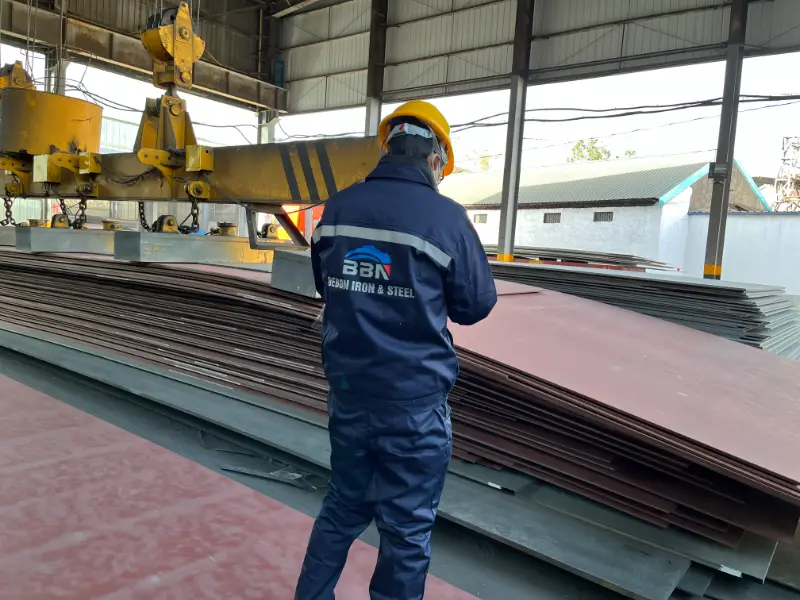
DIN 17155 15Mo3 Pressure Vessel Steel Plate
DIN 17155 15Mo3 Pressure Vessel Steel Plate - Properties, Composition and Equivalents
Comprehensive technical datasheet for 15Mo3 steel under DIN 17155: chemical composition, mechanical and thermal properties, international equivalents, and application guidance for pressure vessels and boilers.
Welding, bending, cutting, machining, forming, normalizing, stress relieving
- Phone : +8618037372205
- Email : [email protected]
- WhatsApp: Contact via Whtsapp
- WeChat: +8618037372205
DIN 17155 15Mo3 Pressure Vessel Steel Plate Introduction
DIN 17155 15Mo3 is a carbon-manganese-molybdenum steel plate designed for elevated temperature service in pressure vessels, boilers, and heat exchangers. Key features:
- Molybdenum addition (0.25–0.35%) improves creep resistance and high-temperature strength.
- Good weldability when proper procedures are followed.
- Supplied in normalized condition (normalized rolling or normalizing heat treatment) to ensure fine grain structure and consistent mechanical properties.
- Tensile strength range of 440–590 MPa and minimum yield strength of 230–275 MPa depending on thickness.
- The grade is now superseded by EN 10028-2 grade 16Mo3 (1.5415) with identical chemical composition.
15Mo3 has been widely used in European pressure vessel construction meeting requirements of AD2000 and other design codes. It offers a good balance of strength, ductility, and resistance to graphitization at temperatures up to 500°C.
DIN 17155 15Mo3 Pressure Vessel Steel Plate Chemical Composition Table
The chemical composition conforms to DIN 17155. Molybdenum increases creep strength and graphitization resistance. Fine grain practice is mandatory; aluminium (≥0.020%) is added as a grain refiner. Residual elements are limited to maintain weldability and mechanical properties.
| Chemical Element | Standard Value (wt.%) | Remarks |
|---|---|---|
| C | 0.12–0.20 | |
| Si | 0.10–0.35 | |
| Mn | 0.40–0.90 | |
| P | ≤0.035 | max |
| S | ≤0.030 | max |
| Mo | 0.25–0.35 | Key alloying element |
| Cr | ≤0.30 | Residual |
| Cu | ≤0.30 | Residual |
| Ni | ≤0.30 | Residual |
| Al (total) | ≥0.020 | For fine grain melting; may be substituted by other grain refiners |
DIN 17155 15Mo3 Pressure Vessel Steel Plate Thermal and Electrical Physical Properties
Physical properties of 15Mo3 / 16Mo3 steel. Thermal expansion, conductivity, and specific heat values are given for representative temperatures. These reference data assist in design and thermal analysis.
| Property | Typical Value | Unit | Test Condition / Temperature |
|---|---|---|---|
| Density | 7.85 | g/cm³ | Room temperature |
| Elastic modulus (E) | 210 | GPa | 20°C |
| Elastic modulus (E) | 200 | GPa | 200°C |
| Elastic modulus (E) | 190 | GPa | 300°C |
| Elastic modulus (E) | 180 | GPa | 400°C |
| Shear modulus (G) | ≈81 | GPa | 20°C |
| Poisson's ratio (ν) | 0.3 | — | 20°C |
| Thermal expansion coefficient (α) | 11.5 ×10⁻⁶ | K⁻¹ | 20–100°C |
| Thermal expansion coefficient (α) | 12.5 ×10⁻⁶ | K⁻¹ | 20–200°C |
| Thermal expansion coefficient (α) | 13.0 ×10⁻⁶ | K⁻¹ | 20–300°C |
| Thermal expansion coefficient (α) | 13.5 ×10⁻⁶ | K⁻¹ | 20–400°C |
| Thermal conductivity (λ) | 42 | W/(m·K) | 20°C |
| Thermal conductivity (λ) | 40 | W/(m·K) | 200°C |
| Thermal conductivity (λ) | 38 | W/(m·K) | 300°C |
| Thermal conductivity (λ) | 36 | W/(m·K) | 400°C |
| Specific heat capacity (c) | 460 | J/(kg·K) | 20°C |
| Specific heat capacity (c) | 500 | J/(kg·K) | 200°C |
| Specific heat capacity (c) | 520 | J/(kg·K) | 300°C |
| Specific heat capacity (c) | 540 | J/(kg·K) | 400°C |
| Electrical resistivity (ρ_e) | 0.23 ×10⁻⁶ | Ω·m | 20°C |
DIN 17155 15Mo3 Pressure Vessel Steel Plate Mechanical Properties
Room temperature tensile and impact properties for normalized 15Mo3 steel plates. Values depend on plate thickness (t). The impact energy is determined on transverse Charpy-V specimens at +20°C. The bend test ensures formability without cracking.
| Property | Standard Requirement | Unit | Test Condition / Remarks |
|---|---|---|---|
| Yield strength (ReH) | ≥275 | MPa | t ≤16 mm |
| Yield strength (ReH) | ≥270 | MPa | 16 mm < t ≤40 mm |
| Yield strength (ReH) | ≥260 | MPa | 40 mm < t ≤60 mm |
| Yield strength (ReH) | ≥230 | MPa | 60 mm < t ≤100 mm |
| Tensile strength (Rm) | 440–590 | MPa | t ≤60 mm |
| Tensile strength (Rm) | 430–580 | MPa | 60 mm < t ≤100 mm |
| Elongation after fracture (A5) | ≥22 | % | t ≤16 mm, L0=5.65√S0 |
| Elongation after fracture (A5) | ≥21 | % | 16 mm < t ≤40 mm |
| Elongation after fracture (A5) | ≥20 | % | 40 mm < t ≤60 mm |
| Elongation after fracture (A5) | ≥19 | % | 60 mm < t ≤100 mm |
| Impact energy (KV2) | ≥27 (min. 19 indiv.) | J | Transverse, +20°C |
| Bend test (180°) | No cracks | — | Mandrel diameter: 3a for t≤30 mm; 4a for 30< t≤100 mm |
DIN 17155 15Mo3 Pressure Vessel Steel Plate Direct Equivalent Material Standards
| Country/Region | Standard | Grade | Remarks |
|---|---|---|---|
| European Union | EN 10028-2 | 16Mo3 (1.5415) | Identical chemical composition and properties; current active standard replacing DIN 17155. |
DIN 17155 15Mo3 Pressure Vessel Steel Plate Application Introduction
15Mo3 steel is widely used in pressure vessels and boilers operating up to 450–500°C. The molybdenum addition provides creep resistance and helps prevent graphitization during long-term high-temperature exposure. Welding requires preheat (150–200°C) and post-weld heat treatment (PWHT at 580–620°C) for thick sections. It is a key material in the petrochemical and power generation sectors.
Product Applications: Steam boilers, Pressure vessels, Heat exchangers, Steam drums, Economizers, Superheaters, Piping and headers, Reactors
Processed into products: Vessel shells and heads, Tube sheets for heat exchangers, Nozzles and flanges, Baffle plates, Support structures for elevated temperature service, Welded components in boiler construction
Application industries: Petrochemical and chemical processing, Power generation (conventional and nuclear), Oil and gas (refineries, LNG plants), Boiler and pressure vessel manufacturing, Heat exchanger production
DIN 17155 15Mo3 Pressure Vessel Steel Plate Similar/Alternative Material Grades
| Country/Region | Standard | Grade | Remarks |
|---|---|---|---|
| USA | ASTM A204/A204M | Grade A, B, C | Mo-alloyed pressure vessel steel with higher Mo content (0.44–0.65%). Higher strength levels; may require design adjustments. |
| Japan | JIS G3103 | SB46M | Killed steel with Mn 0.80–1.20%, Mo 0.40–0.65%. Higher Mn and Mo; properties differ. |
| United Kingdom (obsolete) | BS 1501-161 | Grade 26B | Legacy C‑Mo steel, superseded by EN 16Mo3. |
Notes:
DIN 17155 has been withdrawn and replaced by EN 10028‑2. When ordering today, specify EN 10028‑2 16Mo3 (1.5415). The material is supplied in normalized condition. For hot-forming operations, the normalizing heat treatment should be performed after forming. Cold bending and flanging are possible; suitable preheating and stress relieving reduce the risk of cracking. The steel has good weldability with low-hydrogen electrodes; preheating (150–200°C) and interpass temperature control are recommended. After welding, a full stress relief at 580–620°C followed by slow cooling is typical to restore ductility and reduce residual stresses.
- Share



