
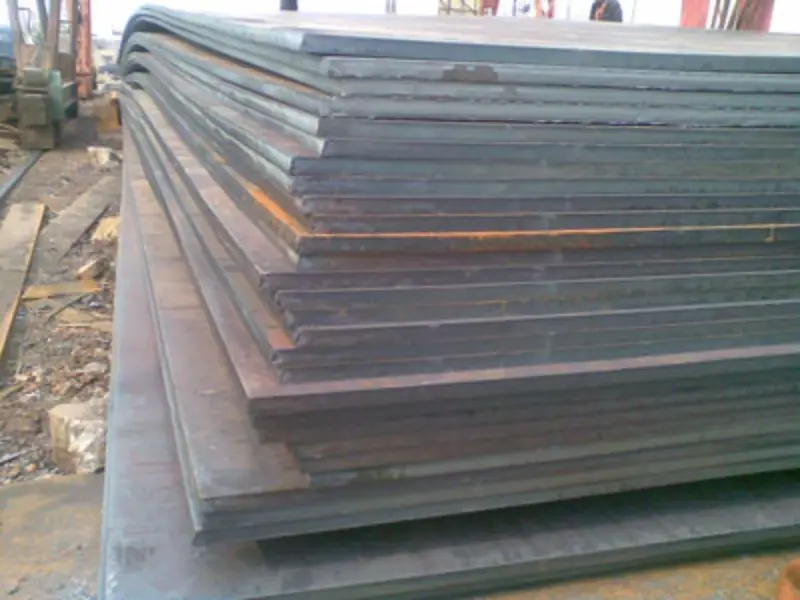
DIN 17102 WStE500 High-Strength Automobile Structural Steel Plate
DIN 17102 WStE500 High-Strength Automobile Structural Steel Plate
Comprehensive property data for DIN 17102 WStE500 steel plate, including chemical composition, mechanical and thermal properties, equivalent grades, and application guidance for automotive structural components.
Hot rolling, thermomechanical rolling, cold forming, bending, welding, flame cutting, plasma cutting, laser cutting
- Phone : +8618037372205
- Email : [email protected]
- WhatsApp: Contact via Whtsapp
- WeChat: +8618037372205
DIN 17102 WStE500 High-Strength Automobile Structural Steel Plate Introduction
DIN 17102 WStE500 is a thermomechanically rolled, weldable fine grain structural steel specifically designed for the automobile industry. It offers a minimum yield strength of 500 MPa in thicknesses up to 16 mm, combined with good formability and excellent weldability.
- Microalloyed with niobium, vanadium, and titanium to achieve fine grain structure and high strength without compromising toughness.
- Ideal for dynamic-loaded chassis and frame components where weight reduction and fatigue resistance are critical.
- Supplied in the thermomechanically rolled (TM) condition, allowing direct use for cold forming and welding without additional heat treatment.
DIN 17102 WStE500 High-Strength Automobile Structural Steel Plate Chemical Composition
The chemical composition is designed to achieve high strength through grain refinement and precipitation hardening while maintaining good weldability. The carbon equivalent (CEV) is typically ≤0.45% to ensure cold cracking resistance. Microalloying elements Nb, V, Ti are essential for fine grain size and strength, and total aluminum is specified for deoxidation.
| Element | Standard Value (max, unless range) | Remarks |
|---|---|---|
| C | 0.12 | For weldability and formability |
| Si | 0.50 | Deoxidation; higher may affect coating |
| Mn | 1.70 | Strength and hardenability control |
| P | 0.025 | Phosphorus content controlled for toughness |
| S | 0.015 | Sulfur controlled for ductility and welding |
| Al (total) | ≥0.015 | Mandatory for fine grain practice |
| Nb | 0.09 | Grain refinement and precipitation strengthening |
| V | 0.20 | Optional microalloying element |
| Ti | 0.15 | Grain refinement and nitrogen fixation |
| N | 0.015 | Max limit to avoid aging effects |
| Mo | 0.20 (residual) | Not intentionally added |
| Cu | 0.30 (residual) | Residual maximum |
| Cr + Ni + Mo | 0.60 (residual sum) | Max combined content |
DIN 17102 WStE500 High-Strength Automobile Structural Steel Plate Thermal and Electrical Physical Properties
The following physical properties are typical for microalloyed structural steels and are provided for design calculations. They are not mandatory requirements of the delivery standard but are representative for WStE500 type material. Density, elastic modulus, and thermal conductivity are key inputs for weight optimization and thermal simulations.
| Property | Typical Value | Unit | Test Condition / Reference |
|---|---|---|---|
| Density (ρ) | 7850 | kg/m³ | Ambient temperature |
| Elastic modulus (E) | 210 | GPa | Room temperature |
| Shear modulus (G) | 80 | GPa | Calculated from E and ν |
| Poisson's ratio (ν) | 0.3 | – | Elastic range |
| Thermal expansion coefficient (α) | 12.0 | 10⁻⁶/K | 20–100 °C |
| Thermal conductivity (λ) | 50 | W/(m·K) | At 20 °C |
| Specific heat capacity (cₚ) | 460 | J/(kg·K) | At 20 °C |
| Electrical resistivity (ρₑ) | 0.23 | 10⁻⁶ Ω·m | At 20 °C |
DIN 17102 WStE500 High-Strength Automobile Structural Steel Plate Mechanical Properties
Mechanical properties depend on the nominal thickness t (mm). Values apply to thermomechanically rolled condition. Yield strength ReH, tensile strength Rm, and elongation A are determined on proportional flat test pieces (L₀ = 5.65√S₀). Impact energy is tested on Charpy-V specimens at -20°C. Bend test uses a mandrel diameter relative to plate thickness.
| Property | Standard Requirement | Unit | Test Condition / Thickness Range |
|---|---|---|---|
| Yield strength (ReH) | ≥500 | MPa | t ≤ 16 mm |
| Yield strength (ReH) | ≥470 | MPa | 16 mm < t ≤ 35 mm |
| Yield strength (ReH) | ≥440 | MPa | 35 mm < t ≤ 50 mm |
| Tensile strength (Rm) | 550 – 700 | MPa | t ≤ 16 mm |
| Tensile strength (Rm) | 520 – 670 | MPa | 16 mm < t ≤ 35 mm |
| Tensile strength (Rm) | 490 – 640 | MPa | 35 mm < t ≤ 50 mm |
| Elongation after fracture (A) | ≥12 | % | t ≤ 16 mm (L₀ = 5.65√S₀) |
| Elongation after fracture (A) | ≥12 | % | 16 mm < t ≤ 35 mm |
| Elongation after fracture (A) | ≥13 | % | 35 mm < t ≤ 50 mm |
| Bend test (180°) | Mandrel diameter = 1 × t | – | t ≤ 16 mm (no cracks) |
| Bend test (180°) | Mandrel diameter = 2 × t | – | 16 mm < t ≤ 35 mm |
| Bend test (180°) | Mandrel diameter = 3 × t | – | 35 mm < t ≤ 50 mm |
| Impact energy (KV₂) | ≥27 | J | -20 °C, longitudinal, t ≤ 50 mm |
DIN 17102 WStE500 High-Strength Automobile Structural Steel Plate Completely Equivalent Material Standards and Substitutable Grades
| Country/Region | Standard | Grade | Remarks |
|---|---|---|---|
| Germany | DIN 17102 | WStE500 | Original specification; delivered in TM condition |
| European Union | EN 10149-2 | S500MC | Thermomechanically rolled; identical technical intent |
| China | Q/BQB 310 | QStE500TM | Baosteel standard, equivalent to WStE500 |
| International (ISO) | ISO 6930-2 | FeE500 | High yield strength structural steels (TM) |
DIN 17102 WStE500 High-Strength Automobile Structural Steel Plate Application Introduction
DIN 17102 WStE500 is engineered for dynamically loaded structural parts in automotive and commercial vehicle construction. Its high yield strength enables thinner, lighter designs without sacrificing fatigue life. The steel is readily cold-formed, bent, and welded using standard procedures, making it a cost-effective choice for mass production.
Product Applications: Truck chassis longitudinal beams, Cross members and subframe assemblies, Suspension control arms and spring brackets, Safety cage and roll-over protection structures (ROPS), Bumper reinforcement beams, Bogie frames for railway carriages
Processed into products: Laser-cut and plasma-cut blanks for welding, Cold-bent profiles (C, U, L shapes), Stamped and deep-drawn structural brackets, Welded box sections and fabricated nodes, Drilled and bolted end connections
Application industries: Automotive (passenger cars, trucks, buses), Commercial vehicle manufacturing, Trailer and semi-trailer construction, Construction machinery and earthmoving equipment, Railway vehicle components
DIN 17102 WStE500 High-Strength Automobile Structural Steel Plate Similar / Alternative Materials with Comparable Performance
| Country/Region | Standard | Grade | Remarks |
|---|---|---|---|
| European Union | EN 10149-2 | S550MC | Next higher strength grade (min ReH 550 MPa) with similar formability and weldability; may require slightly higher forming forces. |
| China | Q/BQB 310 | QStE550TM | Higher strength version of QStE500TM; suitable for weight reduction when higher strength is acceptable. |
| European Union | EN 10149-2 | S460MC | Lower strength grade (min ReH 460 MPa); offers better formability but increased thickness for same load. |
| Japan | JIS G 3113 | SAPH 440 | Automobile structural hot-rolled steel with lower strength; not a direct replacement but used in similar applications where strength requirements are lower. |
Notes:
Welding procedures should follow recommendations for microalloyed fine grain steels, e.g., EN 1011-2. Preheating is normally not required for thicknesses below 30 mm when using low-hydrogen processes. The material can be hot-dip galvanized without significant reduction in mechanical properties. For improved service life under corrosion exposure, specify coated or primed delivery condition. This data is based on DIN 17102 and typical reference values; for certified material, request 3.1 inspection certificate per EN 10204.
- Share



