
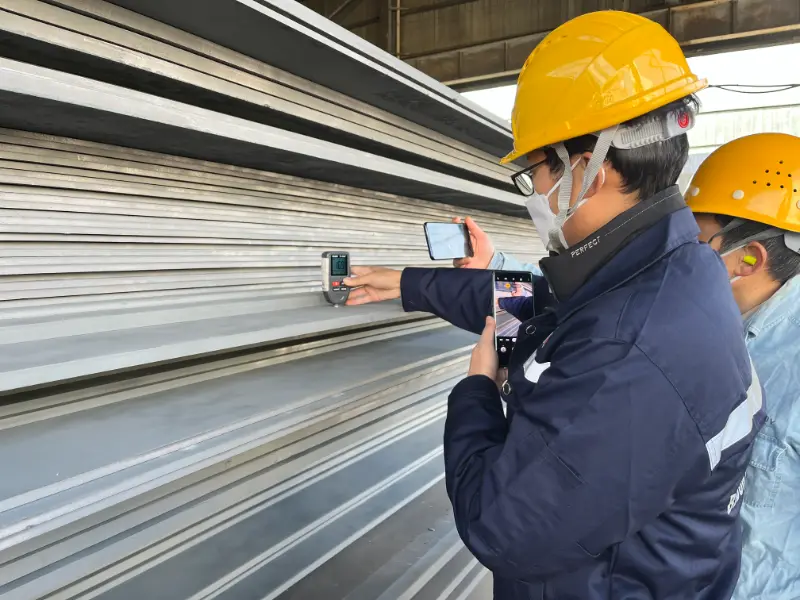
DIN 17102 WStE380
DIN 17102 WStE380: Weather-Resistant Structural Steel for Welded Heavy-Duty Applications
Comprehensive technical analysis of DIN 17102 WStE380, a fine-grain weather-resistant structural steel with minimum yield strength of 380 MPa, suitable for welded structures exposed to atmospheric corrosion.
Processing methods include welding, bending, shearing, punching, and machining; suitable for hot forming prior to normalizing; normalized delivery condition guarantees uniformity.
- Phone : +8618037372205
- Email : [email protected]
- WhatsApp: Contact via Whtsapp
- WeChat: +8618037372205
DIN 17102 WStE380 Introduction
DIN 17102 WStE380 is a normalized, weldable, fine-grain structural steel with improved atmospheric corrosion resistance, classified as a weather-resistant low-alloy high-strength steel. Designed for long service life in outdoor environments without protective coatings, it forms a stable, dense oxide layer that retards further corrosion. Key features include:
- Minimum yield strength of 380 MPa for thicknesses ≤16 mm, providing robust load-bearing capacity.
- Excellent weldability owing to low carbon equivalent values, facilitating fabrication of complex structures.
- Enhanced notch toughness down to -20°C, ensuring reliable performance in cold climates.
- Chemical composition balanced with copper, chromium and nickel to achieve weathering properties while maintaining formability.
Supplied primarily as hot-rolled coils and cut plates in normalized condition, WStE380 finds extensive use in bridges, railway vehicles, structural frameworks and container construction.
DIN 17102 WStE380 Chemical Composition
The chemical analysis corresponds to ladle analysis according to DIN 17102:1983 for weather-resistant fine-grain steel WStE380. The alloying elements Cu, Cr, and Ni provide enhanced atmospheric corrosion resistance by promoting formation of a protective patina. Fine-grain practice is ensured by aluminum and optional microalloying elements (Nb, V, Ti).
| Chemical Element | Typical Value / Limit | Remarks |
|---|---|---|
| Carbon (C) | ≤ 0.20 | Controls strength and weldability |
| Silicon (Si) | ≤ 0.50 | Deoxidation agent; higher content may affect paint adhesion |
| Manganese (Mn) | 1.00 – 1.60 | Refines grain, improves strength and toughness |
| Phosphorus (P) | ≤ 0.030 | Residual element, kept low for toughness |
| Sulfur (S) | ≤ 0.025 | Residual element, kept low for hot workability |
| Aluminum (Altot.) | ≥ 0.020 | Grain refiner and deoxidizer |
| Nitrogen (N) | ≤ 0.020 | Restricted to avoid strain ageing |
| Copper (Cu) | 0.25 – 0.55 | Essential for weather resistance |
| Chromium (Cr) | 0.30 – 1.25 | Patina former, increases strength |
| Nickel (Ni) | ≤ 0.65 | Improves toughness and corrosion resistance |
| Molybdenum (Mo) | ≤ 0.30 | Optional, increases hardenability and strength |
| Zirconium (Zr) | ≤ 0.15 | Optional grain refinement |
| Niobium (Nb) | ≤ 0.05 | Microalloying for grain refinement |
| Vanadium (V) | ≤ 0.10 | Microalloying for strength |
| Titanium (Ti) | ≤ 0.05 | Optional microalloying |
DIN 17102 WStE380 Thermal and Electrical Physical Properties
The physical properties listed are typical for WStE380 grade steel at room temperature unless otherwise noted. These values are representative of similarly composed structural steels and can be used for design calculations. Actual values may vary slightly depending on exact chemical composition and heat treatment condition.
| Property | Typical Value | Unit | Condition / Temperature |
|---|---|---|---|
| Density (ρ) | 7.85 | kg/dm³ | at 20°C |
| Modulus of Elasticity (E) | 210 | GPa | at 20°C |
| Shear Modulus (G) | 81 | GPa | at 20°C |
| Poisson's Ratio (ν) | 0.30 | – | elastic range, 20°C |
| Thermal Expansion Coefficient (α) | 11.1 | 10⁻⁶/K | 20–100°C |
| Thermal Expansion Coefficient (α) | 12.1 | 10⁻⁶/K | 20–200°C |
| Thermal Expansion Coefficient (α) | 13.0 | 10⁻⁶/K | 20–400°C |
| Thermal Conductivity (λ) | 42 – 53 | W/(m·K) | at 20°C, typical range |
| Specific Heat Capacity | 460 | J/(kg·K) | at 20°C |
| Electrical Resistivity (ρ_e) | 0.13 – 0.20 | µΩ·m | at 20°C |
DIN 17102 WStE380 Mechanical Properties
The mechanical properties are listed for normalized delivery condition (+N) according to DIN 17102:1983, measured on longitudinal test pieces. For plate thicknesses not tabled, the closest lower range applies or as agreed. Minimum Charpy V-notch impact energy (KV) is guaranteed at -20°C for quality level J2 (standard for WStE380).
| Property | Specified Value | Unit | Test Condition / Thickness Range |
|---|---|---|---|
| Yield Strength (ReH) | ≥ 380 | MPa | t ≤ 16 mm |
| Yield Strength (ReH) | ≥ 370 | MPa | 16 mm < t ≤ 40 mm |
| Yield Strength (ReH) | ≥ 360 | MPa | 40 mm < t ≤ 63 mm |
| Yield Strength (ReH) | ≥ 340 | MPa | 63 mm < t ≤ 80 mm |
| Yield Strength (ReH) | ≥ 330 | MPa | 80 mm < t ≤ 100 mm |
| Tensile Strength (Rm) | 500 – 650 | MPa | t ≤ 100 mm |
| Elongation after fracture (A5) | ≥ 22 | % | t ≤ 40 mm, longitudinal |
| Elongation after fracture (A5) | ≥ 22 | % | 40 mm < t ≤ 100 mm, longitudinal |
| Charpy Impact Energy (KV) | ≥ 27 | J | at -20°C, longitudinal, V-notch |
| Bend Test (Mandrel dia.) | 1.6 t | – | 180° bend, t ≤ 16 mm |
| Bend Test (Mandrel dia.) | 2.0 t | – | 180° bend, 16 mm < t ≤ 25 mm |
DIN 17102 WStE380 Completely Equivalent Material Standards and Replaceable Grade Recommendations
| Country/Region | Standard | Grade | Remarks |
|---|---|---|---|
| Germany/Europe | DIN 17102 (historic) | WStE380 | Original specification; obsolete but still encountered |
| Europe | EN 10025-5:2004 | S355J2W+N | Closest current equivalent; yield strength reduced to 355 MPa; same weathering concept and toughness class (-20°C) |
| Europe | EN 10025-5:2004 | S355J0W+N | Alternative with 0°C toughness; use when -20°C not required |
DIN 17102 WStE380 Application Introduction
WStE380 is a specialized weathering steel that develops a tightly adherent oxide layer upon exposure to atmosphere, eliminating the need for painting in many environments. It is suitable for welded, bolted and riveted structures. Typical applications and components include:
Product Applications: Welded I‑beams, box girders, tubular sections, Rolled and bent profiles for bridge decks, Container corrugated walls and frames, Railcar underframes and side panels, Structural tubes for lattice towers
Processed into products: Flanges and webs of welded bridge beams, Stiffeners and gusset plates, Bogie frames and suspension components for railways, Pylon members for cable‑stayed bridges, Architectural exposed columns and trusses, Pressure‑containing vessels in non‑aggressive environments (approval required), Heavy‑duty fasteners and bolted connections
Application industries: Bridge construction (road and railway bridges, pedestrian overpasses), Architecture (facade cladding, exposed structural frameworks, sculptures), Railway engineering (wagons, locomotive bodies, track components), Logistics and transport (shipping containers, truck chassis), Energy and infrastructure (transmission line towers, wind turbine towers, chimneys), Offshore and coastal structures (where corrosion protection is combined with sacrificial thickness allowance)
DIN 17102 WStE380 Near/Similar Alternative Material Recommendations
| Country/Region | Standard | Grade | Remarks |
|---|---|---|---|
| USA | ASTM A588 / A588M | Grade A | Equivalent atmospheric corrosion resistance; yield strength ~345 MPa; composition similar (Cu, Cr, Ni) |
| USA | ASTM A572 / A572M | Grade 50 | High strength (345 MPa) but without dedicated weathering elements; may need coating for corrosion protection |
| Japan | JIS G 3114 | SMA490AW | Weather-resistant steel, minimum yield 365 MPa (≤16 mm); close in strength class |
| China | GB/T 4171 | Q355NH | Atmospheric corrosion resistant steel, yield 355 MPa; often used for similar applications |
| India | IS 11587 | Fe 490 W | Weather resistant structural steel, yield ~360 MPa; alternative for Indian projects |
Notes:
Welding precautions: Use low‑hydrogen electrodes and controlled heat input. Preheat and interpass temperatures depend on thickness, typically 50‑150°C.
Patina stabilization: Uncoated surfaces require wet‑dry cycles to develop a uniform protective layer; initial runoff can be staining. Consider design detailing to avoid water traps.
Thickness limitations: The guaranteed yield strength decreases for thicknesses above 16 mm – refer to the mechanical properties table for design values.
Certification: Material can be supplied with inspection certificates 3.1 or 3.2 per EN 10204 if ordered specifically.
Obsolescence note: DIN 17102 has been formally withdrawn, but WStE380 remains in use for maintenance and replication of legacy structures.
- Share



