
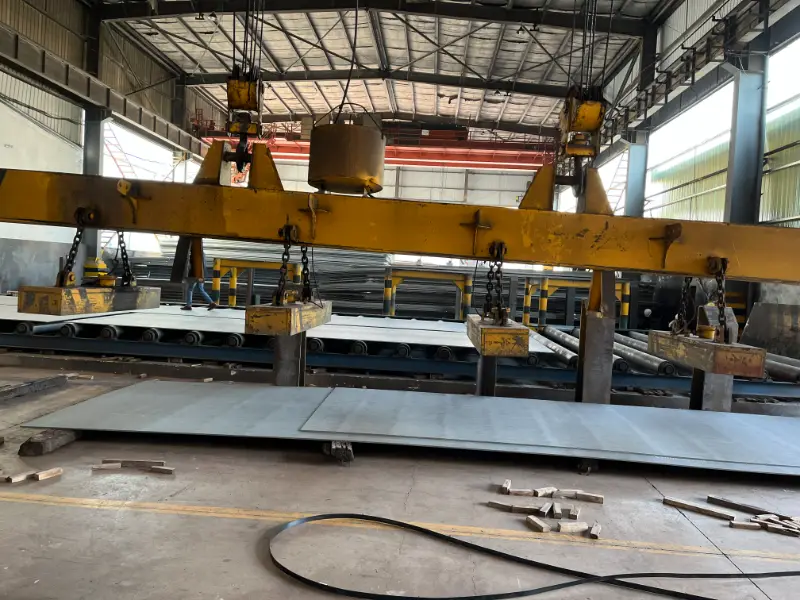
DIN 17102 TStE380 Thermomechanically Rolled Fine Grain Structural Steel
DIN 17102 TStE380 Thermomechanically Rolled Fine Grain Structural Steel
Comprehensive data sheet for TStE380 high-strength low-alloy steel coil including chemistry, mechanical and physical properties, equivalents, and applications.
Cutting (shearing, flame, plasma), bending, drilling, welding (all common arc processes), limited cold forming
- Phone : +8618037372205
- Email : [email protected]
- WhatsApp: Contact via Whtsapp
- WeChat: +8618037372205
DIN 17102 TStE380 Thermomechanically Rolled Fine Grain Structural Steel Introduction
TStE380 is a thermomechanically rolled weldable fine grain structural steel defined by the obsolete German standard DIN 17102. It belongs to the carbon and low-alloy high-strength (HSLA) group and delivers a minimum yield strength of 380 MPa in its thinner gauges. The alloy benefits from microalloying elements (Nb, V, Ti) that provide exceptional grain refinement, leading to a combination of high strength, good toughness at sub-zero temperatures, and excellent weldability. Typical delivery is in the as-rolled condition without subsequent normalizing. This material was widely used in heavy structural engineering, bridge construction, offshore platforms, cranes, and pressure equipment. Although the standard is outdated, TStE380 remains a reference grade and is often replaced in modern projects by grades from the EN 10025‑4 series or equivalent international specifications.
DIN 17102 TStE380 Thermomechanically Rolled Fine Grain Structural Steel Chemical Composition
The chemical composition of TStE380 is designed to ensure fine grain structure and good weldability. Carbon is kept low to avoid hardening in the heat-affected zone, while manganese provides solid solution strengthening. The steel is fully killed and contains aluminium for deoxidation and grain refinement. Microalloying elements such as niobium, vanadium, and titanium may be added singly or in combination to achieve the required strength and toughness.
| Element | Standard Value (wt%) | Remarks |
|---|---|---|
| C | ≤0.16 | Carbon equivalent typically ≤0.45 |
| Si | ≤0.50 | Silicon for deoxidation |
| Mn | 1.00 – 1.70 | Manganese for strength and toughness |
| P | ≤0.030 | Phosphorus limited for toughness |
| S | ≤0.025 | Sulphur controlled for formability |
| N | ≤0.020 | Nitrogen may be bound by microalloying |
| Al (total) | ≥0.020 | Grain refinement; acid soluble Al usually >0.015 |
| Nb | ≤0.05* | Optional grain refiner/carbide former |
| V | ≤0.12* | Optional precipitation strengthener |
| Ti | ≤0.05* | Optional grain refiner/nitride former |
| Cr+Cu+Ni+Mo | ≤0.60 (each ≤0.30) | Residual elements; total not specified but typically low |
DIN 17102 TStE380 Thermomechanically Rolled Fine Grain Structural Steel Thermal and Electrical Physical Properties
The following physical properties are typical for this class of low‑alloy structural steel. They are intended as reference data for design calculations (e.g., thermal expansion, heat transfer, and electrical resistance). Actual values may vary slightly with exact chemical composition and processing history.
| Property | Typical Value | Unit | Test Condition |
|---|---|---|---|
| Density (ρ) | 7.85 | kg/dm³ (g/cm³) | 20°C |
| Modulus of elasticity (E) | 210 | GPa | 20°C |
| Shear modulus (G) | 81 | GPa | 20°C (calculated) |
| Poisson's ratio (ν) | 0.30 | — | 20°C |
| Thermal expansion coefficient (α) | 12.0 × 10⁻⁶ | K⁻¹ | 20 – 100°C |
| Thermal expansion coefficient (α) | 12.5 × 10⁻⁶ | K⁻¹ | 20 – 200°C |
| Thermal conductivity (λ) | 50 | W/(m·K) | 20°C |
| Specific heat capacity (cp) | 460 | J/(kg·K) | 20°C |
| Electrical resistivity (ρe) | 0.25 × 10⁻⁶ | Ω·m | 20°C |
DIN 17102 TStE380 Thermomechanically Rolled Fine Grain Structural Steel Mechanical Properties
Mechanical properties of TStE380 are thickness dependent. The values below represent the minimum requirements specified in DIN 17102 for the thermomechanically rolled condition. Yield and tensile strengths decrease with increasing thickness, while elongation remains high, ensuring good formability. The steel offers reliable low‑temperature toughness; impact energy at -20°C confirms its suitability for structural applications exposed to cold climates.
| Property | Standard Value | Unit | Test Condition |
|---|---|---|---|
| Yield strength (ReH) – min. | 380 | MPa | thickness ≤ 16 mm |
| Yield strength (ReH) – min. | 360 | MPa | 16 < t ≤ 35 mm |
| Yield strength (ReH) – min. | 350 | MPa | 35 < t ≤ 50 mm |
| Yield strength (ReH) – min. | 340 | MPa | 50 < t ≤ 70 mm |
| Yield strength (ReH) – min. | 320 | MPa | 70 < t ≤ 100 mm |
| Tensile strength (Rm) | 500 – 650 | MPa | t ≤ 50 mm |
| Tensile strength (Rm) | 480 – 630 | MPa | 50 < t ≤ 70 mm |
| Tensile strength (Rm) | 470 – 620 | MPa | 70 < t ≤ 100 mm |
| Elongation (A5) – min. | 20 | % | t ≤ 16 mm |
| Elongation (A5) – min. | 19 | % | 16 < t ≤ 35 mm |
| Elongation (A5) – min. | 18 | % | 35 < t ≤ 50 mm |
| Elongation (A5) – min. | 17 | % | 50 < t ≤ 70 mm |
| Elongation (A5) – min. | 16 | % | 70 < t ≤ 100 mm |
| Impact energy (KV) – min. | 27 | J | longitudinal, -20°C, average |
DIN 17102 TStE380 Thermomechanically Rolled Fine Grain Structural Steel Fully Equivalent Material Standards and Replaceable Grades
| Country/Region | Standard | Grade | Remarks |
|---|---|---|---|
| Germany | DIN 17102 | TStE380 | Original designation – obsolete; superseded by EN 10025‑4 |
| USA | ASTM A572 | Grade 55 | Same minimum yield strength (380 MPa); HSLA structural steel; not necessarily fine grain treated |
| China | GB/T 1591 | Q390 (e.g., Q390C, Q390D) | High‑strength low‑alloy structural steel; minimum yield 390 MPa; close match in strength and chemistry |
DIN 17102 TStE380 Thermomechanically Rolled Fine Grain Structural Steel Application Introduction
TStE380 is a versatile structural steel suitable for welded and bolted constructions that require high strength and good ductility. Its fine grain structure and low‑temperature toughness make it an excellent choice for demanding environments. Typical fields of application, products, and components are listed below.
Product Applications: Hot‑rolled steel coils and plates, Cut‑to‑length sheets and blanks, Welded plate girders and box sections, Pressed or rolled profiles (when post‑formed), Slit strip for component manufacture
Processed into products: Bridge main girders, cross beams, and truss members, Offshore platform legs, braces, and decks, Crane booms, jibs, and chassis frames, High‑rise building columns and transfer beams, Heavy‑duty chassis for earthmoving equipment, Penstocks and large‑diameter pressure pipe segments
Application industries: Structural engineering and building construction, Bridge and highway engineering, Heavy machinery and equipment manufacturing, Offshore oil & gas and marine structures, Crane and lifting equipment, Pressure vessel and storage tank fabrication
DIN 17102 TStE380 Thermomechanically Rolled Fine Grain Structural Steel Similar / Near-Equivalent Alternative Materials
| Country/Region | Standard | Grade | Remarks |
|---|---|---|---|
| European Union | EN 10025‑4 | S355M | Thermomechanically rolled fine grain steel; min. yield 355 MPa (slightly lower); often used as replacement |
| European Union | EN 10025‑4 | S420M | Thermomechanically rolled fine grain steel; min. yield 420 MPa (higher strength alternative) |
| International | ISO 4951‑2 | S355M | Same concept as EN 10025‑4 S355M; slightly lower yield strength |
| Japan | JIS G3106 | SM490A (limited similarity) | Welded structural steel; min. yield 325–365 MPa; not a direct match but used in similar applications |
| USA | ASTM A572 | Grade 50 | HSLA structural steel; min. yield 345 MPa; often used but lower strength than TStE380 |
Notes:
TStE380 is an obsolete grade from DIN 17102. Modern projects typically adopt equivalent steels from the current EN 10025‑4 or equivalent national standards. When substituting, ensure that the alternative grade meets required yield strength, toughness class (e.g., impact energy at -20°C), and delivery condition (thermomechanically rolled). Welding should follow established procedures for HSLA steels; preheat and interpass temperatures must be controlled to avoid cold cracking. The steel is not intended for prolonged use at elevated temperatures above 300°C as strength may degrade. Consult the original standard or steel manufacturer for precise compatibility.
- Share



