
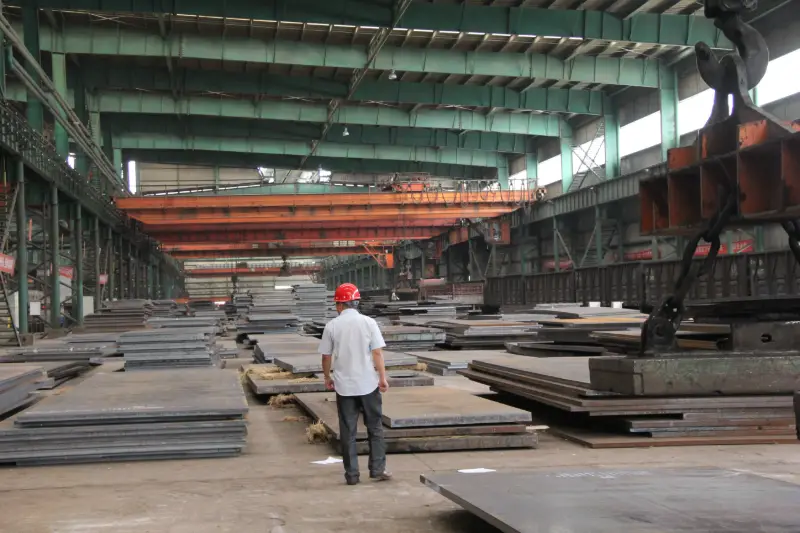
DIN 17102 EStE380 High-Strength Fine-Grain Structural Steel
DIN 17102 EStE380 High-Strength Fine-Grain Structural Steel - Full Data Sheet & Properties
Comprehensive material data for DIN 17102 EStE380 hot-rolled weldable fine-grain steel coil: chemical composition, mechanical properties, thermal and electrical performance, international equivalents, and detailed application guide for structural and automotive engineering.
Hot rolling, thermomechanical rolling, normalizing, cold forming, cutting, punching, welding
- Phone : +8618037372205
- Email : [email protected]
- WhatsApp: Contact via Whtsapp
- WeChat: +8618037372205
DIN 17102 EStE380 High-Strength Fine-Grain Structural Steel Introduction
DIN 17102 EStE380 is a thermomechanically rolled or normalized weldable fine-grain structural steel with a minimum yield strength of 380 MPa. It belongs to the family of high-strength low-alloy (HSLA) steels designed for weight-saving welded structures. Thanks to controlled microalloying with elements such as niobium, vanadium and titanium, it offers good toughness at low temperatures and excellent cold formability.
Key characteristics:
- Yield strength ≥ 380 MPa in thicknesses up to 16 mm, with good elongation (≥ 18 %)
- Charpy impact energy of at least 27 J at -20 °C ensures reliable service in cold climates
- Very good weldability with low carbon equivalent, enabling all common welding processes
- Fine-grain microstructure guarantees homogeneous mechanical properties and high fatigue resistance
The grade corresponds to the European standard EN 10149-2 S380MC and is widely used in truck chassis, crane booms, and heavy-duty structural parts.
DIN 17102 EStE380 High-Strength Fine-Grain Structural Steel Chemical Composition
Ladle analysis according to DIN 17102. The steel is fully killed and fine-grain treated. Microalloying elements are used singly or in combination to achieve the required strength and toughness. Nb, V and Ti act as grain refiners and precipitation strengtheners.
Residual elements (Cr, Ni, Mo, Cu) may be present but are not deliberately added; their total is limited to avoid hardenability effects that could impair weldability.
| Element | Standard Value (wt. %) | Remarks |
|---|---|---|
| C | ≤ 0.20 | Main strengthener; kept low for good weldability |
| Si | ≤ 0.50 | Deoxidizer |
| Mn | ≤ 1.60 | Deoxidizer, solid-solution strengthener |
| P | ≤ 0.025 | Impurity, controlled to avoid brittleness |
| S | ≤ 0.015 | Impurity; very low for improved toughness and formability |
| Al (total) | ≥ 0.020 | Deoxidizer and grain refiner |
| Nb | ≤ 0.09 | Grain refiner, precipitation strengthener |
| V | ≤ 0.10 | Grain refiner, precipitation strengthener |
| Ti | ≤ 0.15 | Grain refiner; also improves toughness |
| Cr+Ni+Mo+Cu (residuals) | ≤ 0.60 | Sum of residual elements; not deliberately added |
DIN 17102 EStE380 High-Strength Fine-Grain Structural Steel Thermal and Electrical Physical Properties
These physical properties are typical for hot-rolled fine-grain structural steel and are not part of DIN 17102 requirements. They are useful for design calculations involving heat transfer, thermal expansion, and electromagnetic effects.
Values are valid for room temperature unless otherwise noted. The resistivity value is approximate for low-alloy steel.
| Property | Typical Value | Unit | Test Condition |
|---|---|---|---|
| Density (ρ) | 7.85 | g/cm³ | Room temperature |
| Elastic modulus (E) | 210 | GPa | Room temperature |
| Shear modulus (G) | 80 | GPa | Calculated from E and ν |
| Poisson's ratio (ν) | 0.3 | — | Room temperature |
| Coefficient of thermal expansion (α) | 12.0 | 10⁻⁶/K | Between 20 °C and 100 °C |
| Thermal conductivity (λ) | 50 | W/(m·K) | Room temperature |
| Specific heat capacity | 460 | J/(kg·K) | Room temperature |
| Electrical resistivity (ρ_e) | 0.25 | μΩ·m | Room temperature |
DIN 17102 EStE380 High-Strength Fine-Grain Structural Steel Mechanical Properties
Mechanical property requirements according to DIN 17102 at room temperature, dependent on product thickness. Impact toughness is tested on Charpy V-notch specimens in the longitudinal direction.
Minimum values are guaranteed; actual values are often higher. The bend test verifies formability and absence of cracks after cold deformation.
| Property | Standard Requirement | Unit | Test Condition |
|---|---|---|---|
| Yield strength (ReH) | ≥ 380 | MPa | Thickness t ≤ 16 mm |
| Yield strength (ReH) | ≥ 360 | MPa | 16 mm < t ≤ 40 mm |
| Yield strength (ReH) | ≥ 340 | MPa | 40 mm < t ≤ 63 mm |
| Tensile strength (Rm) | 510 – 650 | MPa | t ≤ 63 mm |
| Elongation after fracture (A) | ≥ 18 | % | t ≤ 16 mm, gauge length L0 = 5.65√S0 |
| Elongation after fracture (A) | ≥ 17 | % | 16 mm < t ≤ 40 mm |
| Elongation after fracture (A) | ≥ 16 | % | 40 mm < t ≤ 63 mm |
| Bend test (mandrel diameter) | t ≤ 8 mm: 1 t; 8 < t ≤ 12.5 mm: 1.5 t; 12.5 < t ≤ 16 mm: 2 t | — | 180° bend, no cracks; where t = specimen thickness |
| Impact energy (KV) | ≥ 27 | J | Longitudinal Charpy V-notch at -20 °C |
DIN 17102 EStE380 High-Strength Fine-Grain Structural Steel Exact Equivalent Standards and Substitution Grades
| Country / Region | Standard | Designation | Remarks |
|---|---|---|---|
| Europe | EN 10149-2 | S380MC | Direct substitute; thermomechanically rolled, yield 380 MPa, comparable fine-grain practice |
| International (ISO) | ISO 4950-2 | E380C | High yield strength flat products for fusion welding; very similar strength and toughness |
| Germany (superseded) | DIN 17102 | EStE380 | Original specification, now replaced by EN 10149-2 |
DIN 17102 EStE380 High-Strength Fine-Grain Structural Steel Application Introduction
Thanks to its balanced combination of high strength, good low-temperature toughness and excellent weldability, EStE380 (now S380MC) is the material of choice for weight-critical welded assemblies subjected to dynamic loads. It can be cold formed into complex shapes and is compatible with all conventional joining methods.
Typical applications include:
- Automotive & transportation: truck frames, trailer chassis, dump bodies
- Lifting & handling: crane telescopic booms, reach stackers, forklift masts
- Civil engineering: bridge girders, temporary structures, scaffolding
- Agricultural & construction machinery: harvesters, bulldozer blades, excavator booms
Product Applications: Truck and trailer chassis frames and cross members, Crane telescopic booms and outrigger beams, Dump truck bodies and tipper trailers, Forklift mast profiles and reach stacker arms, Pressed structural panels for agricultural machines, Conveyor systems and structural platforms
Processed into products: Longitudinal and cross beams of heavy-duty vehicle frames, Boom sections and pivot brackets for mobile cranes, Formed brackets and reinforcement plates in chassis, Hydraulic cylinder support lugs, Locking bars and wear edges on earthmoving equipment, Welded tubular structures for roll-over protection (ROPS)
Application industries: Automotive and transportation, Material handling and crane manufacturing, Heavy machinery, Construction and bridge engineering, Agricultural equipment
DIN 17102 EStE380 High-Strength Fine-Grain Structural Steel Similar / Alternative Materials
| Country / Region | Standard | Designation | Remarks |
|---|---|---|---|
| Europe | EN 10149-2 | S420MC | Higher yield strength (420 MPa), comparable weldability and formability |
| Europe | EN 10025-2 | S355J2+N | Structural steel with lower yield (355 MPa), excellent ductility; requires increased thickness for same load |
| USA | ASTM A1011 HSLAS | Grade 55 Class 1 | Hot-rolled sheet, yield ~380 MPa, similar chemical philosophy |
| Japan | JIS G3134 | SPFH590 | Tensile strength 590 MPa; yield typically around 440 MPa, used in automotive structural parts |
Notes:
The data presented in this data sheet refer to the superseded DIN 17102 standard and are provided for reference, as the grade is now typically supplied according to EN 10149-2 S380MC. When ordering, the applicable edition of the standard and the delivery condition should be clearly specified. Additional requirements (e.g., improved surface quality, restricted chemical composition, ultrasonic testing) can be agreed upon at the time of enquiry and order.
Welding recommendations: Preheating is generally not required up to 30 mm thickness; low-hydrogen welding consumables are advised. For cold forming, ensure the bend radii comply with the data provided to avoid cracking. The steel is suitable for hot-dip galvanizing without significant loss of mechanical properties.
- Share



