
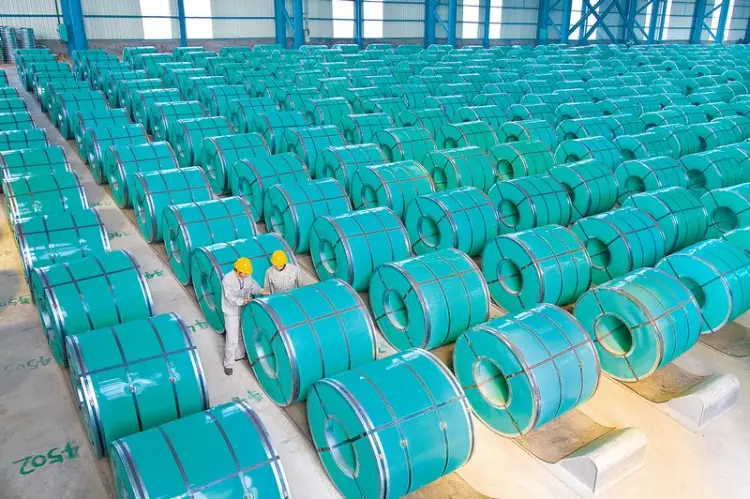
DIN 17102 StE420 High-Strength Structural Steel Coil
DIN 17102 StE420 High-Strength Structural Steel Coil: Composition, Properties & Equivalents
Detailed analysis of DIN 17102 StE420 carbon and low-alloy high-strength steel coil: chemical composition, mechanical and thermal properties, international equivalents (EN S420N, ASTM A572 Gr.60), and application guidelines.
Hot rolling, normalizing, welding, cutting, cold forming (limited), machining
- Phone : +8618037372205
- Email : [email protected]
- WhatsApp: Contact via Whtsapp
- WeChat: +8618037372205
DIN 17102 StE420 High-Strength Structural Steel Coil Introduction
DIN 17102 StE420 is a normalized, weldable fine-grain structural steel with a minimum yield strength of 420 MPa. It belongs to the category of low-alloy high-strength steels designed for heavy load-bearing applications.
- Fine-grain microstructure achieved through controlled addition of microalloying elements such as niobium, vanadium, and titanium, providing high strength and excellent toughness.
- Normalized delivery condition ensures homogeneous mechanical properties and good weldability without preheating in many cases.
- Widely used in steel construction, bridge building, crane manufacturing, and general mechanical engineering where weight reduction and high strength are required.
- Complies with the now superseded German standard DIN 17102, with current international equivalents like EN 10025‑3 S420N.
DIN 17102 StE420 High-Strength Structural Steel Coil Chemical Composition
The chemical composition of DIN 17102 StE420 is designed to ensure fine-grain structure, high strength, and good weldability. The table shows the required limits according to the standard. Microalloying elements Nb, V, Ti may be added individually or in combination to achieve the specified mechanical properties, with minimum aluminium content for grain refinement.
| Element | Standard Value (%) | Remarks |
|---|---|---|
| Carbon (C) | ≤ 0.22 | For thickness ≤ 16 mm; for thicker products, slightly higher values may apply |
| Silicon (Si) | ≤ 0.55 | Deoxidation and strength |
| Manganese (Mn) | 1.00 – 1.70 | Major strength and toughness element |
| Phosphorus (P) | ≤ 0.035 | Impurity, controlled for toughness |
| Sulfur (S) | ≤ 0.035 | Impurity, controlled for ductility |
| Nitrogen (N) | ≤ 0.020 | Typically limited; higher nitrogen may be combined with grain refiners |
| Aluminium (Altotal) | ≥ 0.020 | Minimal acid-soluble aluminium for fine-grain effect |
| Niobium (Nb) | ≤ 0.05 | Optional microalloying for grain refinement |
| Vanadium (V) | ≤ 0.12 | Optional microalloying for precipitation strengthening |
| Titanium (Ti) | ≤ 0.05 | Optional microalloying for grain refinement |
| Copper (Cu) | ≤ 0.50 | Residual element |
| Chromium (Cr) | ≤ 0.30 | Residual element; may improve hardenability |
| Nickel (Ni) | ≤ 0.30 | Residual element; beneficial for toughness |
| Molybdenum (Mo) | ≤ 0.10 | Residual element; increases strength but restricted for weldability |
DIN 17102 StE420 High-Strength Structural Steel Coil Thermal and Electrical Physical Properties
The physical properties given below are typical for low-alloy structural steels of this class at room temperature and over a range of temperatures. These values are generic and not specified in the product standard, but are essential for engineering design calculations. Slight variations may occur depending on exact composition and heat treatment.
| Property | Standard Value | Unit | Test Condition |
|---|---|---|---|
| Density (ρ) | 7800 | kg/m³ | At 20 °C |
| Elastic Modulus (E) | 210 | GPa | At 20 °C |
| Shear Modulus (G) | 80 | GPa | At 20 °C |
| Poisson's Ratio (ν) | 0.3 | – | At 20 °C |
| Thermal Expansion Coefficient (α) | 12.0 × 10⁻⁶ | K⁻¹ | 20 – 100 °C |
| Thermal Expansion Coefficient (α) | 12.5 × 10⁻⁶ | K⁻¹ | 20 – 200 °C |
| Thermal Expansion Coefficient (α) | 13.0 × 10⁻⁶ | K⁻¹ | 20 – 300 °C |
| Thermal Conductivity (λ) | 50 | W/(m·K) | At 20 °C |
| Thermal Conductivity (λ) | 45 | W/(m·K) | At 200 °C |
| Thermal Conductivity (λ) | 38 | W/(m·K) | At 400 °C |
| Specific Heat Capacity (cₚ) | 460 | J/(kg·K) | At 20 °C |
| Electrical Resistivity (ρₑ) | 0.15 × 10⁻⁶ | Ω·m | At 20 °C |
DIN 17102 StE420 High-Strength Structural Steel Coil Mechanical Properties
The mechanical properties of StE420 are verified on normalized test specimens in longitudinal direction at ambient temperature. Values vary with product thickness. The most stringent requirements apply to thin gauges typical for steel coils (≤16 mm). For quality B, minimum impact energy at -20 °C is 27 J (longitudinal). Yield strength for thickness >80 mm may be agreed upon delivery.
| Property | Required Value | Unit | Test Condition |
|---|---|---|---|
| Yield Strength (ReH) | ≥ 420 | MPa | Thickness ≤ 16 mm, longitudinal |
| Yield Strength (ReH) | ≥ 400 | MPa | Thickness 16 – 35 mm, longitudinal |
| Yield Strength (ReH) | ≥ 380 | MPa | Thickness 35 – 50 mm, longitudinal |
| Yield Strength (ReH) | ≥ 360 | MPa | Thickness 50 – 80 mm, longitudinal |
| Tensile Strength (Rm) | 510 – 650 | MPa | Thickness ≤ 16 mm |
| Tensile Strength (Rm) | 490 – 630 | MPa | Thickness 16 – 40 mm |
| Tensile Strength (Rm) | 470 – 610 | MPa | Thickness 40 – 63 mm |
| Elongation (A5) | ≥ 20 | % | Thickness ≤ 16 mm, gauge length 5.65√Sₒ |
| Elongation (A5) | ≥ 19 | % | Thickness 16 – 40 mm |
| Elongation (A5) | ≥ 18 | % | Thickness 40 – 63 mm |
| Impact Energy (KV₂, -20 °C) | ≥ 27 | J | Longitudinal, V‑notch, for quality class B (typical specification) |
| Bend test | No cracks | – | Mandrel diameter 3a, 180° bending, thickness ≤ 35 mm (optional, by agreement) |
DIN 17102 StE420 High-Strength Structural Steel Coil International Equivalent Standards and Grades
| Country / Region | Standard | Grade | Remarks |
|---|---|---|---|
| European Union | EN 10025‑3:2004 | S420N | Direct equivalent, normalized fine-grain structural steel with minimum 420 MPa yield strength. |
| USA | ASTM A572/A572M | Grade 60 (415) | Similar yield strength (415 MPa min), but typically supplied as-rolled or TMCP; not always normalized. Not identical for toughness. |
| International | ISO 630‑2 | E420 | High‑strength structural steel (formerly Fe420); aligned with EN S420N. |
| Japan | JIS G3106 | SM490B | Minimum yield 325 MPa, lower strength; close alternative is SM520B (365 MPa). Some producers offer a 420 MPa grade by modification. |
DIN 17102 StE420 High-Strength Structural Steel Coil Application Introduction
DIN 17102 StE420 is employed wherever high static strength combined with good weldability and toughness is required. Typical usage scenarios include:
Product Applications: Steel bridges and viaducts, Crane booms and lattice structures, Heavy‑duty truck chassis and trailer frames, Excavator arms and construction equipment, Welded structural beams and columns, Offshore platform frameworks, Wind turbine tubular towers, Pressure vessel shells (outside ASME requirements)
Processed into products: Welded girders and box sections, Flanges and stiffeners for steel structures, Load‑bearing hinge connections, Gusset plates and node connections in trusses, Bolted and welded end‑plates, Structural hollow sections (when processed from coil), Heavy‑duty brackets and supports, Machine frames subjected to dynamic loading
Application industries: Civil and structural engineering, Heavy machinery and equipment manufacturing, Crane and lifting technology, Bridge construction, Offshore and marine structures, Pressure vessels and storage tanks (for moderate temperatures), Wind energy (tower structures, foundations), Railway vehicles and wagons
DIN 17102 StE420 High-Strength Structural Steel Coil Materials with Similar Properties and Substitution Potential
| Country / Region | Standard | Grade | Remarks |
|---|---|---|---|
| EU | EN 10025‑3 | S460N | Higher strength (460 MPa min), similar fine-grain normalized condition. Suitable when weight savings are required and higher strength can be utilised. |
| EU | EN 10025‑4 | S420M | Thermomechanically rolled, same yield but different delivery condition; weldability is comparable, often can be interchanged after checking fatigue and toughness requirements. |
| USA | ASTM A633 | Grade E / Grade C | Normalized high‑strength structural steel with yield ~415 MPa; used in similar structural applications. |
| Japan | JIS G3106 | SM520B | Minimum yield 365 MPa; lower strength but often over‑alloyed to meet 420 MPa. Possible substitution with design review. |
| China | GB/T 1591 | Q420C/Q420D | Normalized or TMCP high‑strength steel; minimum yield 420 MPa. Close alternative in Chinese standards. |
Notes:
StE420 under DIN 17102 is often delivered with quality classification B (notch toughness at -20 °C) or C (at -40 °C), by agreement. In modern projects, EN 10025‑3 S420N should be specified as the replacement. Due to its fine‑grain structure, preheating for welding is usually unnecessary up to a carbon equivalent of about 0.45. Post‑weld heat treatment may be required for thick sections to relieve residual stresses.
- Share



