
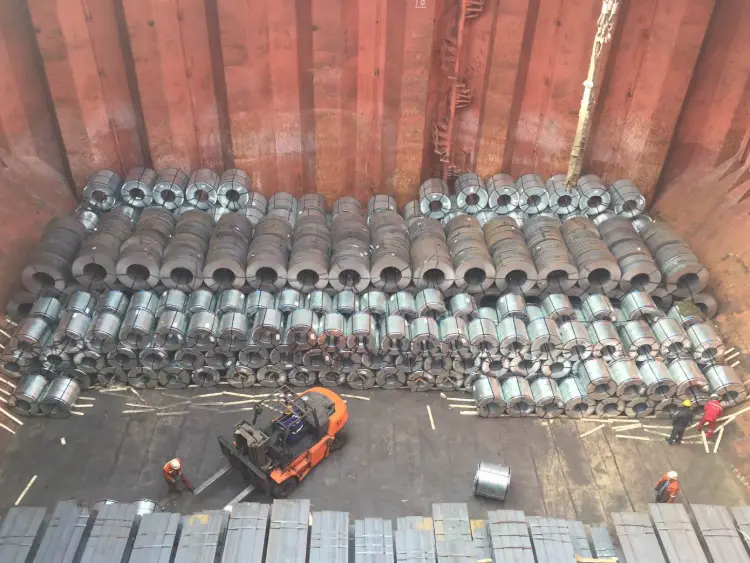
DIN 17102 StE380 Weldable Fine-Grain Structural Steel Coil
DIN 17102 StE380 Weldable Fine-Grain Structural Steel Coil - Properties & Equivalents
Comprehensive technical data for DIN 17102 StE380 carbon and low-alloy high-strength steel coil, including chemical composition, mechanical properties, thermal and electrical physical properties, international equivalents, and application guidance.
Suitable for cold forming, bending, welding (all common methods), thermal cutting, and machining.
- Phone : +8618037372205
- Email : [email protected]
- WhatsApp: Contact via Whtsapp
- WeChat: +8618037372205
DIN 17102 StE380 Weldable Fine-Grain Structural Steel Coil Introduction
StE380 is a weldable fine-grain structural steel specified in the withdrawn German standard DIN 17102. It is a low-alloy, high-strength steel produced in normalized or normalized-rolled condition, offering a minimum yield strength of 380 MPa for thicknesses up to 16 mm. Key features:
- Excellent weldability due to low carbon equivalent and fine-grain microstructure
- High strength combined with good toughness, even at low temperatures
- Suitable for dynamic and static loading in heavy-duty welded structures
- Often used as a predecessor to modern EN 10025-3 steels like S355N or S420N
DIN 17102 StE380 Weldable Fine-Grain Structural Steel Coil Chemical Composition
Typical chemical composition according to DIN 17102:1980 for StE380 weldable fine-grain steel. Key microalloying elements such as Nb, V, and Ti may be present singly or in combination to achieve grain refinement and precipitation strengthening.
- Aluminum is mandatory for fine-grain practice.
- Low sulfur and phosphorus levels ensure good cleanliness and toughness.
| Element | Standard Value (max or range) | Remarks |
|---|---|---|
| C | ≤ 0.20 | Carbon, wt% |
| Si | ≤ 0.50 | Silicon |
| Mn | 0.90 – 1.65 | Manganese |
| P | ≤ 0.035 | Phosphorus |
| S | ≤ 0.030 | Sulfur |
| Al (total) | ≥ 0.02 | Metallic aluminum, for grain refinement |
| N | ≤ 0.020 | Nitrogen, unless bound by Al or other nitride formers |
| Cr | ≤ 0.30 | Chromium (residual) |
| Cu | ≤ 0.20 | Copper (residual) |
| Mo | ≤ 0.08 | Molybdenum (residual) |
| Ni | ≤ 0.30 | Nickel (residual) |
| Nb | ≤ 0.05 | Niobium (may be added for grain refinement) |
| V | ≤ 0.10 | Vanadium (may be added for precipitation hardening) |
| Ti | ≤ 0.03 | Titanium (may be added for sulfide shape control or grain refinement) |
DIN 17102 StE380 Weldable Fine-Grain Structural Steel Coil Thermal & Electrical Physical Properties
Approximate physical properties at room temperature and up to 500°C for low‑alloy structural steels. These values are suitable for engineering calculations and may vary slightly depending on the exact composition and heat treatment condition.
- Density is constant for practical purposes.
- Thermal expansion and heat conduction change with temperature; representative values are provided.
| Property | Standard Value | Unit | Temperature / Condition |
|---|---|---|---|
| Density (ρ) | 7.85 | g/cm³ | 20°C |
| Modulus of elasticity (E) | 210 | GPa | 20°C |
| Shear modulus (G) | Approx. 80 | GPa | 20°C (calculated from E and ν) |
| Poisson's ratio (ν) | 0.3 | – | 20°C |
| Thermal expansion coefficient (α) | 12.0 | 10⁻⁶/K | 20 – 100°C |
| Thermal expansion coefficient (α) | 12.5 | 10⁻⁶/K | 20 – 200°C |
| Thermal expansion coefficient (α) | 13.0 | 10⁻⁶/K | 20 – 300°C |
| Thermal conductivity (λ) | 50 | W/(m·K) | 20°C |
| Thermal conductivity (λ) | 47 | W/(m·K) | 100°C |
| Thermal conductivity (λ) | 42 | W/(m·K) | 200°C |
| Thermal conductivity (λ) | 38 | W/(m·K) | 300°C |
| Thermal conductivity (λ) | 34 | W/(m·K) | 400°C |
| Thermal conductivity (λ) | 30 | W/(m·K) | 500°C |
| Specific heat capacity (cp) | 460 | J/(kg·K) | 20°C |
| Specific heat capacity (cp) | 490 | J/(kg·K) | 100°C |
| Specific heat capacity (cp) | 520 | J/(kg·K) | 200°C |
| Specific heat capacity (cp) | 540 | J/(kg·K) | 300°C |
| Specific heat capacity (cp) | 570 | J/(kg·K) | 400°C |
| Specific heat capacity (cp) | 610 | J/(kg·K) | 500°C |
| Electrical resistivity (ρe) | Approx. 0.20 – 0.25 | µΩ·m | 20°C |
DIN 17102 StE380 Weldable Fine-Grain Structural Steel Coil Mechanical Properties
Typical minimum yield and tensile strength values at room temperature for normalized condition, dependent upon product thickness. Impact properties are verified by Charpy-V notch test; temperature and energy level (e.g., 27 J at -20°C or -50°C) must be specified at the time of order using suffix N or NL.
- All values are for longitudinal direction unless noted.
- For thicknesses above 70 mm, values are subject to agreement.
| Property | Standard Required Value | Unit | Test Condition |
|---|---|---|---|
| Yield strength (ReH) | ≥ 380 | MPa | t ≤ 16 mm |
| Yield strength (ReH) | ≥ 360 | MPa | 16 mm < t ≤ 35 mm |
| Yield strength (ReH) | ≥ 340 | MPa | 35 mm < t ≤ 50 mm |
| Yield strength (ReH) | ≥ 320 | MPa | 50 mm < t ≤ 70 mm |
| Tensile strength (Rm) | 510 – 650 | MPa | t ≤ 16 mm |
| Tensile strength (Rm) | 490 – 630 | MPa | 16 mm < t ≤ 35 mm |
| Tensile strength (Rm) | 470 – 610 | MPa | 35 mm < t ≤ 50 mm |
| Tensile strength (Rm) | 450 – 590 | MPa | 50 mm < t ≤ 70 mm |
| Elongation (A5) | ≥ 22 | % | Gauge length L0 = 5.65√S0, longitudinal, t ≤ 16 mm |
| Elongation (A5) | ≥ 22 | % | L0 = 5.65√S0, longitudinal, 16 mm < t ≤ 35 mm |
| Elongation (A5) | ≥ 22 | % | L0 = 5.65√S0, longitudinal, 35 mm < t ≤ 50 mm |
| Elongation (A5) | ≥ 22 | % | L0 = 5.65√S0, longitudinal, 50 mm < t ≤ 70 mm |
| Charpy impact (KV2) | ≥ 27 (typical for quality 'N') | J | At -20°C, longitudinal (minimum value agreed upon ordering) |
| Charpy impact (KV2) | ≥ 27 (for 'NL' grade) | J | At -50°C, longitudinal (when specified) |
| Bending test | Mandrel diameter = 2t (t ≤ 16 mm) / 3t (t > 16 mm) | – | Bend angle 180°; no cracks or defects |
DIN 17102 StE380 Weldable Fine-Grain Structural Steel Coil Directly Equivalent Material Standards & Recommended Replacement Grades
| Country/Region | Standard | Grade | Remarks |
|---|---|---|---|
| Germany (historic) | DIN 17102:1980 | StE380 | Original designation; standard is withdrawn. |
| Europe | EN 10025-3:2004 | S355N / S355NL | Closest modern replacement; yield point is 355 MPa (<380 MPa). Often used with slight thickness adjustment. |
| Europe | EN 10025-3:2004 | S420N / S420NL | Higher strength alternative; yield 420 MPa. May require re‑qualification of welding procedure. |
| USA | ASTM A572/A572M | Grade 55 [380] | Closest match in ASTM system; yield 380 MPa (55 ksi). Check toughness requirements. |
| Japan | JIS G 3106 | SM490YA / SM490YB | Yield 365‑395 MPa range for SM490; requires detailed comparison of thickness and impact class. |
| United Kingdom (former) | BS 4360:1990 | Grade 50D / 50DD | Comparable fine-grain steel with 355 MPa yield; use Grade 50DD for low temperature. |
DIN 17102 StE380 Weldable Fine-Grain Structural Steel Coil Application Introduction
Due to its excellent combination of high strength, good toughness and weldability, StE380 (and its modern counterparts) is extensively used in welded constructions subjected to static and dynamic loads.
- Normalized delivery ensures uniform mechanical properties and fine grain.
- It is particularly suitable for cold‑bent sections and welded assemblies without post‑weld heat treatment in many cases.
- Low‑temperature toughness (N or NL grades) makes it ideal for offshore and arctic applications.
Product Applications: Welded girders and columns for high‑rise buildings, Bridge decks, arches, and box sections, Offshore jacket structures and decks, Crane booms and chassis, Mining truck frames and excavator arms, Pressure vessels for moderate temperatures, Roll‑formed hollow sections and corrugated webs
Processed into products: Load‑bearing welded connections, Stiffened panels and box sections, Flanges and webs of heavy‑duty I‑beams, Bent plates for transition pieces in wind turbines, Base plates and anchor frames, Wheel hubs and bogie frames for rail vehicles
Application industries: Civil engineering and construction, Bridge building, Shipbuilding and offshore platforms, Heavy machinery and earthmoving equipment, Pressure vessel and storage tank manufacturing, Railway vehicle components, Crane and lifting equipment
DIN 17102 StE380 Weldable Fine-Grain Structural Steel Coil Materials with Similar / Comparable Properties
| Country/Region | Standard | Grade | Remarks |
|---|---|---|---|
| China | GB/T 1591 | Q390C / Q390D | High-strength structural steel with 390 MPa yield class; check for fine‑grain practice. |
| Russia/CIS | GOST 19281 | 09G2S (345 MPa) / 10G2S1 | Not exact match; slightly lower strength but similar weldability. |
| Italy | UNI 7382 | FeE380KGN | Italian equivalent of StE380 (withdrawn); identical minimum yield. |
| International | ISO 4950-2 | E355DD / E390 | High-yield-strength structural steel; E390 has ReH ≥ 390 MPa, close to StE380. |
| India | IS 2062 | E350 / E410 | E350 (355 MPa) lower strength; E410 (410 MPa) higher strength. |
Notes:
Welding note: StE380 can be welded by all common arc processes (SMAW, SAW, GMAW, FCAW). The choice of filler metal should match the base metal strength (e.g., E51xx series). Preheat and interpass temperatures depend on thickness and heat input; typical preheat >5°C for moderate thicknesses. Forming note: Cold bending radii for normalized condition: min. 2t for t ≤ 16 mm; 3t for thicker material. Hot forming should be followed by re‑normalizing if the original strength and toughness must be restored. Inspection: Ultrasonic testing to EN 10160 is commonly required for plates intended for welded structures. Stock availability of StE380 under its original DIN designation is limited; users are encouraged to order EN 10025-3 S355N or S420N with appropriate yield class substitution.
- Share



