
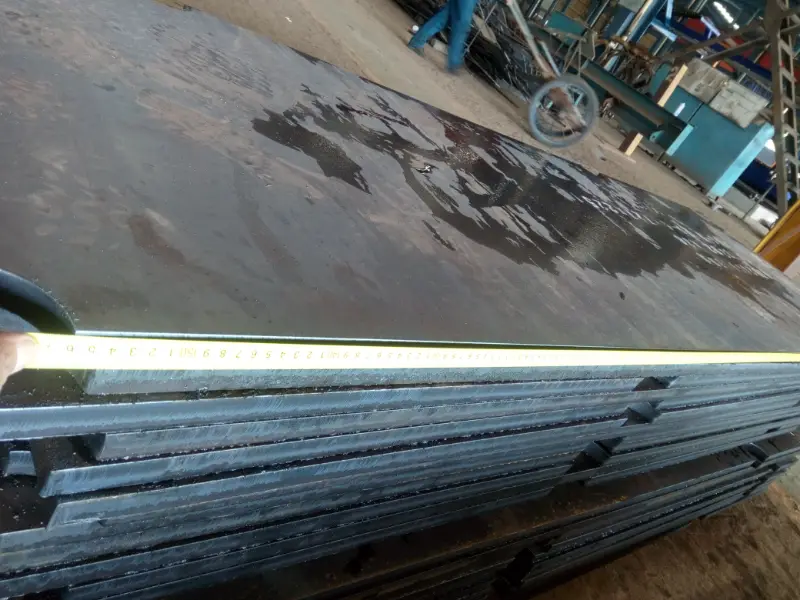
DIN 17102 WStE255
WStE255 Weathering Steel: High-Strength Low-Alloy Structural Steel to DIN 17102 for Uncoated Atmospheric Applications
Discover WStE255, a weldable fine-grain structural steel with enhanced atmospheric corrosion resistance (weathering steel) per DIN 17102. Its balanced chemistry of copper, chromium, and nickel forms a protective patina, making it ideal for uncoated outdoor structures like bridges and facades.
Cold forming, hot forming (if followed by normalizing), welding, cutting, punching, bending, and drawing
- Phone : +8618037372205
- Email : [email protected]
- WhatsApp: Contact via Whtsapp
- WeChat: +8618037372205
DIN 17102 WStE255 Introduction
DIN 17102 WStE255 is a normalized or normalized-and-tempered weldable fine-grain structural steel classified as a weathering (atmospheric corrosion-resistant) steel. It belongs to the low-alloy high-strength steel family and is distinguished by its ability to develop a tightly adhering oxide patina when exposed to the atmosphere, significantly reducing corrosion rates without the need for painting. Key characteristics:
- Minimum yield strength of 255 MPa for thicknesses ≤ 16 mm
- Excellent weldability and good notch toughness at low temperatures (down to -20 °C for J2 variants)
- Chemical composition enriched with copper, chromium, and nickel to promote stable protective rust formation
- Compliant with DIN 17102 and equivalent to ISO 4952 Fe255W; widely used in structural engineering, bridge building, and outdoor industrial equipment
The material is typically delivered in the normalized condition, ensuring uniform mechanical properties and improved toughness.
DIN 17102 WStE255 Chemical Composition
Typical ladle analysis according to DIN 17102:1978 for WStE255. The alloying elements Cu, Cr, and Ni are present to improve atmospheric corrosion resistance by supporting a dense, adherent oxide layer (patina). The carbon equivalent (CEV) is controlled to ensure good weldability. Product analysis may have slight deviations as per the standard.
| Element | Typical / Maximum Value (wt%) | Remarks |
|---|---|---|
| Carbon (C) | ≤ 0.18 | Controlled for weldability and strength |
| Silicon (Si) | 0.10 – 0.50 | Deoxidation and strength contribution |
| Manganese (Mn) | 0.60 – 1.30 | Enhances strength and hardenability |
| Phosphorus (P) | ≤ 0.030 | Residual element; limited for toughness |
| Sulfur (S) | ≤ 0.025 | Residual; limited for formability and weldability |
| Chromium (Cr) | 0.30 – 1.25 | Essential for corrosion resistance as a patina former |
| Copper (Cu) | 0.25 – 0.55 | Crucial for initiating protective rust layer |
| Nickel (Ni) | ≤ 0.30 | Improves toughness and assists in patina uniformity |
| Molybdenum (Mo) | ≤ 0.10 | Optional; may be present for additional strength |
| Vanadium (V) | ≤ 0.02 | Microalloying element for grain refinement |
| Aluminum (Al, total) | ≥ 0.02 | Deoxidation and grain refinement |
DIN 17102 WStE255 Thermophysical and Electrical Properties
These values are typical for normalized low-alloy structural steels at room temperature unless stated otherwise. They are not mandatory per DIN 17102 but represent common engineering data for WStE255. Variations may occur depending on exact composition and heat treatment.
| Property | Typical Value | Unit | Test Condition / Remarks |
|---|---|---|---|
| Density (ρ) | 7.85 | g/cm³ | At 20 °C |
| Modulus of elasticity (E) | 210 | GPa | At 20 °C, static loading |
| Shear modulus (G) | 81 | GPa | Calculated from E and Poisson ratio |
| Poisson ratio (ν) | 0.3 | – | Elastic region at ambient temperature |
| Thermal expansion coefficient (α) | 12.0 × 10⁻⁶ | K⁻¹ | Mean value between 20 °C and 100 °C |
| Thermal expansion coefficient (α) | 12.5 × 10⁻⁶ | K⁻¹ | 20 °C to 200 °C |
| Thermal expansion coefficient (α) | 13.0 × 10⁻⁶ | K⁻¹ | 20 °C to 300 °C |
| Thermal conductivity (λ) | 48 – 52 | W/(m·K) | At 20 °C, typical for low-alloy steel |
| Specific heat capacity (cₚ) | 460 | J/(kg·K) | At 20 °C |
| Electrical resistivity (ρₑ) | 0.18 – 0.25 | μΩ·m | At 20 °C, depends on exact composition |
DIN 17102 WStE255 Mechanical Properties
Mechanical properties as per DIN 17102 for normalized WStE255. Yield strength and tensile strength vary with product thickness. The table shows guaranteed minimum values for longitudinal test pieces. Impact energy is given for the common toughness grade J0 (27 J at 0 °C); when J2 is specified, the same energy is required at -20 °C. Bend test is performed with a mandrel diameter related to the thickness.
| Property | Specified Value | Unit | Test Condition / Remarks |
|---|---|---|---|
| Yield strength (ReH) | ≥ 255 | MPa | Nominal thickness ≤ 16 mm, transverse or longitudinal |
| Yield strength (ReH) | ≥ 245 | MPa | Nominal thickness >16 mm ≤ 40 mm |
| Yield strength (ReH) | ≥ 235 | MPa | Nominal thickness >40 mm ≤ 63 mm |
| Tensile strength (Rm) | 360 – 510 | MPa | For thickness ≤ 16 mm, typical range |
| Tensile strength (Rm) | 350 – 500 | MPa | Thickness >16 mm ≤ 40 mm |
| Tensile strength (Rm) | 340 – 490 | MPa | Thickness >40 mm ≤ 63 mm |
| Elongation (A) | ≥ 24 (longitudinal) | % | Gauge length L₀ = 5.65√S₀, thickness ≤ 16 mm |
| Elongation (A) | ≥ 22 (transverse) | % | Gauge length L₀ = 5.65√S₀, thickness ≤ 16 mm |
| Elongation (A) | ≥ 23 (longitudinal) | % | Thickness >16 mm ≤ 40 mm |
| Elongation (A) | ≥ 22 (longitudinal) | % | Thickness >40 mm ≤ 63 mm |
| Bend test (mandrel diameter) | d ≤ 2t | - | 180° bend for thickness ≤ 16 mm |
| Bend test (mandrel diameter) | d ≤ 3t | - | 180° bend for thickness >16 mm ≤ 63 mm |
| Impact energy (KV, 0 °C) | ≥ 27 | J | J0 quality, Charpy-V longitudinal, min. average of 3 tests |
| Impact energy (KV, -20 °C) | ≥ 27 | J | J2 quality, Charpy-V longitudinal, min. average of 3 tests |
DIN 17102 WStE255 Fully Equivalent Material Standards and Substitute Grades
| Country/Region | Standard | Grade | Remarks |
|---|---|---|---|
| International (ISO) | ISO 4952:2003 | Fe255W (with toughness suffix, e.g., Fe255W-0 or Fe255W-2) | Identical chemical and mechanical concept – weathering steel with min. 255 MPa yield |
| Germany | DIN 17102 | WStE255 | Original designation; may be ordered with J0 or J2 toughness |
| France | NF A35-502 | E 255 W-... | Historical equivalent from the French standard |
| UK | BS 4360 | WR 50 B/C | Withdrawn standard, comparable weathering grade with similar tensile range |
DIN 17102 WStE255 Application Introduction
WStE255 is designed for load-bearing structures exposed to the atmosphere without protective coatings in many environments. Its self-protecting patina reduces maintenance costs and extends service life. Key application guidelines:
- Best suited for cyclic wet-dry conditions; not recommended for constant immersion or aggressive chemical atmospheres without additional protection
- May be used bare when the patina formation period is acceptable; accelerate patina with wet-dry cycles during construction
- Excellent weldability with standard methods (SMAW, GMAW, SAW) using matching weathering electrodes
- Hot-dip galvanizing and painting are possible if surface is prepared; however, weathering steel is primarily chosen to avoid coatings
Product Applications: Bridge girders, box girders, and orthotropic decks, Architectural cladding panels and exposed steel frameworks, Freight containers and intermodal chassis, Railway wagon bodies and underframes, Transmission towers and communication masts, Open-air storage silos and hoppers, Scultural and landscape structures
Processed into products: Welded I-beams and built-up sections for long-span structures, Cold-formed purlins and cladding rails for industrial buildings, Shear studded composite bridge elements, Bolted connection gusset plates and splice plates, Bent plates for curved architectural elements, Flame-cut parts for machinery frames and support structures, Press-braked brackets and stiffening ribs
Application industries: Civil engineering and infrastructure (bridges, footbridges, highway structures), Architecture and building construction (facades, roofing, sculptural elements), Railway rolling stock and freight wagons, Shipbuilding and offshore engineering (deck equipment, structural parts above waterline), Mining and heavy machinery (dumper bodies, conveyor gantries), Power transmission (towers, substation structures), Container and storage tank manufacturing
DIN 17102 WStE255 Similar / Alternative Weathering Steel Grades
| Country/Region | Standard | Grade | Remarks |
|---|---|---|---|
| Europe | EN 10025-5:2004 | S235J2W (1.8962) / S235J0W | Weathering steel, slightly lower yield (235 MPa); suitable for substitution when strength can be downgraded |
| Europe | EN 10025-5:2004 | S355J2W (1.8966) / S355J0W | Weathering steel with higher yield (355 MPa); could over-match and affect design, but provides better load-carrying capacity |
| USA | ASTM A588 / A588M | Grade A, Grade B | High-strength low-alloy weathering steel; min. yield 345 MPa for Grade A; widely used in North America |
| Japan | JIS G3114 | SMA400AW / SMA400AP | Weathering steel with min. yield 245 MPa (AW) – close match for many WStE255 applications, especially where paint-free use is required |
| China | GB/T 4171-2008 | Q295NH | Atmospheric corrosion resistant structural steel with min. yield 295 MPa; higher strength but could be considered if design allows |
| International | ISO 4952:2003 | Fe235W | Lower strength ISO weathering grade (235 MPa) for less demanding applications |
Notes:
Atmospheric exposure notes: WStE255 performs best in moderately aggressive industrial or rural atmospheres. In marine environments, careful detailing to avoid crevices and ensure drainage is required. The material is not intended for use in contact with de-icing salts or in submerged conditions. Fabrication: Preheating may be required for thick sections to avoid hydrogen cracking; typically 50–100 °C for thicknesses above 30 mm. Post-weld heat treatment is usually not necessary but may be applied for stress relief. The CEV (carbon equivalent) typically ranges 0.38–0.42, ensuring excellent weldability with low-hydrogen practices.
- Share



