
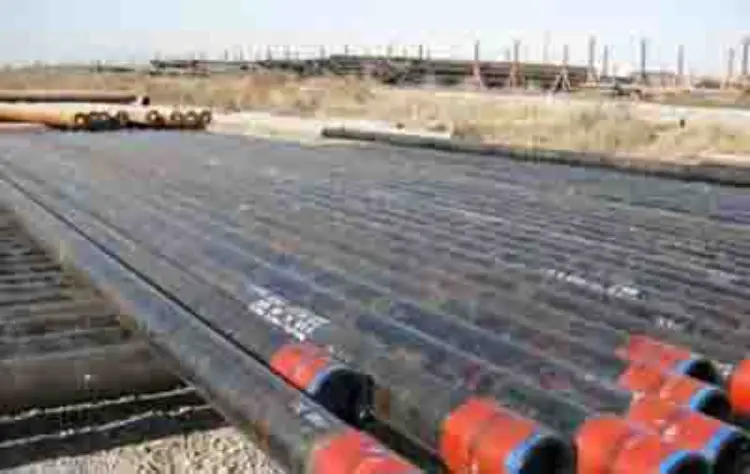
API 5L X70 PSL1 LSAW Pipe
API 5L X70 PSL1 LSAW Pipe: Properties, Equivalents & Applications
Explore the chemical composition, mechanical and thermal properties, international equivalents, and application industries of API 5L X70 PSL1 LSAW pipe. Complete data based on official standards.
Welding, bending, cutting, beveling; suitable for cold expansion, coating, and field girth welding.
- Phone : +8618037372205
- Email : [email protected]
- WhatsApp: Contact via Whtsapp
- WeChat: +8618037372205
API 5L X70 PSL1 LSAW Pipe Introduction
API 5L X70 PSL1 is a high-strength low-alloy (HSLA) steel grade for line pipe, produced in Longitudinal Submerged Arc Welded (LSAW) form. Governed by the American Petroleum Institute specification 5L, it is designed for oil and gas transmission pipelines under moderate conditions with less stringent testing than PSL2. X70 offers a minimum yield strength of 485 MPa (70 ksi) and excellent weldability due to its controlled carbon equivalent. The LSAW manufacturing process uses a single longitudinal seam welded from both inside and outside, providing dimensional accuracy and structural integrity for large-diameter, thick-wall pipes. Typical applications include onshore and offshore pipelines where a balance of strength, toughness, and cost-effectiveness is required. Key features include:
- High strength-to-weight ratio
- Good ductility and bendability
- Suitable for sour service with appropriate chemistry control
- Available in a wide range of dimensions
API 5L X70 PSL1 LSAW Pipe Chemical Composition
The table below lists the typical chemical requirements for API 5L X70 PSL1 pipe. For PSL1, the standard specifies maximum limits for C, Mn, P, and S. Microalloying elements such as Nb, V, and Ti are commonly added for strengthening but are not mandatory; when used, their combined content is limited. The carbon equivalent (CEIIW) is often controlled to ensure weldability, though not strictly required for PSL1 unless by agreement. Actual composition may vary by manufacturer and thickness. These values are based on API 5L, Table 4, and common supplementary agreements.
| Chemical Element | Standard Value (max unless noted) | Remarks |
|---|---|---|
| Carbon (C) | ≤0.26 | Max limit, typical for good weldability |
| Silicon (Si) | ≤0.40 | Typical, may not be specified in PSL1 unless agreed |
| Manganese (Mn) | ≤1.65 | Max limit |
| Phosphorus (P) | ≤0.030 | Mandatory max for PSL1 |
| Sulfur (S) | ≤0.030 | Mandatory max for PSL1 |
| Aluminum (Al) | ≥0.015 (if used) | Grain refinement; min if Al is added |
| Niobium (Nb) | ≤0.05 (typical) | Microalloying; combined V+Nb+Ti ≤0.15% |
| Vanadium (V) | ≤0.10 | Microalloying |
| Titanium (Ti) | ≤0.04 | Microalloying |
| Copper (Cu) | ≤0.50 | Residual element, max typical |
| Nickel (Ni) | ≤0.50 | Residual |
| Chromium (Cr) | ≤0.50 | Residual |
| Molybdenum (Mo) | ≤0.50 | Residual |
| Nitrogen (N) | ≤0.012 (if not Al-killed) | Typically controlled |
API 5L X70 PSL1 LSAW Pipe Thermal and Electrical Physical Properties
These physical properties are typical for API 5L X70 grade steel at ambient temperature unless otherwise noted. The material is a low-carbon, microalloyed steel, so properties are similar to standard structural carbon steels but with minimal variation due to controlled chemistry. Values are derived from general data for HSLA steel in the range of 0.2-0.3% C, and may be influenced by specific manufacturing processes like TMCP. They are not part of the API 5L specification but useful for design.
| Property | Standard Reference Value | Unit | Condition / Remarks |
|---|---|---|---|
| Density (ρ) | 7.85 | g/cm³ | At 20 °C |
| Elastic Modulus (E) | 205 – 210 | GPa | Tension, room temperature |
| Shear Modulus (G) | 79 – 81 | GPa | Calculated from E and Poisson ratio |
| Poisson Ratio (ν) | 0.3 | — | Within elastic range |
| Thermal Expansion Coefficient (α) | 11.7 × 10⁻⁶ | 1/K | 20–100 °C |
| Thermal Conductivity (λ) | 52 | W/(m·K) | At 20 °C |
| Specific Heat Capacity | 486 | J/(kg·K) | At 20 °C |
| Electrical Resistivity (ρe) | 0.22 × 10⁻⁶ | Ω·m | At 20 °C |
API 5L X70 PSL1 LSAW Pipe Mechanical Properties
The mechanical properties listed are for pipe body base metal of API 5L X70 PSL1 LSAW pipes at room temperature. For PSL1, only tensile properties are mandatory; impact testing is optional unless agreed. Elongation is calculated as per API 5L based on specimen area and tensile strength, but a typical minimum is provided here. No hardness limits are specified for PSL1 unless required by purchase order. Values may differ for weld seam (which shall not exhibit any defect). These are based on API 5L standard requirements.
| Property | Standard Required Value | Unit | Test Condition |
|---|---|---|---|
| Yield Strength (Rt0.5) | ≥485 | MPa | Transverse strip test, room temp |
| Yield Strength (Rt0.5) | ≥70.3 | ksi | Transverse strip test, room temp |
| Tensile Strength (Rm) | ≥570 | MPa | Transverse strip test |
| Tensile Strength (Rm) | ≥82.7 | ksi | Transverse strip test |
| Elongation (A50) | ≥18 (min) | % | Gauge length 50 mm or 2 in., calculated per API 5L eq. |
| Yield to Tensile Ratio | ≤0.93 | - | Not mandatory for PSL1, typical for strain-based design |
| Hardness (HV10) | Not required | HV | PSL1; if required, max 250 HV is typical for sour service |
API 5L X70 PSL1 LSAW Pipe Complete Equivalent Material Standards & Replaceable Grades
| Country/Region | Standard | Grade | Remarks |
|---|---|---|---|
| International (ISO) | ISO 3183 | L485 | PSL1 equivalent to API 5L X70 |
| European Union | EN 10208-2 | L485MB | For welded pipes; closely matches X70 chemistry and properties |
| China | GB/T 9711 | L485 (X70) | National standard for line pipe, identical requirements |
| Canada | CSA Z245.1 | Grade 483 | Comparable yield strength (483 MPa) but slightly lower; check exact specs |
| Russia/CEI | GOST R 52079 | К60 | Strength class similar to X70; verify exact chemistry |
API 5L X70 PSL1 LSAW Pipe Application Introduction
API 5L X70 PSL1 LSAW pipes are widely used in the energy transportation sector. Their combination of high strength, good weldability, and dimensional accuracy makes them a cost-effective choice for onshore and shallow offshore pipelines. Typical applications and suitable components are listed below.
Product Applications: Long-distance gas and oil pipelines, Flowlines and gathering lines, Tubular piling for marine and foundation structures, Pipe-in-pipe systems, Coil tubing (if produced as seamless)
Processed into products: Line pipe sections (straight lengths), Field bends (cold bends up to 3D radius), Pipeline fittings (elbows, tees, reducers) manufactured from pipe, Mechanical connectors and flanges (when compatible), Structural columns and beams (when cut and welded)
Application industries: Oil and gas exploration and production, Pipeline transportation (gas, crude oil, refined products), Water transmission and distribution, Structural engineering (piles, caissons), Offshore platform risers (sweet service)
API 5L X70 PSL1 LSAW Pipe Similar / Alternative Materials Recommendation
| Country/Region | Standard | Grade | Remarks |
|---|---|---|---|
| International | API 5L | X65 | Lower strength (min YS 450 MPa), but similar category; often used where X70 is over-designed |
| International | API 5L | X80 | Higher strength (min YS 555 MPa); for higher-pressure or reduced-weight pipelines, but requires more stringent welding |
| International | API 5L | X70 PSL2 | Stricter requirements (chemistry, toughness, NDT) for critical service; can replace PSL1 with additional testing |
| Europe | EN 10208-2 | L450MB | Similar to X65, suitable for less demanding applications |
| Japan | JIS G 3474 | STK 490 | High-strength steel tube, approximate grade but not fully equivalent; check pipe type |
Notes:
LSAW pipe is manufactured by forming steel plate into a cylinder and welding the longitudinal seam from both inside and outside using submerged arc welding. For API 5L PSL1, inspection and testing are less stringent than PSL2; typically no non-destructive testing of the weld seam is mandated, although it is commonly performed. The user must specify additional requirements such as impact toughness, chemical composition restrictions, or NDT in the purchase order. This material is not intended for highly sour service (H₂S-containing environments) without additional testing; for such applications, grade X70S (sour service) with controlled hardness and chemistry may be required. Dimensional tolerances, weld protrusion, and out-of-roundness are per API 5L. Carbon equivalent (CEIIW) is typically ≤0.45% when agreed to ensure field weldability. Unless otherwise specified, pipes are furnished with plain ends or beveled ends.
- Share



