
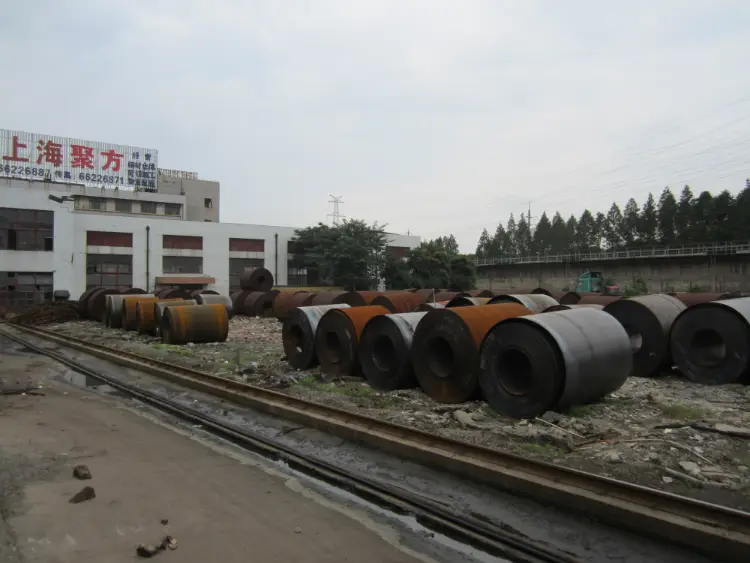
DIN 17102 StE255 Carbon Structural Steel Coil
DIN 17102 StE255 Carbon and Low-Alloy High-Strength Structural Steel Coil
Detailed technical data for DIN 17102 StE255 steel coil including chemical composition, mechanical properties, physical and thermal characteristics, international equivalents, and application guidance.
Hot rolling, normalizing, stress relieving, welding, cold forming, machining
- Phone : +8618037372205
- Email : [email protected]
- WhatsApp: Contact via Whtsapp
- WeChat: +8618037372205
DIN 17102 StE255 Carbon Structural Steel Coil Introduction
DIN 17102 StE255 is a weldable, normalized fine-grain structural steel with a minimum yield strength of 255 MPa for thicknesses up to 16 mm. It belongs to the group of carbon and low-alloy high-strength steels and is widely used in welded structures requiring good notch toughness. The steel is characterized by:
- Excellent weldability due to low carbon equivalent and fine-grain practice
- Uniform mechanical properties in all loading directions
- High resistance to brittle fracture at normal operating temperatures
- Good formability for cold bending and profiling
This grade is typically supplied in as-rolled or normalized condition and can be easily processed by flame cutting, shearing, and machining. It is intended for applications in structural engineering, bridge building, and mechanical engineering where combined strength and plasticity are required.
DIN 17102 StE255 Carbon Structural Steel Coil Chemical Composition
The chemical composition according to DIN 17102 for StE255 in the as-delivered condition. The steel is fully killed with aluminium and may contain microalloying elements for grain refinement. Values are maximum unless a range is given.
| Element | Standard Value | Remark |
|---|---|---|
| Carbon (C) | ≤ 0.22 | Max |
| Silicon (Si) | ≤ 0.55 | Max |
| Manganese (Mn) | 0.50 – 1.40 | Range |
| Phosphorus (P) | ≤ 0.035 | Max |
| Sulfur (S) | ≤ 0.035 | Max |
| Aluminium (Al total) | ≥ 0.020 | Min, for fine-grain practice |
| Nitrogen (N) | ≤ 0.012 | Typical maximum |
| Niobium (Nb) | ≤ 0.05 | Optional microalloy |
| Vanadium (V) | ≤ 0.10 | Optional microalloy |
| Titanium (Ti) | ≤ 0.03 | Optional microalloy |
DIN 17102 StE255 Carbon Structural Steel Coil Thermal and Electrical Physical Properties
Physical properties representative for carbon and low-alloy structural steels at room temperature unless stated otherwise. These values are not mandatory from DIN 17102 but are based on generic data for similar steel grades and may vary slightly with actual composition and heat treatment.
| Property | Standard Value | Unit | Test Condition |
|---|---|---|---|
| Density (ρ) | 7.85 | g/cm³ | 20 °C |
| Modulus of elasticity (E) | 210 | GPa | 20 °C |
| Shear modulus (G) | 81 | GPa | 20 °C |
| Poisson's ratio (ν) | 0.3 | — | 20 °C |
| Thermal expansion coefficient (α) | 11.7 | 10⁻⁶/K | 20–100 °C |
| Thermal expansion coefficient (α) | 12.5 | 10⁻⁶/K | 20–200 °C |
| Thermal conductivity (λ) | 51.9 | W/(m·K) | 20 °C |
| Specific heat capacity (c) | 486 | J/(kg·K) | 20 °C |
| Electrical resistivity (ρ_e) | 0.13 | 10⁻⁶ Ω·m | 20 °C |
DIN 17102 StE255 Carbon Structural Steel Coil Mechanical Properties
Mechanical properties for normalized or as-rolled condition according to DIN 17102. The values apply to longitudinal test pieces unless otherwise stated. For thicknesses over 100 mm, special agreements apply. Bend test requirement: no cracks after 180° bending using specified mandrel diameter.
| Property | Standard Requirement | Unit | Test Condition |
|---|---|---|---|
| Yield strength (ReH) | ≥ 255 | MPa | thickness ≤ 16 mm |
| Yield strength (ReH) | ≥ 245 | MPa | 16 < t ≤ 35 mm |
| Yield strength (ReH) | ≥ 235 | MPa | 35 < t ≤ 50 mm |
| Yield strength (ReH) | ≥ 215 | MPa | 50 < t ≤ 70 mm |
| Tensile strength (Rm) | 360 – 480 | MPa | all thicknesses |
| Elongation after fracture (A) | ≥ 24 | % | longitudinal, t ≤ 40 mm, L₀=5.65√S₀ |
| Elongation after fracture (A) | ≥ 23 | % | longitudinal, 40 < t ≤ 63 mm |
| Elongation after fracture (A) | ≥ 22 | % | longitudinal, 63 < t ≤ 100 mm |
| Elongation after fracture (A) | ≥ 22 | % | transverse, t ≤ 40 mm |
| Elongation after fracture (A) | ≥ 21 | % | transverse, 40 < t ≤ 63 mm |
| Elongation after fracture (A) | ≥ 20 | % | transverse, 63 < t ≤ 100 mm |
| Bend test (mandrel diameter) | d = 1.5a | — | t ≤ 16 mm, a = specimen thickness |
| Bend test (mandrel diameter) | d = 2.0a | — | 16 < t ≤ 100 mm |
DIN 17102 StE255 Carbon Structural Steel Coil Equivalent Material Standards and Replaceable Grades
| Country/Region | Standard | Grade | Remark |
|---|---|---|---|
| European Union | EN 10025-3 | S275N | Direct equivalent, normalized fine-grain steel |
| ISO | ISO 4950-1 | Fe430B | Comparable yield class, normalized |
| France | NF A35-213 | E255 FP | Equivalent grade in French standard |
| United Kingdom | BS 4360 | 43D | Historical equivalent (withdrawn) |
DIN 17102 StE255 Carbon Structural Steel Coil Application Introduction
DIN 17102 StE255 is designed for use in welded, riveted, or bolted structures where a guaranteed minimum yield strength of 255 MPa is required. Its good balance of strength, toughness, and weldability makes it suitable for both static and dynamic loads. Typical processing includes hot-rolling, normalizing to achieve fine-grain structure, and subsequent cold forming or machining. The steel can be welded by all common arc welding processes provided appropriate preheat and interpass temperatures are observed.
Product Applications: Welded I-beams, H-beams, and channels, Heavy plates for structural components, Cold-formed profiles and sections, Crane booms and jibs, Bridge deck plates and girders, Vehicle chassis rails, Tower segments for wind energy equipment
Processed into products: Main load-bearing beams, Truss members, Column base plates, Stiffeners and gusset plates, Frame structures for presses and injection molding machines, Welded tubular constructions, Earthmoving equipment arms and booms
Application industries: Civil engineering and infrastructure, Bridge construction, Heavy machinery and crane manufacturing, Automotive and transportation (chassis frames), Shipbuilding and marine engineering, Pressure vessel and storage tank fabrication, Offshore platforms and wind turbine towers
DIN 17102 StE255 Carbon Structural Steel Coil Similar or Alternative Material Recommendations
| Country/Region | Standard | Grade | Remark |
|---|---|---|---|
| European Union | EN 10025-2 | S275JR | Hot-rolled non-alloy structural steel, similar strength, not fine-grain |
| European Union | EN 10025-2 | S275J0 | Better impact toughness than JR, still non-fine-grain |
| USA | ASTM A572/A572M | Grade 42 [290] | High-strength low-alloy, yield 290 MPa, similar applications |
| USA | ASTM A36/A36M | A36 | Mild carbon steel, yield 250 MPa, widely used |
| China | GB/T 1591 | Q275 | Low-alloy high-strength structural steel, 275 MPa yield |
| China | GB/T 1591 | Q345B | Higher yield strength (345 MPa), often substituted for heavier sections |
Notes:
- Welding: The steel has a carbon equivalent (CEV) typically below 0.40, ensuring good weldability without excessive preheat. Use low-hydrogen electrodes or wire to avoid cold cracking.
- Heat treatment: Normalizing at 880–920 °C followed by air cooling is recommended for best toughness. Stress relieving at 580–620 °C may be applied after welding.
- Corrosion resistance: Not inherently corrosion-resistant; protective coatings (paint, galvanizing) are required for outdoor or aggressive environments.
- All data are based on the DIN 17102 standard (withdrawn, replaced by EN 10025-3). For new designs, consult the EN 10025-3 grade S275N.
- Share



