
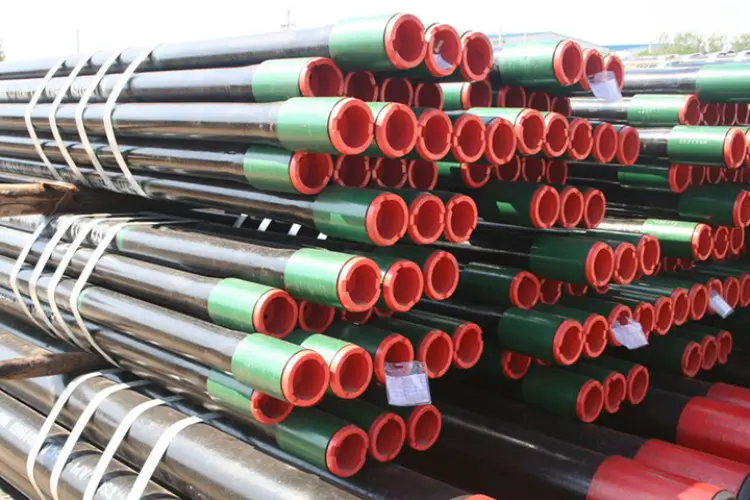
API 5L X65 PSL1 LSAW Pipe
API 5L PSL1 X65 LSAW Pipe Material Data & Equivalent Standards
Complete material profile for API 5L PSL1 X65 longitudinal submerged arc welded (LSAW) pipe including chemical composition, mechanical and physical properties, international equivalents, similar materials, and typical applications.
Thermomechanical Controlled Process (TMCP), As-rolled, Normalized, or Quenched and Tempered at manufacturer's option
- Phone : +8618037372205
- Email : [email protected]
- WhatsApp: Contact via Whtsapp
- WeChat: +8618037372205
API 5L X65 PSL1 LSAW Pipe Introduction
API 5L X65 PSL1 is a high-strength low-alloy (HSLA) steel grade primarily used for line pipe in oil and gas transportation systems. Manufactured as LSAW (Longitudinal Submerged Arc Welded) pipe, it offers excellent weldability and a minimum yield strength of 450 MPa (65 ksi). The PSL1 designation refers to the normal quality level within API Specification 5L, which specifies general requirements for the manufacturing and testing of seamless and welded steel line pipe. This grade provides a cost-effective balance of strength and ductility for less critical applications under moderate service conditions, where stringent notch toughness requirements are not mandatory.
API 5L X65 PSL1 LSAW Pipe Chemical Composition
The chemical composition limits below conform to API 5L PSL1 requirements for pipe body and weld metal. Values are maximum unless a range is specified. Carbon equivalent (CEIIW) is typically controlled to ensure weldability and is agreed upon between manufacturer and purchaser.
| Element | Value (max %) | Remarks | |
|---|---|---|---|
| Carbon (C) | 0.26 | Max | For all PSL1 pipes, wall thickness ≤ 25.0 mm |
| Manganese (Mn) | 1.40 | Max | |
| Phosphorus (P) | 0.030 | Max | |
| Sulfur (S) | 0.030 | Max | |
| Titanium (Ti) | 0.04 | Max | When used as grain refiner |
| Niobium (Nb) + Vanadium (V) + Titanium (Ti) | ≤ 0.15 | Sum of microalloying elements | |
| Copper (Cu), Nickel (Ni), Chromium (Cr), Molybdenum (Mo) | Not specified, added as required | Residual elements; may be limited by CEV requirement | |
| Carbon Equivalent (CEIIW) | Typically ≤ 0.43 | For weldability, agreed upon; PSL1 does not mandate CEV |
API 5L X65 PSL1 LSAW Pipe Physical Properties
The values listed are typical for low-carbon microalloyed pipeline steels. Actual properties may slightly vary depending on exact chemical composition and thermomechanical processing. These are reference data, not mandatory specification limits.
| Property | Typical Value | Unit | Test Condition / Remarks |
|---|---|---|---|
| Density (ρ) | 7,850 | kg/m³ | At 20 °C |
| Modulus of Elasticity (E) | 200 – 210 | GPa | At 20 °C (typically 207 GPa) |
| Shear Modulus (G) | 80 – 83 | GPa | Calculated from E and Poisson's ratio |
| Poisson's Ratio (ν) | 0.29 – 0.30 | – | Elastic range |
| Thermal Expansion Coefficient (α) | 11.7 – 12.5 | ×10⁻⁶ /K | Linear expansion from 20 °C to 100 °C (typical 12.0) |
| Thermal Conductivity (λ) | 42 – 48 | W/m·K | At 20 °C, typical value 45 W/m·K |
| Specific Heat Capacity (c) | 460 – 500 | J/kg·K | At 20 °C, typical 470 J/kg·K |
| Electrical Resistivity (ρ_e) | 0.18 – 0.25 | μΩ·m | At 20 °C, typical 0.20 μΩ·m |
API 5L X65 PSL1 LSAW Pipe Mechanical Properties
Mechanical property requirements for X65 PSL1 line pipe in transverse (or longitudinal) direction. Impact testing is not mandatory in PSL1 unless supplementary requirements are specified by the purchaser.
| Property | Required Value | Unit | Test Condition / Remarks |
|---|---|---|---|
| Yield Strength (ReH/Rt0.5) | 450 – 600 | MPa (N/mm²) | Transverse direction, 0.5% total extension under load (Rt0.5); typical minimum 65 ksi. Upper limit 600 MPa to avoid excessive yield-tensile ratio. |
| Tensile Strength (Rm) | 535 – 760 | MPa (N/mm²) | Transverse direction, minimum 77 ksi |
| Elongation (A) | ≥ 18 (transverse) / ≥ 20 (longitudinal) | % | In 50 mm (2 in) gauge length; calculation per API 5L formula if exact value is not specified |
| Yield-to-Tensile Ratio (ReH/Rm) | ≤ 0.93 (typical for TMCP) | – | Not mandatory in PSL1 but often guaranteed for strain-based design applications |
| Bend Test | No cracks or ruptures under 180° bend | – | D = 2T (bend diameter), 180° for wall thickness ≤ 12.7 mm; D = 3T for t > 12.7 mm; condition: ambient temperature |
| Charpy V-Notch Impact Test | Not required | – | PSL1 does not specify; optional via supplementary requirement SR5 or SR6 |
| Weld Tensile Test | ReH ≥ 450 MPa (min) | MPa | Transverse weld specimen; tensile strength ≥ 535 MPa |
API 5L X65 PSL1 LSAW Pipe Completely Equivalent Material Standards & Substitute Grades
| Country / Region | Standard | Grade | Remarks |
|---|---|---|---|
| International (ISO) | ISO 3183:2012 | L450S (L450 with PSL1 delivery condition) | Direct equivalent to API 5L X65 PSL1; L450 indicates minimum yield strength 450 MPa; S denotes normal quality. |
| China | GB/T 9711-2017 | L450 (PSL1) | Equivalent to ISO 3183 L450S, interchangeable with X65 PSL1 for pipeline applications. |
| Europe | EN 10208-2 | L450MB | EN 10208-2 specifies PSL2-level requirements; L450MB is chemically and mechanically equivalent to X65 but with mandatory notch toughness. Can replace X65 PSL1 when improved toughness is desired. |
| Russia / CIS | GOST R 52079 | K56 | Strength grade K56 corresponds to yield strength 441-568 MPa; considered equivalent to X65/X70 range, may require additional verification for complete interchangeability. |
API 5L X65 PSL1 LSAW Pipe Application Introduction
API 5L X65 PSL1 LSAW pipe is widely used in onshore and offshore piping systems where high strength and reliable weld integrity are essential. The LSAW process produces large-diameter straight-seam pipes from heavy plates, ideal for high-pressure transmission lines. Typical downstream processing includes coating (FBE, 3LPE/3LPP) and cold bending to 5D radius.
Product Applications: Mainline transmission pipelines (cross-country), Offshore pipeline and risers, Gas distribution networks (high pressure), Fire and water service lines, Pipe piles for marine structures
Processed into products: Pipe barrel sections (cans) for S-lay and J-lay installations, Induction bends (hot-formed) with matching parent pipe grade, Pipeline fittings (tees, wyes, reducers) manufactured from LSAW pipe, Flanged spools and tie-in piping, Structural columns and bracing in steel structures
Application industries: Oil and gas exploration & production (upstream), Pipeline transmission (midstream), Petrochemical and refining plants, Water and slurry transportation, Structural and piling applications
API 5L X65 PSL1 LSAW Pipe Comparable / Similar Material Alternatives
| Country / Region | Standard | Grade | Remarks |
|---|---|---|---|
| International (API) | API 5L PSL2 | X65 PSL2 | Higher quality level with mandatory impact testing and tighter chemistry; offers enhanced toughness but higher cost. Chemically similar, mechanical property ranges overlap. |
| International (API) | API 5L | X60 (L415) | Lower strength grade (min YS 415 MPa). Suitable when design pressure is lower; may require wall thickness increase. |
| International (API) | API 5L | X70 (L485) | Higher strength grade (min YS 485 MPa). Potential alternative for weight reduction, but may need more careful welding control. |
| Structural (ASTM) | ASTM A572/A572M | Grade 65 (450) | Structural steel with similar yield strength, typically used for welded bridges and buildings. Not intended for pressurized pipeline; lacks HIC/SSC testing requirements. |
Notes:
Supplementary requirements (SRs) such as SR5 (Charpy impact testing at specified temperature) or SR6 (drop weight tear test) can be added to PSL1 pipe when elevated toughness is needed. Hydrostatic testing is mandatory per API 5L; weld seam NDT (ultrasonic or radiographic) is required for LSAW pipe. For sour service applications, PSL2 grade with HIC (Hydrogen Induced Cracking) resistance should be specified instead of PSL1.
- Share



