
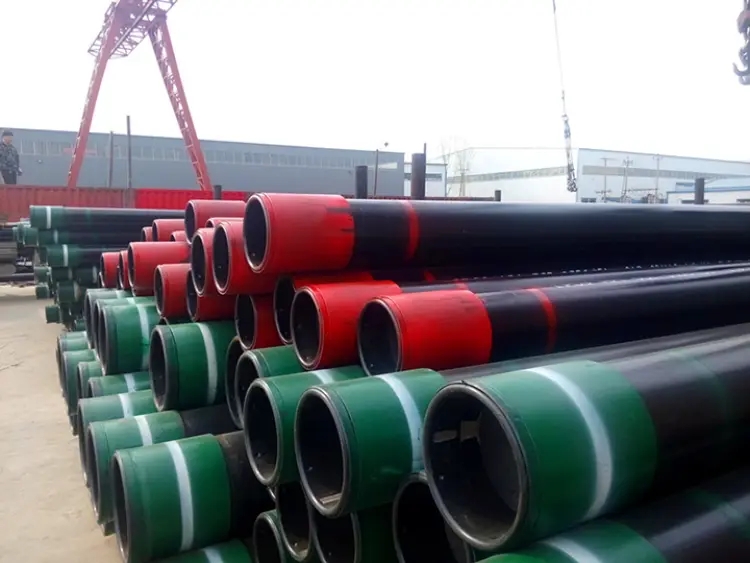
API 5L X60 PSL1 LSAW Pipe
API 5L PSL1 X60 LSAW Pipe: Technical Data, Equivalents & Applications
Comprehensive material data for API 5L PSL1 X60 LSAW steel pipe, including chemical composition, mechanical properties, physical properties, equivalent standards, and typical applications.
Welding, cutting, bending, cold/hot forming, machining
- Phone : +8618037372205
- Email : [email protected]
- WhatsApp: Contact via Whtsapp
- WeChat: +8618037372205
API 5L X60 PSL1 LSAW Pipe Introduction
API 5L X60 PSL1 is a high-strength low-alloy (HSLA) pipeline steel specified by the American Petroleum Institute standard 5L. Manufactured using the Longitudinal Submerged Arc Welding (LSAW) process, it is designed for conveying oil, gas, and water in transmission pipelines. PSL1 represents the standard quality level with relatively broad chemical and mechanical requirements. The grade offers a minimum yield strength of 415 MPa (60 ksi) and good weldability, making it widely adopted in both onshore and offshore pipeline projects.
API 5L X60 PSL1 LSAW Pipe Chemical Composition
The chemical composition limits for API 5L X60 PSL1 are defined by ladle analysis per the API 5L standard. Only maximum values for carbon, manganese, phosphorus, and sulfur are mandated. Other elements like niobium, vanadium, and titanium may be added at the manufacturer's discretion and are shown as typical ranges. Carbon equivalent (CE) is not a requirement for PSL1 but is provided for weldability reference.
| Element | Standard Value (max, %) | Remarks |
|---|---|---|
| C | 0.28 | For wall thickness ≤ 25 mm; higher limits apply for thicker sections per standard |
| Mn | 1.40 | Maximum; may be adjusted for required strength and toughness |
| P | 0.030 | Maximum per PSL1 |
| S | 0.030 | Maximum per PSL1 |
| Nb | ≤ 0.05* | Typical microalloying addition; not mandatory in PSL1 |
| V | ≤ 0.05* | Typical microalloying addition; not mandatory in PSL1 |
| Ti | ≤ 0.04* | Typical microalloying addition; not mandatory in PSL1 |
| Si | 0.45 | Typical maximum for ladle analysis; not explicitly limited in PSL1 |
| CE (IIW) | 0.43 | Typical maximum carbon equivalent for good field weldability; advisory, not a specification limit |
API 5L X60 PSL1 LSAW Pipe Thermal and Electrical Physical Properties
The physical properties are typical values for LSAW line pipe steel X60 and are not part of the API 5L standard. They apply to carbon-manganese steel at the indicated temperatures and are suitable for engineering calculations.
| Property | Typical Value | Unit | Condition |
|---|---|---|---|
| Density (ρ) | 7.85 | g/cm³ | At 20 °C |
| Elastic Modulus (E) | 205 | GPa | At 20 °C |
| Shear Modulus (G) | 80 | GPa | At 20 °C |
| Poisson's Ratio (ν) | 0.3 | – | At 20 °C |
| Thermal Expansion Coefficient (α) | 11.7 × 10⁻⁶ | K⁻¹ | 20–100 °C |
| Thermal Expansion Coefficient (α) | 12.5 × 10⁻⁶ | K⁻¹ | 20–200 °C |
| Thermal Conductivity (λ) | 50 | W/(m·K) | At 20 °C |
| Specific Heat Capacity (c) | 470 | J/(kg·K) | At 20 °C |
| Electrical Resistivity (ρₑ) | 0.20 | μΩ·m | At 20 °C |
API 5L X60 PSL1 LSAW Pipe Mechanical Properties
The mechanical properties listed below are the minimum requirements as defined in API 5L for X60 PSL1 from transverse strip tensile tests. Elongation is determined by the API 5L empirical formula; a typical value for common wall thickness is provided. Bend tests and impact toughness are not mandatory for PSL1 unless specified by supplementary requirements.
| Property | Standard Requirement | Unit | Test Condition |
|---|---|---|---|
| Yield Strength (Rt0.5) | 415 – 565 | MPa | Transverse, 0.5% total extension under load (PSL1) |
| Tensile Strength (Rm) | 520 – 760 | MPa | Transverse, at room temperature |
| Elongation after fracture (A) | Determined by formula* | % | 2 in (50.8 mm) gauge length; A = 1940 Aₓc⁰·² / U⁰·⁹ |
| Elongation (typical, 10 mm wall) | ≥ 22 | % | Typical for pipe wall thickness 10 mm; minimum per formula |
| Bend Test | Not required | – | PSL1 does not mandate bend test unless specified |
| Charpy Impact Energy (KV) | Not required | Joule | No requirement for PSL1; may be added by supplementary specification |
API 5L X60 PSL1 LSAW Pipe Fully Equivalent Standards and Substitutable Grades
| Country/Region | Standard | Grade | Remarks |
|---|---|---|---|
| International (ISO) | ISO 3183 | L415 (PSL1) | Direct equivalent; identical yield and tensile requirements as API 5L X60 PSL1 |
| Europe | EN 10208-2 | L415NB | Normalized line pipe steel with minimum yield 415 MPa; matches X60 PSL1 after normalizing |
| China | GB/T 9711 | L415 (PSL1) | Adopts ISO 3183; chemically and mechanically equivalent |
| Russia | GOST R 52079 | K60 (К60) | Grade for large-diameter line pipe; 415 MPa minimum yield |
| Canada | CSA Z245.1 | 414/415 Category I | Comparable strength level for pipeline service |
API 5L X60 PSL1 LSAW Pipe Application Introduction
API 5L X60 PSL1 LSAW pipe is predominantly employed in the oil and gas industry for long-distance transmission of hydrocarbons. Its moderate strength combined with excellent weldability and formability makes it suitable for both onshore and shallow-water offshore projects. The LSAW production route ensures precise diameter–to–wall thickness ratios and straightness, which are critical for field construction.
Product Applications: Cross-country oil and gas pipelines, Gathering lines and flowlines, Water mains and reclaimed water systems, Structural pipe piles for bridges and buildings, Offshore platform legs and risers
Processed into products: Line pipe segments for onshore and offshore pipelines, Fittings (tees, elbows, reducers) requiring pipe base material, Piling for marine terminals and jetties, Tubular structural members in trusses and towers, Compressor and pump station piping headers
Application industries: Oil & Gas Exploration and Production, Petrochemical Processing, Water Transmission and Distribution, Civil and Structural Engineering, Mining
API 5L X60 PSL1 LSAW Pipe Similar / Closely Related Substitute Materials
| Country/Region | Standard | Grade | Remarks |
|---|---|---|---|
| USA | API 5L | X60 PSL2 | Higher PSL with mandatory toughness, lower S max, and tighter chemistry; ideal for critical applications |
| USA | API 5L | X65 PSL1 | Slightly higher strength grade (YS ≥ 450 MPa), otherwise similar weldable HSLA steel |
| Europe | EN 10208-2 | L415MB | Thermomechanically rolled version; offers improved toughness and strength compared to NB |
| International | ISO 3183 | L415M (PSL2) | PSL2 equivalent with mandatory fracture toughness; suitable where crack arrest properties are required |
| Japan | JIS G 3445 | STKM 18A | Carbon steel tube for machine structural use with YS ~415 MPa, but different application and narrower chemistry |
Notes:
Additional information: LSAW pipe is formed by cold-expanding steel plates, welding along the longitudinal seam using submerged-arc welding, and then expanding again to relieve stress. X60 PSL1 is not inherently sour-service compliant; if H2S exposure is expected, supplementary requirements such as hardness limits and HIC testing per NACE MR0175/ISO 15156 must be specified. All data reflect the latest edition of API 5L; users should confirm with the exact edition referenced in their project.
- Share



