
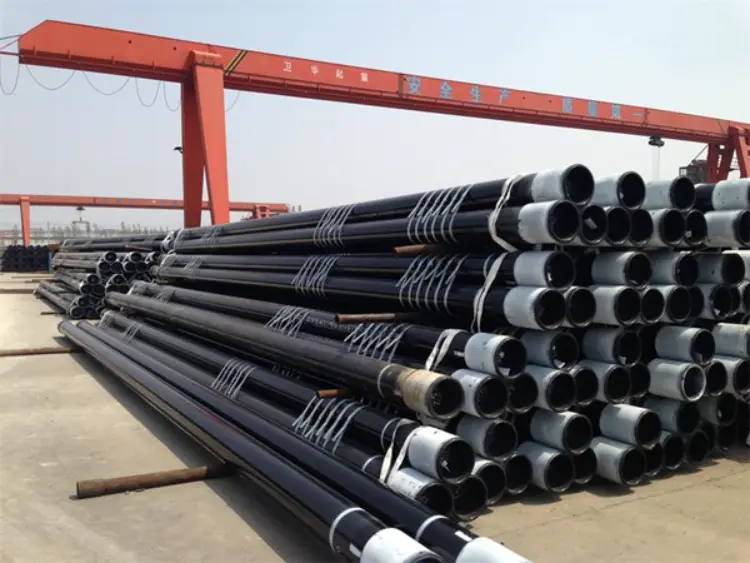
API 5L X56 PSL1 LSAW Line Pipe
API 5L X56 PSL1 LSAW Line Pipe: High-Strength Carbon Steel for Oil & Gas Transmission
API 5L X56 PSL1 LSAW pipe is a longitudinally submerged arc welded line pipe made from microalloyed high-strength low-alloy steel, designed for oil, gas, and water transmission under moderate to high pressure. It offers a minimum yield strength of 56 ksi (386 MPa) with excellent weldability and toughness.
Welding (LSAW, ERW), bending, cold forming, coating (FBE, 3LPE, etc.), threading, hydrostatic testing
- Phone : +8618037372205
- Email : [email protected]
- WhatsApp: Contact via Whtsapp
- WeChat: +8618037372205
API 5L X56 PSL1 LSAW Line Pipe Introduction
API 5L X56 is a high-strength carbon-manganese microalloyed steel grade specified by the American Petroleum Institute for line pipe used in the oil and gas industry. The PSL1 designation indicates standard quality requirements without mandatory impact testing, while LSAW (Longitudinally Submerged Arc Welded) refers to the pipe manufacturing process where the seam is welded using submerged arc welding along the pipe's length. This grade provides a balanced combination of strength, ductility, and cost-effectiveness for onshore and offshore pipeline systems, typically operating at temperatures above -20°C. It is widely adopted for gathering lines, transmission mains, and distribution networks transporting sweet or mildly sour hydrocarbons and water.
API 5L X56 PSL1 LSAW Line Pipe Chemical Composition
The chemical composition of API 5L X56 PSL1 follows the standard requirements for PLS1 pipe grades. The values below represent the maximum limits for heat analysis as per API 5L. Carbon equivalent (CE) is often controlled for weldability; for X56, CE_IIW is typically ≤ 0.43%. Microalloying elements like Nb, V, and Ti are added to refine grain size and achieve the required strength without excessive carbon content. The sum of Nb + V + Ti shall not exceed 0.15% for PSL1 X56.
| Element | Max. (%) | Remarks |
|---|---|---|
| Carbon (C) | 0.26 | For t ≤ 25 mm (1 in); max 0.28 for t > 25 mm per API 5L Table 4 |
| Manganese (Mn) | 1.35 | For t ≤ 25 mm; max 1.40 for t > 25 mm |
| Phosphorus (P) | 0.030 | |
| Sulfur (S) | 0.030 | |
| Silicon (Si) | 0.45 | Typical addition for deoxidation, not a mandatory requirement |
| Niobium (Nb) | 0.05 | Microalloying addition; combined Nb+V+Ti ≤ 0.15% |
| Vanadium (V) | 0.05 | Microalloying addition |
| Titanium (Ti) | 0.04 | Microalloying addition |
| Copper (Cu) | 0.50 | Max if specified to improve atmospheric corrosion resistance |
| Nickel (Ni) | 0.50 | Max if specified |
| Chromium (Cr) | 0.50 | Max if specified |
| Molybdenum (Mo) | 0.15 | Max if specified |
| Aluminum (Al) | 0.060 | Total, max; usually added for grain refinement |
API 5L X56 PSL1 LSAW Line Pipe Physical Properties
The following thermal, electrical, and physical properties are typical for carbon-manganese microalloyed pipeline steels in the as-welded or normalized condition. These values are not specified in API 5L but are commonly used for engineering and design calculations. Properties may vary slightly with exact composition and heat treatment.
| Property | Typical Value | Unit | Condition / Remarks |
|---|---|---|---|
| Density (ρ) | 7850 | kg/m³ | At 20°C |
| Modulus of Elasticity (E) | 205 | GPa | At room temperature |
| Shear Modulus (G) | 80 | GPa | Calculated from E and Poisson's ratio |
| Poisson's Ratio (ν) | 0.3 | — | In elastic range |
| Thermal Expansion Coefficient (α) | 11.7 | 10⁻⁶/K | Between 20°C and 100°C |
| Thermal Expansion Coefficient | 12.5 | 10⁻⁶/K | Between 20°C and 300°C |
| Thermal Conductivity (λ) | 50 | W/m·K | At 20°C |
| Thermal Conductivity | 44 | W/m·K | At 200°C |
| Thermal Conductivity | 38 | W/m·K | At 400°C |
| Specific Heat Capacity | 460 | J/kg·K | At 20°C |
| Specific Heat Capacity | 520 | J/kg·K | At 200°C |
| Electrical Resistivity (ρ_e) | 0.19 | μΩ·m | At 20°C, typical for low-alloy steel |
API 5L X56 PSL1 LSAW Line Pipe Mechanical Properties
Mechanical properties for API 5L X56 PSL1 LSAW pipes are determined on the pipe body in the transverse direction. The values are the minimum required by the standard unless otherwise noted. For PSL1, Charpy V-notch impact testing is not mandatory; however it may be specified by the purchaser (e.g., 27 J at 0°C as a typical supplementary requirement). The bend test is performed at 180° with a mandrel diameter related to the wall thickness.
| Property | Required Value | Unit | Test Condition / Remarks |
|---|---|---|---|
| Yield Strength (Rt0.5) | 386 minimum (56 000) | MPa (psi) | Transverse; pipe body; 0.5% total extension |
| Tensile Strength (Rm) | 489 minimum (71 000) | MPa (psi) | Transverse; pipe body |
| Elongation (A) | calculated per formula | % | In 50 mm (2 in) gauge length; A = 1940 * A^0.2 / U^0.9, where A = cross-sectional area (mm²) and U = tensile strength (MPa). Typical value ~22% |
| Elongation (A) – typical | 22–28 | % | Typical range for X56 PSL1, depending on wall thickness |
| Bend Test (mandrel diameter) | See note | — | 180° bend; mandrel diameter = 2.5t for t ≤ 12.7 mm, 3t for t > 12.7 mm (t = wall thickness) |
| Charpy V-Notch Impact (optional) | > 27 | J | at 0°C, transverse, average of three specimens; typical when ordered |
API 5L X56 PSL1 LSAW Line Pipe Identical Material Standards & Substitute Grades
| Country/Region | Standard | Grade | Remarks |
|---|---|---|---|
| International | ISO 3183:2019 | L390M | PSL1 equivalent; min YS 390 MPa, min TS 510 MPa. Slightly higher strength than API X56 (56 ksi ≈ 386 MPa) |
| Europe | EN 10208-2 | L390MB | Comparable to X56; min YS 390 MPa, TS 460–593 MPa; technically interchangeable |
| China | GB/T 9711-2017 | L390 | PSL1 grade; matches API 5L X56 in strength and chemical requirements |
| Canada | CSA Z245.1-18 | Grade 386 | Approximate equivalent; minimum yield 386 MPa |
API 5L X56 PSL1 LSAW Line Pipe Application Introduction
API 5L X56 PSL1 LSAW pipe is primarily used in the construction of long-distance pipelines for hydrocarbons and water. Its high strength-to-weight ratio and good weldability make it suitable for onshore and offshore projects where pressure containment is critical. The LSAW manufacturing process allows large diameters (typically 16" to 64") with thick walls, making the product ideal for high-volume, high-pressure transmission lines. Due to PSL1 requirements, it is mainly used in non-sour service environments where brittle fracture resistance is not a primary concern; for arctic or sour service, supplement with toughness or HIC testing.
Product Applications: Cross-country oil trunklines, Gas gathering and distribution networks, Subsea flowlines (when coated and supplemented with CP), Water injection and disposal pipelines, Structural tubular members in jackets and topsides, Pipe piles and foundation casings
Processed into products: Main pipeline sections (12 m or 24 m lengths), Induction bends and elbows, Tees, reducers, and caps (fittings), Flanges and connectors, Valve bodies and pig launching/receiving barrels, Riser pipes and J-tubes
Application industries: Oil & Gas transmission (onshore and offshore), Water transportation (aqueducts, injection lines), Petrochemical plants (process piping), Marine & offshore structures (jack-up legs, riser pipes), Mining (slurry and tailings pipelines), Civil engineering (jacking pipes, piling)
API 5L X56 PSL1 LSAW Line Pipe Similar / Nearby Substitute Steels
| Country/Region | Standard | Grade | Remarks |
|---|---|---|---|
| USA/International | API 5L | X52 (L360) | Lower strength (min YS 52 ksi/360 MPa). Often used when pressure requirements are lower; provides better weldability with lower CE. |
| USA/International | API 5L | X60 (L415) | Higher strength (min YS 60 ksi/415 MPa). Suitable for higher pressure pipelines, though may require stricter welding controls. |
| Europe | EN 10208-2 | L360NB | Strength level slightly below X56; can be substituted if design allows for lower yield. |
| Europe | EN 10208-2 | L415MB | Above X56; appropriate for non-sour service requiring extra capacity. |
Notes:
- Welding: LSAW pipes are typically joined by girth welding (manual/automatic), using E7010/E8010 or ER70S-6/ER80S-D2 consumables. Preheat may be required for thicker sections (>20 mm) to avoid hydrogen cracking.
- Corrosion Protection: Usually coated externally with 3-layer polyethylene/polypropylene (3LPE/3LPP) or fusion-bonded epoxy (FBE), and internally with liquid epoxy or cement mortar for water lines.
- Service Restrictions: Not intended for severe sour service (H₂S partial pressure > 0.3 kPa) unless specifically tested to NACE MR0175/ISO 15156. For sour applications, consider X56 PSL2 with HIC/SSC qualification.
- Supplementary Testing: When impact toughness is required, typical acceptance values are 27 J at 0°C or -10°C. Ultrasonic and radiographic inspection of welds is mandatory per the standard.
- Share



