
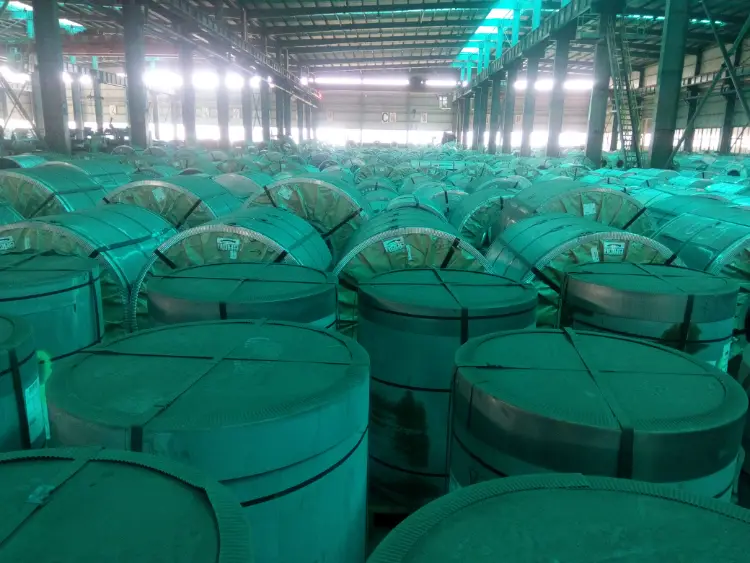
DIN 17100 St52-3 Steel Coil
DIN 17100 St52-3 Structural Steel Coil: Properties, Equivalents & Application Data
Comprehensive technical datasheet for St52-3 carbon and low-alloy high-strength steel coil to DIN 17100, covering chemical composition, mechanical and physical properties, international equivalents, and application guidance.
Hot rolling, cold forming, welding, machining, cutting, punching, bending
- Phone : +8618037372205
- Email : [email protected]
- WhatsApp: Contact via Whtsapp
- WeChat: +8618037372205
DIN 17100 St52-3 Steel Coil Introduction
DIN 17100 St52-3 is a weldable, general purpose structural steel with a minimum yield strength of 355 MPa for thicknesses up to 16 mm. It belongs to the carbon and low-alloy high-strength steel category and is primarily supplied in the as-rolled (+AR) or normalized (+N) condition. Key features include:
- Good combination of strength, ductility and weldability
- Suitable for cold forming and machining
- Available as coils, plates, sheets, strips and sections
- Can be ordered with optional impact toughness down to -20°C (e.g. St52-3 N)
The grade is widely used in structural engineering, bridge construction, vehicle manufacturing and general machinery. It is the predecessor of the modern EN 10025-2 S355J2 designation.
DIN 17100 St52-3 Steel Coil Chemical Composition
The ladle analysis according to DIN 17100 for St52-3. Microalloying elements such as niobium, vanadium or titanium may be added by the manufacturer to meet the required mechanical properties. The steel is typically fully killed and fine-grained treated if ordered with the symbol N (normalized). Maximum phosphorus and sulfur contents ensure good weldability and toughness.
| Element | Content (wt%) | Remarks |
|---|---|---|
| Carbon (C) | ≤ 0.22 | Higher C may be used if compensated by other elements |
| Silicon (Si) | ≤ 0.55 | deoxidation element |
| Manganese (Mn) | ≤ 1.60 | enhances strength and hardenability |
| Phosphorus (P) | ≤ 0.045 | upper limit for weldability |
| Sulfur (S) | ≤ 0.045 | controls hot shortness |
| Iron (Fe) | Balance | base element |
DIN 17100 St52-3 Steel Coil Thermal and Electrical Physical Properties
Physical properties for St52-3 at room temperature unless stated otherwise. These are typical values for low-carbon structural steels and are suitable for design calculations involving thermal expansion, heat transfer, and electrical resistivity. Actual values may vary slightly depending on the exact composition and heat treatment.
| Property | Standard Value | Unit | Test Conditions |
|---|---|---|---|
| Density (ρ) | 7850 | kg/m³ | 20°C |
| Modulus of elasticity (E) | 210 | GPa | 20°C |
| Shear modulus (G) | ≈ 81 | GPa | 20°C |
| Poisson's ratio (ν) | 0.3 | - | 20°C |
| Thermal expansion coefficient (α) | 11.5 × 10⁻⁶ | K⁻¹ | 20 - 100°C |
| Thermal expansion coefficient (α) | 12.5 × 10⁻⁶ | K⁻¹ | 20 - 200°C |
| Thermal expansion coefficient (α) | 13.5 × 10⁻⁶ | K⁻¹ | 20 - 400°C |
| Thermal conductivity (λ) | ≈ 50 | W/(m·K) | at 100°C |
| Specific heat capacity (cp) | ≈ 460 | J/(kg·K) | 20°C |
| Electrical resistivity (ρe) | ≈ 0.22 | μΩ·m | 20°C |
DIN 17100 St52-3 Steel Coil Mechanical Properties
Mechanical properties of St52-3 in the hot-rolled (+AR) condition according to DIN 17100. Yield strength decreases with increasing product thickness. Impact toughness is not mandatory for the basic grade; when ordered with the symbol N (normalized), a minimum impact energy of 27 J at -20°C is required (longitudinal Charpy-V notch). Bending tests are routine acceptance tests.
| Property | Standard Requirement | Unit | Test Conditions |
|---|---|---|---|
| Yield strength (ReH) | ≥ 355 | MPa | Thickness ≤ 16 mm |
| Yield strength (ReH) | ≥ 335 | MPa | Thickness > 16 ≤ 35 mm |
| Yield strength (ReH) | ≥ 325 | MPa | Thickness > 35 ≤ 50 mm |
| Yield strength (ReH) | ≥ 315 | MPa | Thickness > 50 ≤ 80 mm |
| Yield strength (ReH) | ≥ 295 | MPa | Thickness > 80 ≤ 100 mm |
| Tensile strength (Rm) | 490 - 630 | MPa | All thicknesses up to 100 mm |
| Elongation (A, longitudinal) | ≥ 22 | % | Thickness ≤ 16 mm |
| Elongation (A, longitudinal) | ≥ 22 | % | Thickness > 16 ≤ 35 mm |
| Elongation (A, longitudinal) | ≥ 21 | % | Thickness > 35 ≤ 50 mm |
| Elongation (A, longitudinal) | ≥ 20 | % | Thickness > 50 ≤ 80 mm |
| Elongation (A, longitudinal) | ≥ 20 | % | Thickness > 80 ≤ 100 mm |
| Bending test (mandrel diameter) | 0.5 a | - | Thickness ≤ 16 mm, 180° bend, a = specimen thickness |
| Bending test (mandrel diameter) | 1.0 a | - | Thickness > 16 ≤ 100 mm |
| Impact energy (KV, longitudinal) | Optional; St52-3 N: ≥ 27 | J | At -20°C, Charpy-V notch; not required for standard +AR |
DIN 17100 St52-3 Steel Coil Direct International Equivalents and Replaceable Grades
| Country / Region | Standard | Grade | Remarks |
|---|---|---|---|
| European Union | EN 10025-2:2004 | S355J2+N (1.0577) | Direct successor to DIN St52-3 N, same strength and impact properties at -20°C |
| International | ISO 630-2:2011 | Fe355D | Chemical and mechanical equivalent; fine grain structural steel |
| China | GB/T 1591-2018 | Q345D | Similar chemistry; minimum yield 345 MPa; -20°C impact guarantee |
| USA | ASTM A572/A572M | Grade 50 [345] | Minimum yield 345 MPa; impact toughness by supplementary requirement |
| Japan | JIS G3106:2015 | SM490B | Yield 325 MPa min; tensile 490-610 MPa; comparable for many applications |
DIN 17100 St52-3 Steel Coil Application Introduction
St52-3 steel combines good weldability, high strength and sufficient toughness for a wide range of structural and engineering applications. It is typically supplied in the hot-rolled condition and can be formed, machined and welded with standard procedures.
- Structural steelwork: Used for frames, columns, beams, trusses, and load-bearing structures in commercial and industrial construction.
- Bridge building: Suitable for bridge girders, deck plates, and support components, especially when normalized impact toughness is specified.
- Offshore and marine: Applied in platforms, jack-up rigs, and substructures where strength and weldability are required.
- Machinery manufacturing: Ideal for crane booms, earth-moving equipment arms, press frames, and heavy-duty material handling systems.
- Transport and automotive: Used in chassis parts, trailer side walls, rail wagon components, and tank containers.
Product Applications: Hot-rolled steel coils, plates and sheets, Structural sections (HEA, IPE, UPN, angles), Welded hollow sections, Cold-formed profiles and tubular products, Cut-to-length and slit strip, Structural fasteners and fittings
Processed into products: Bridge main girders and cross-beams, High-rise building columns and bracing, Crane booms and lattice structures, Excavator arms and bulldozer blades, Trailer chassis and rail wagon underframes, Wind turbine tower internal platforms, Storage tank walls and roofs, Agricultural plough frames and harrows
Application industries: Building and infrastructure construction, Bridge and highway engineering, Offshore and marine structural engineering, Heavy machinery and equipment manufacturing, Railway and road transportation, Agricultural and forestry machinery, Pressure vessel and tank fabrication
DIN 17100 St52-3 Steel Coil Similar / Alternative Material Recommendations
| Country / Region | Standard | Grade | Remarks |
|---|---|---|---|
| European Union | EN 10025-2 | S355JR, S355J0 | S355JR has impact at +20°C, S355J0 at 0°C; chemical and tensile properties align closely with St52-3 |
| China | GB/T 1591 | Q345B, Q345C | Q345B (0°C) and Q345C (-20°C) provide near-equivalent utility for structural applications |
| USA | ASTM A709/A709M | Grade 50/50W | Structural steel for bridges; yield 345 MPa; similar weldability and strength |
| Russia | GOST 19281 | 17G1S (17Г1С) | Low-alloy structural steel with comparable tensile properties and service temperature range |
| India | IS 2062:2011 | E350C | Fe 490 with microalloying; min yield 350 MPa; impact at -20°C available |
Notes:
Important additional information:
- When ordering St52-3 material for welded structures with dynamic loading, it is recommended to specify normalized delivery (+N) with guaranteed impact energy (St52-3 N) to assure brittle fracture resistance.
- For thicknesses above 100 mm, special agreements may be necessary as the standard DIN 17100 covers up to 100 mm for St52-3.
- The steel is not intended for heat treatment for strengthening purposes; however, stress-relief annealing and normalizing are possible.
- Welding procedures should follow recognized standards (e.g., EN 1011-2) with appropriate preheating if required for thick sections. Low-hydrogen consumables are advised.
- Cold forming radii should respect the material's bend ratio to avoid cracking; a minimum inner bending radius of 1.0t is typically safe.
- Share



