
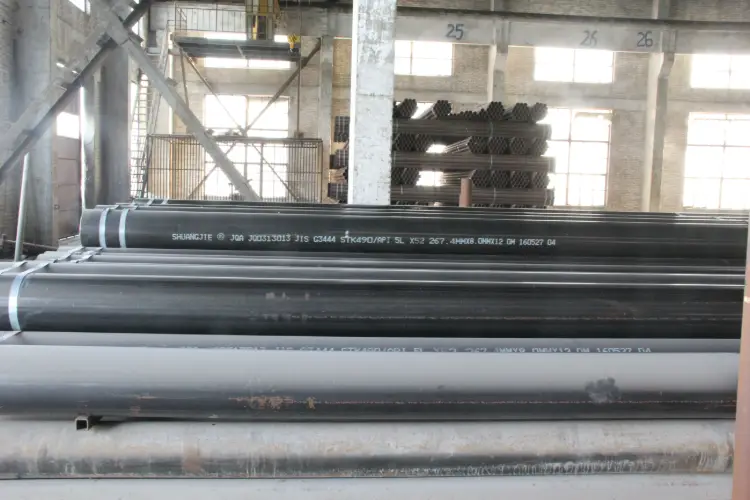
API 5L PSL1 X52 LSAW Pipe
API 5L PSL1 X52 LSAW Pipe: Complete Material Data & Equivalent Grades
Detailed technical data for API 5L PSL1 X52 LSAW pipe with chemical composition, mechanical and physical properties, international equivalents, and typical applications in oil & gas transmission.
Plate/coil forming, LSAW welding, optional normalizing or thermomechanical rolling; pipes can be supplied as-rolled, normalized, or normalizing-rolled
- Phone : +8618037372205
- Email : [email protected]
- WhatsApp: Contact via Whtsapp
- WeChat: +8618037372205
API 5L PSL1 X52 LSAW Pipe Introduction
API 5L X52 PSL1 LSAW pipe is a high-strength pipeline steel grade specified by the American Petroleum Institute (API). It is commonly produced by the Longitudinal Submerged Arc Welding (LSAW) process, offering a balanced combination of moderate strength, good weldability, and cost-effectiveness for oil and gas transportation systems.
- Grade designation "X52" indicates a minimum yield strength of 52,000 psi (360 MPa).
- PSL1 (Product Specification Level 1) covers standard quality line pipe without mandatory impact testing or restrictive chemical limits, making it suitable for general pipeline applications.
- LSAW pipes are formed from steel plates and welded along the longitudinal seam using submerged arc welding, resulting in large-diameter, thick-wall pipes for high-pressure conveyance.
Typical uses include onshore and offshore transmission pipelines, gathering lines, water mains, and structural piling where reliable performance at a competitive cost is required.
API 5L PSL1 X52 LSAW Pipe Chemical Composition
The chemical composition limits for API 5L X52 PSL1 as specified by API 5L standard (heat analysis). For PSL1, only maximum values for C, Mn, P, and S are mandatory. Other elements such as Si, Al, V, Nb, and Ti may be present as residual or microalloying additions but are not subject to specification limits.
| Element | Standard Value (wt%) | Remarks |
|---|---|---|
| C | ≤0.28 | Maximum per API 5L PSL1 |
| Mn | ≤1.40 | Maximum |
| P | ≤0.030 | Maximum |
| S | ≤0.030 | Maximum |
API 5L PSL1 X52 LSAW Pipe Thermal & Electrical Physical Properties
Typical physical properties for carbon‑manganese steel similar to API 5L X52. These values are not specified by the API 5L standard but are provided for common engineering calculations. Actual properties may vary slightly depending on exact composition and manufacturing route.
| Property | Typical Value | Unit | Test Condition |
|---|---|---|---|
| Density (ρ) | 7850 | kg/m³ | At room temperature |
| Elastic Modulus (E) | 205 | GPa | Typical, ambient temperature |
| Shear Modulus (G) | 80 | GPa | Typical |
| Poisson's Ratio (ν) | 0.29 | – | Typical |
| Thermal Expansion Coefficient (α) | 12.0 ×10⁻⁶ | 1/K | 20–100 °C range |
| Thermal Conductivity (λ) | 50 | W/(m·K) | At 25 °C |
| Specific Heat Capacity | 460 | J/(kg·K) | Typical |
| Electrical Resistivity (ρ_e) | 0.20 | µΩ·m | At 20 °C |
API 5L PSL1 X52 LSAW Pipe Mechanical Properties
Mechanical properties of API 5L X52 PSL1 LSAW pipe (base metal) as required by API 5L. Tensile testing can be performed on the pipe in longitudinal or transverse direction. The values are mandatory for PSL1 qualification.
| Property | Standard Requirement | Unit | Test Condition |
|---|---|---|---|
| Yield Strength (ReH) | ≥360 (min) | MPa | Transverse or longitudinal, at room temperature (52.2 ksi) |
| Tensile Strength (Rm) | 460–760 (min – max) | MPa | As per API 5L PSL1 (66.7–110.2 ksi) |
| Elongation (A) | ≥22 | % | Longitudinal specimen, gauge length 50 mm (2 in), round bar per API 5L Table 7 |
| Elongation (A) | ≥21 | % | Transverse specimen, gauge length 50 mm (2 in), flat bar per API 5L Table 7 |
API 5L PSL1 X52 LSAW Pipe Fully Equivalent Standards & Replaceable Grades
| Country/Region | Standard | Grade | Remarks |
|---|---|---|---|
| International | ISO 3183 | L360 | Same yield strength level for line pipe |
| Europe | EN 10208-2 | L360MB / L360NB | Welded line pipe, equivalent mechanical requirements |
| China | GB/T 9711 | L360 | Chinese line pipe standard equivalent to API 5L X52 |
| Canada | CSA Z245.1 | Gr. 359 Cat II | Canadian pipeline standard equivalent |
| Norway | DNV-OS-F101 | 360 | Offshore pipeline standard, comparable strength |
API 5L PSL1 X52 LSAW Pipe Application Introduction
API 5L X52 PSL1 LSAW pipe is widely used in the oil & gas industry for long‑distance pipelines due to its good balance of strength, toughness, and cost. It is also adopted in water infrastructure and structural engineering. Typical end‑use products and components include:
Product Applications: Onshore and offshore transmission pipelines, Gathering and flowlines, Water mains and distribution pipes, Casing and conductor pipes in wells, Structural piling and foundation tubes
Processed into products: LSAW line pipe segments (standard lengths 12 m or longer), Induction bends and elbows fabricated from LSAW mother pipe, Flanges and weld‑on fittings (when compatible with pipe grade), Offshore platform risers, Strainers and spools in pipeline assemblies
Application industries: Oil & Gas (upstream, midstream), Water Treatment & Supply, Structural and Civil Engineering, Marine and Offshore
API 5L PSL1 X52 LSAW Pipe Similar / Substitute Material Recommendations
| Country/Region | Standard | Grade | Remarks |
|---|---|---|---|
| International | API 5L / ISO 3183 | X50 (L340) | Slightly lower yield strength (340 MPa); may be substituted where design loads allow |
| International | API 5L / ISO 3183 | X56 (L390) | Slightly higher yield strength (390 MPa); offers increased load capacity |
| Europe | EN 10208-2 | L340 / L390 | Similar substitution range for welded line pipe applications |
Notes:
Additional Remarks:
- PSL1 pipes are generally not intended for sour service (H₂S environments) or low‑temperature toughness applications. For sour service, refer to PSL2 with Annex H requirements.
- Impact testing is not mandatory for PSL1; supplementary fracture toughness requirements must be specified if needed.
- The data presented are based on the current API 5L standard and are provided for reference. Always consult the latest edition and the relevant purchase specification for final requirements.
- Share



