
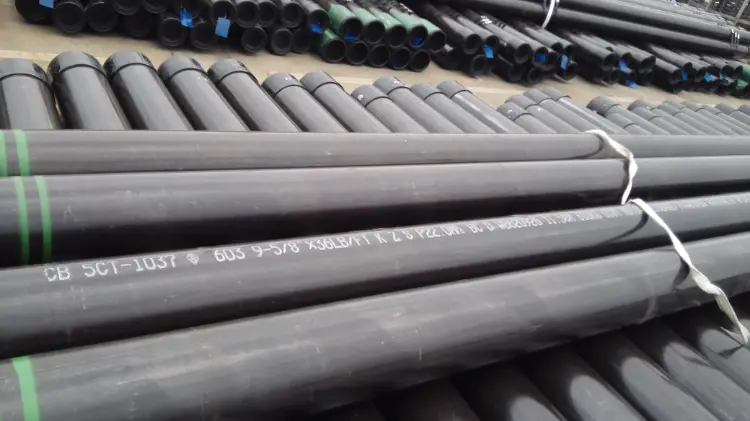
API 5L X46 PSL1 LSAW Pipe
API 5L X46 PSL1 LSAW Pipe: Specification, Chemical Composition, and Mechanical Properties
Complete material data for API 5L X46 PSL1 longitudinal submerged arc welded (LSAW) pipe according to API Specification 5L, including chemical requirements, mechanical properties, physical constants, and international equivalents.
Longitudinal submerged arc welding (LSAW); base material is steel plate processed by controlled rolling or normalizing rolling; pipe can be cold expanded after welding.
- Phone : +8618037372205
- Email : [email protected]
- WhatsApp: Contact via Whtsapp
- WeChat: +8618037372205
API 5L X46 PSL1 LSAW Pipe Introduction
API 5L X46 PSL1 is a high-strength carbon-manganese steel grade for longitudinal submerged arc welded (LSAW) line pipes, specified under Product Specification Level 1 (PSL1) of API 5L. It is primarily used in oil, gas, and water transmission pipelines. The grade X46 corresponds to a minimum yield strength of 46,000 psi (317 MPa) and offers a good combination of strength, ductility, and weldability. LSAW pipes are manufactured by forming heavy plates into a cylinder and welding the longitudinal seam under a submerged arc process, providing large diameters and thick walls suitable for high-pressure transmission. The PSL1 specification covers basic quality requirements without mandatory toughness testing, making it a cost-effective choice for non-sour, moderate environments. Key features include:
- Controlled carbon and manganese content for field weldability
- Guaranteed minimum tensile properties
- Simple chemistry with no mandatory microalloying element limits (manufacturer's option)
- Available in a wide range of diameters and wall thicknesses
API 5L X46 PSL1 LSAW Pipe Chemical Composition
The chemical composition is in accordance with API 5L Table 1 for PSL 1 grade X46 (L320). The values represent maximum limits on heat analysis. Microalloying elements such as niobium, vanadium, or titanium may be added at the manufacturer's discretion, but their contents are not specified by the standard for PSL 1 products.
- Carbon equivalent (CE) is not mandatory for PSL 1, but typically controlled to ensure good field weldability.
- Deoxidation practice (fully killed, fine grain) is common.
| Element | Standard Value (max % unless specified) | Remarks |
|---|---|---|
| Carbon (C) | 0.28 | Maximum for all thicknesses |
| Manganese (Mn) | 1.40 | Maximum; typically in range 1.00–1.35 for balanced properties |
| Phosphorus (P) | 0.030 | Maximum |
| Sulfur (S) | 0.030 | Maximum |
| Niobium (Nb) | Not specified | May be added by manufacturer |
| Vanadium (V) | Not specified | May be added by manufacturer |
| Titanium (Ti) | Not specified | May be added by manufacturer |
| Other alloys | Not specified | Trace elements as per melting practice |
API 5L X46 PSL1 LSAW Pipe Thermal and Electrical Physical Properties
These properties represent approximate values for carbon-manganese steel similar to API 5L X46. They are not directly specified in API 5L and may vary slightly with actual chemical composition and manufacturing process.
- Values at room temperature unless otherwise noted.
- Typical for low-alloy steel pipe grade.
| Property | Typical Value | Unit | Test Condition / Remarks |
|---|---|---|---|
| Density (ρ) | 7.85 | g/cm³ | Room temperature |
| Modulus of Elasticity (E) | 205 | GPa | Tensile modulus, ambient temperature |
| Shear Modulus (G) | 80 | GPa | Calculated from E and v |
| Poisson's Ratio (ν) | 0.29 – 0.30 | – | Typical for steel |
| Thermal Expansion Coefficient (α) | 11.7 (20–100 °C); 12.5 (20–200 °C); 13.5 (20–400 °C) | 10⁻⁶/K | Linear expansion coefficient range |
| Thermal Conductivity (λ) | 50 (at 20 °C); 45 (at 200 °C); 38 (at 400 °C) | W/(m·K) | Decreases with temperature increase |
| Specific Heat Capacity (cp) | 480 | J/(kg·K) | Approximate at 20 °C |
| Electrical Resistivity (ρe) | 0.18 | μΩ·m | At ambient temperature |
API 5L X46 PSL1 LSAW Pipe Mechanical Properties
The following data are based on API 5L PSL1 requirements for grade X46. Tensile test specimens are taken from the pipe body in transverse orientation (unless otherwise agreed).
- Yield strength (ReH) and tensile strength (Rm) are minimum values; no upper yield limit is specified for PSL1.
- Elongation (A) is calculated using the API 5L formula: Af = C × Axc0.2 / U0.9, where C = 1940 (SI), Axc is the cross-sectional area of the tensile test piece (mm²), and U is the specified minimum tensile strength (MPa). Typical elongation values for common thicknesses are listed.
- Bend test is required; no cracks or openings exceeding specified limits are allowed.
- Charpy impact (KV) is not required for PSL1; thus, no values are specified.
| Property | Standard Requirement / Typical Value | Unit | Test Condition / Remarks |
|---|---|---|---|
| Yield Strength (ReH or Rt0.5) | ≥ 320 (46 ksi) | MPa | Transverse strip test; 0.5% total extension under load |
| Tensile Strength (Rm) | ≥ 435 (63 ksi) | MPa | Transverse strip test |
| Yield to Tensile Ratio (ReH/Rm) | Not specified (typically 0.80–0.90) | – | For information only |
| Elongation (A) | Af (formula based) – typical ≥ 22 | % | Gauge length 50 mm (2 in); example for wall thickness 12.7 mm (A=22%) |
| Bend Test (bend angle 180°) | No cracks or ruptures | – | Mandrel diameter as per API 5L Table 22; varies with diameter/thickness |
| Charpy Impact (KV) | Not required | J | PSL1 does not mandate impact testing |
| Hardness | Not specified | HV10 | Not required by PSL1 |
API 5L X46 PSL1 LSAW Pipe International Equivalent Grades and Standards
| Country/Region | Standard | Grade | Remarks |
|---|---|---|---|
| Global (ISO) | ISO 3183:2012 | L320 (PSL1) | Identical technical delivery conditions; X46 equivalent |
| Europe (CEN) | EN 10208-2:2009 | L320MB (approx.) | PSL1 requirements similar; L320MB is for sour service but mechanical properties match X46 |
| China | GB/T 9711-2017 | L320 | PSL1 grade with same chemistry and tensile requirements |
| Russia / CIS | GOST 20295-85 | K48 (approximate) | Similar strength level; need to verify dimension compatibility |
API 5L X46 PSL1 LSAW Pipe Application Introduction
API 5L X46 PSL1 LSAW pipe is extensively used in onshore and shallow offshore pipeline systems for transporting crude oil, natural gas, petroleum products, and water. Its combination of moderate strength and good weldability makes it a popular choice for flowlines, gathering lines, and main transmission lines operating at intermediate pressures. The PSL1 grade is typically selected for non-sour, ambient-temperature services where fracture toughness is not a critical concern.
Product Applications: Cross-country oil and gas pipelines, Subsea flowlines (sweet service), Feeder lines and gathering systems, Pipe-in-pipe systems, Offshore risers (moderate depths), Power plant cooling water lines, Piling pipes for civil engineering
Processed into products: Line pipe sections (12–24+meter lengths), Induction bends (hot-formed from mother pipe), Flanged spools and pup pieces, Welded tees and elbows (if fabricated from plate), Reducer transitions, Anchor flanges, Weld-on connectors
Application industries: Oil & Gas upstream and midstream, Petrochemical and refinery, Water transmission and distribution, Structural and piling (secondary application), Mining slurry transportation
API 5L X46 PSL1 LSAW Pipe Similar or Alternative Grades
| Country/Region | Standard | Grade | Remarks |
|---|---|---|---|
| Global | API 5L (PSL1) | X42 / L290 | Lower strength grade; yield ≥ 42 ksi (290 MPa); suitable for less demanding pressure requirements |
| Global | API 5L (PSL1) | X52 / L360 | Higher strength grade; yield ≥ 52 ksi (360 MPa); provides additional safety factor |
| USA / ASTM | ASTM A53 | Grade B | Seamless / welded pipe; yield ≥ 35 ksi (240 MPa) lower; not a direct substitute but used in lower-pressure applications |
| Europe | EN 10217-3 | P275NL1 | Similar carbon-manganese steel for pressure purposes; differs in requirements |
Notes:
Notes:
- All chemical and mechanical data must be confirmed with the Material Test Certificate (MTC) according to EN 10204 type 3.1 or 3.2 as per order requirements.
- For sour service applications (H₂S containing environments), PSL2 grades with supplementary testing (HIC, SSC) and different chemistry limits are required; X46 PSL1 is generally not suitable.
- LSAW pipes are often externally coated (FBE, 3LPE, 3LPP) and internally lined for corrosion protection; this data sheet refers to bare steel properties.
- Pipe dimensions (OD, wall thickness) shall comply with API 5L dimensional tables; the grade chemistry and mechanical properties are thickness-independent within the range of the standard.
- For welding procedures, refer to qualified WPS; typical preheat may not be necessary for moderate wall thicknesses due to low carbon content.
- Share



