
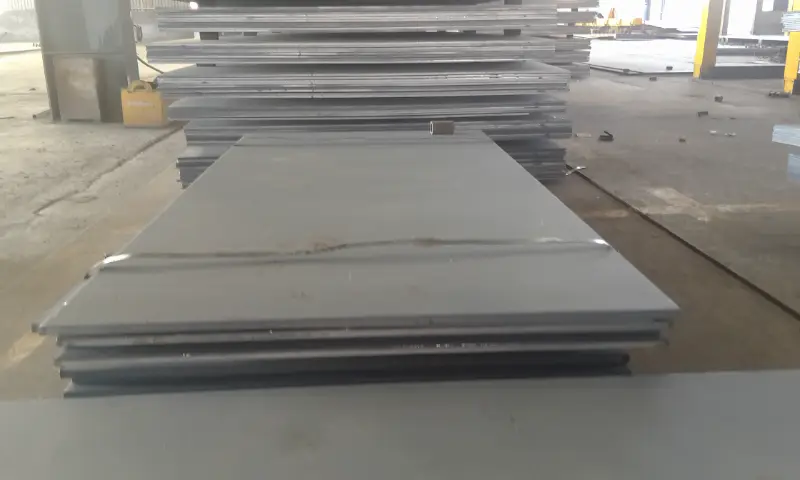
DIN 17102 TStE460 High-Strength Fine-Grain Structural Steel
DIN 17102 TStE460 High-Strength Fine-Grain Structural Steel for Superior Weldability
Comprehensive data sheet for DIN 17102 TStE460 normalized fine-grain structural steel covering chemical composition, mechanical properties, physical data, international equivalents and typical applications.
Welding, cutting, cold forming, machining, bending
- Phone : +8618037372205
- Email : [email protected]
- WhatsApp: Contact via Whtsapp
- WeChat: +8618037372205
DIN 17102 TStE460 High-Strength Fine-Grain Structural Steel Introduction
TStE460 is a weldable fine-grain structural steel delivered in the normalized condition in accordance with DIN 17102. It belongs to the group of low-carbon, low-alloy high-strength steels with a minimum yield strength of 460 MPa for thicknesses up to 16 mm. The steel combines high strength with excellent toughness and good weldability, making it suitable for stressed constructions in mechanical engineering, bridges, offshore structures and crane building. The fine-grain structure is achieved by microalloying elements such as niobium, vanadium and titanium, and the normalizing treatment ensures uniform mechanical properties across the cross-section. Typical delivery forms include hot-rolled coils, cut-to-length plates and wide flats.
DIN 17102 TStE460 High-Strength Fine-Grain Structural Steel Chemical Composition
Chemical composition according to DIN 17102 for TStE460. All values are ladle analysis. The steel is microalloyed with elements such as niobium, vanadium and titanium to ensure fine-grain strengthening. Elements like aluminium are added for deoxidation and grain refinement.
- Phosphorus and sulfur are limited to ensure toughness and weldability.
- Nitrogen is controlled to avoid embrittlement.
| Chemical Element | Standard Value | Remarks |
|---|---|---|
| C | ≤ 0.20 | |
| Si | ≤ 0.50 | |
| Mn | 1.00 – 1.70 | |
| P | ≤ 0.035 | |
| S | ≤ 0.030 | |
| Nb | ≤ 0.05 | |
| V | ≤ 0.20 | |
| Al (total) | ≥ 0.020 | Acid-soluble aluminium |
| Ti | ≤ 0.20 | |
| N | ≤ 0.020 | |
| Cu | ≤ 0.20 | If specified |
| Cr | ≤ 0.30 | If specified |
| Ni | ≤ 0.50 | If specified |
| Mo | ≤ 0.10 | If specified |
DIN 17102 TStE460 High-Strength Fine-Grain Structural Steel Thermal and Electrical Physical Properties
Typical physical properties for TStE460 at room temperature unless otherwise stated. These values are not specified by DIN 17102 but are derived from general structural steel data.
- Slight variations may occur depending on exact composition and microstructure.
- Thermal properties are important for processing (e.g., preheating before welding) and design.
| Property | Standard Value | Unit | Test Condition |
|---|---|---|---|
| Density (ρ) | 7.85 | g/cm³ | 20°C |
| Elastic modulus (E) | 210 | GPa | Room temperature |
| Shear modulus (G) | 81 | GPa | Room temperature |
| Poisson's ratio (ν) | 0.3 | Room temperature | |
| Thermal expansion coefficient (α) | 12.0 | 10⁻⁶/K | 20–100°C |
| Thermal expansion coefficient (α) | 12.5 | 10⁻⁶/K | 20–200°C |
| Thermal expansion coefficient (α) | 13.0 | 10⁻⁶/K | 20–300°C |
| Thermal conductivity (λ) | 45 | W/(m·K) | 20°C |
| Specific heat capacity | 460 | J/(kg·K) | 20°C |
| Electrical resistivity (ρe) | 0.25 | μΩ·m | 20°C |
DIN 17102 TStE460 High-Strength Fine-Grain Structural Steel Mechanical Properties
Tensile and impact properties for TStE460 in normalized condition as per DIN 17102. Values depend on product thickness. The yield strength is guaranteed at room temperature; impact energy is verified at -20°C for longitudinal specimens.
- Elongation measured on a gauge length of L0=5.65√S0.
- Bend test with mandrel diameter depending on thickness.
| Property | Standard Requirement | Unit | Test Condition |
|---|---|---|---|
| Yield strength (ReH) | ≥ 460 | MPa | Thickness ≤ 16 mm |
| Yield strength (ReH) | ≥ 450 | MPa | Thickness 16 < t ≤ 35 mm |
| Yield strength (ReH) | ≥ 440 | MPa | Thickness 35 < t ≤ 50 mm |
| Yield strength (ReH) | ≥ 420 | MPa | Thickness 50 < t ≤ 70 mm |
| Tensile strength (Rm) | 550 – 710 | MPa | Thickness ≤ 70 mm |
| Elongation (A) | ≥ 17 | % | Longitudinal, L0=5.65√S0 |
| Bend test (mandrel diameter) | 3t (t≤16 mm) / 4t (t>16 mm) | 180° bend, t = specimen thickness | |
| Impact energy (KV2) | ≥ 27 | J | Longitudinal, -20°C |
DIN 17102 TStE460 High-Strength Fine-Grain Structural Steel Exactly Equivalent Material Standards and Substitutable Designations
| Country/Region | Standard | Designation | Remarks |
|---|---|---|---|
| European Union | EN 10025-3 | S460N | Normalized fine-grain steel; TStE460 is the predecessor |
| Germany | DIN 17102 | TStE460 | Original standard, now superseded by EN 10025-3 |
| International | ISO 630-3 | E460C | ISO equivalent for normalized high-strength steel |
DIN 17102 TStE460 High-Strength Fine-Grain Structural Steel Application Introduction
TStE460 steel is engineered for heavy-duty welded structures where high strength and good toughness are essential. The normalized delivery condition ensures consistent mechanical properties and facilitates cold forming and machining.
- Typical industries include heavy machinery, civil engineering, offshore, and transportation.
- Components benefit from the combination of strength and toughness, reducing weight while maintaining safety.
Product Applications: Crane booms and chassis, Loader arms and excavator buckets, Steel bridge girders, Offshore platform structural members, Pressure vessel shells, High-strength welded pipes, Heavy vehicle frames and trailers
Processed into products: Welded beams and columns, Lifting and handling equipment parts, Bogie frames for rail vehicles, Boom sections for mobile cranes, Jack-up rig legs, Support structures for wind turbines, Cutting edges and wear plates
Application industries: Construction and civil engineering, Heavy machinery manufacturing, Offshore and marine engineering, Transportation (bridges, vehicles), Energy (wind turbine towers, pressure vessels)
DIN 17102 TStE460 High-Strength Fine-Grain Structural Steel Similarly Performant Substitute Materials
| Country/Region | Standard | Designation | Remarks |
|---|---|---|---|
| European Union | EN 10025-4 | S460M/ML | Thermomechanical rolled, similar strength, better weldability |
| European Union | EN 10025-6 | S460Q/QL | Quenched and tempered, higher strength capabilities |
| United States | ASTM A572/A572M | Grade 65 | Similar yield strength but less stringent toughness requirements |
| Japan | JIS G3106 | SM570 | Weldable structural steel with comparable tensile properties |
| China | GB/T 1591 | Q460C/D | High-strength low-alloy structural steel, similar strength class |
Notes:
Weldability: TStE460 has a carbon equivalent (CEV) typically around 0.42–0.45, requiring preheating for thicker sections to avoid hydrogen-induced cracking. Formability: Cold forming radii should follow the recommendations of the steel supplier; for hot forming, normalizing after forming is recommended. Superseding Standards: The grade is technically superseded by EN 10025-3 S460N, but TStE460 remains recognized in many older project specifications.
- Share



