
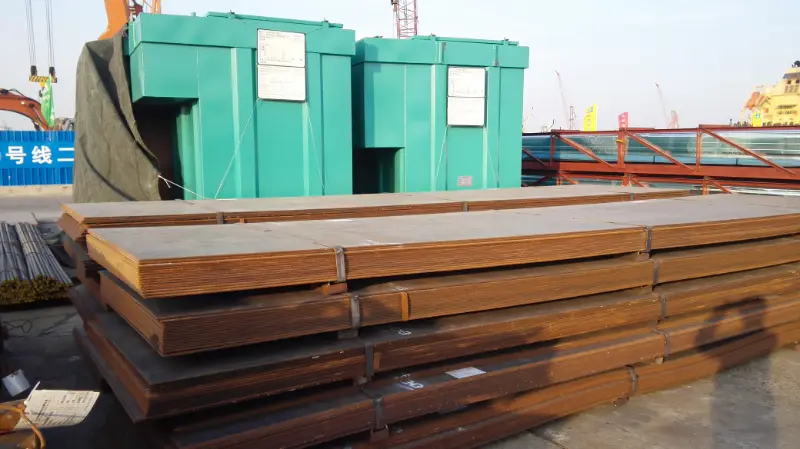
DIN 17102 EStE460
DIN 17102 EStE460: High-Strength Weldable Structural Steel for Heavy Engineering
In-depth profile of EStE460 steel under DIN 17102: composition, mechanical properties, thermal performance, international equivalents, and typical applications in welded structures.
Welding, cold forming, hot forming, bending, cutting, machining
- Phone : +8618037372205
- Email : [email protected]
- WhatsApp: Contact via Whtsapp
- WeChat: +8618037372205
DIN 17102 EStE460 Introduction
EStE460 is a normalized fine-grain structural steel specified in German standard DIN 17102. It is designed for welded, highly stressed structures requiring excellent notch toughness and good cold formability. With a minimum yield strength of 460 MPa, it offers an optimal balance of strength and weldability, making it suitable for bridges, cranes, offshore structures, and heavy machinery components. The steel is typically supplied in hot-rolled coils or plates and is characterized by a low carbon equivalent to ensure reliable welding performance without preheating in many cases.
DIN 17102 EStE460 Chemical Composition
The chemical composition of EStE460 conforms to DIN 17102. It is a low-carbon, fine-grain steel with controlled microalloying elements to achieve high strength and toughness. Typical ladle analysis limits are given; product analysis may differ slightly.
- Low carbon equivalent (CEV) ensures good weldability.
- Aluminum, niobium, vanadium or titanium may be added singly or in combination for grain refinement and precipitation strengthening.
| Element | Typical/Max Value (%) | Remarks |
|---|---|---|
| Carbon (C) | ≤0.20 | Ladle analysis; product analysis ≤0.22 |
| Silicon (Si) | ≤0.50 | Ladle analysis; product analysis ≤0.55 |
| Manganese (Mn) | 1.00 – 1.70 | Ladle analysis; product analysis 0.90 – 1.80 |
| Phosphorus (P) | ≤0.035 | Ladle analysis |
| Sulfur (S) | ≤0.030 | Ladle analysis |
| Aluminum (Al, total) | ≥0.020 | Fine-grain practice; acid-soluble Al ≥0.015 |
| Niobium (Nb) | ≤0.05 | Optional microalloy |
| Vanadium (V) | ≤0.10 | Optional microalloy |
| Titanium (Ti) | ≤0.03 | Optional microalloy |
| Nitrogen (N) | ≤0.020 | Ladle analysis |
| Copper (Cu) | ≤0.20 | Residual element if not deliberately added |
| Nickel (Ni) | ≤0.30 | Residual element |
| Chromium (Cr) | ≤0.30 | Residual element |
| Molybdenum (Mo) | ≤0.08 | Residual element |
DIN 17102 EStE460 Thermal and Electrical Physical Properties
The following physical properties are typical for low-alloy structural steels and are provided for design calculations. They do not replace mandatory standards but are representative of EStE460 material behavior.
- Values are at room temperature unless noted.
- Thermal conductivity varies with temperature; the given value is for ~100 °C.
| Property | Typical Value | Unit | Test Condition / Remarks |
|---|---|---|---|
| Density (ρ) | 7.85 | g/cm³ | At 20 °C |
| Elastic modulus (E) | 210 | GPa | At 20 °C |
| Shear modulus (G) | 80 | GPa | At 20 °C |
| Poisson's ratio (ν) | 0.3 | — | Within elastic range |
| Thermal expansion coefficient (α) | 11.5 × 10⁻⁶ | K⁻¹ | 20 – 100 °C |
| Thermal conductivity (λ) | 52 | W/(m·K) | At ~100 °C |
| Specific heat capacity (cₚ) | 460 | J/(kg·K) | At 20 – 100 °C |
| Electrical resistivity (ρₑ) | 0.15 × 10⁻⁶ | Ω·m | At 20 °C |
DIN 17102 EStE460 Mechanical Properties
Mechanical properties are determined from transverse test pieces taken from the product. The steel exhibits a pronounced yield plateau and excellent toughness at low temperatures. Values depend on product thickness. Testing is performed at room temperature unless otherwise stated.
- Yield strength guarantees structural integrity under load.
- Impact energy KV₂ is measured on Charpy-V specimens at -20 °C for the standard EStE460 grade.
| Property | Specified/Required Value | Unit | Test condition / Remarks |
|---|---|---|---|
| Yield strength (ReH) | ≥460 | MPa | Thickness ≤ 16 mm |
| Yield strength (ReH) | ≥430 | MPa | 16 < t ≤ 35 mm |
| Yield strength (ReH) | ≥400 | MPa | 35 < t ≤ 50 mm |
| Yield strength (ReH) | ≥380 | MPa | 50 < t ≤ 80 mm |
| Yield strength (ReH) | ≥360 | MPa | 80 < t ≤ 100 mm |
| Tensile strength (Rm) | 530 – 720 | MPa | Thickness ≤ 16 mm |
| Tensile strength (Rm) | 510 – 690 | MPa | 16 < t ≤ 35 mm |
| Tensile strength (Rm) | 490 – 670 | MPa | 35 < t ≤ 50 mm |
| Tensile strength (Rm) | 470 – 650 | MPa | 50 < t ≤ 80 mm |
| Tensile strength (Rm) | 450 – 630 | MPa | 80 < t ≤ 100 mm |
| Elongation (A, L₀=5.65√S₀) | ≥17 | % | Transverse, thickness ≤ 16 mm |
| Elongation (A) | ≥16 | % | 16 < t ≤ 35 mm |
| Elongation (A) | ≥15 | % | 35 < t ≤ 50 mm |
| Elongation (A) | ≥14 | % | 50 < t ≤ 80 mm |
| Elongation (A) | ≥14 | % | 80 < t ≤ 100 mm |
| Impact energy (KV₂, -20 °C) | ≥31 | J | Longitudinal; average of 3 tests, minimum single value 22 J |
| Bend test (mandrel diameter) | No cracks | — | d = 3a for t ≤ 16 mm; d = 4a for t > 16 mm (a = specimen thickness) |
DIN 17102 EStE460 Fully Equivalent Material Standards and Substitutable Grades
| Country/Region | Standard | Grade | Remarks |
|---|---|---|---|
| European Union | EN 10025-3 | S460N | Normalized fine-grain steel, equivalent to EStE460; mechanical properties match. |
| International | ISO 4950/1 | E460DD | High yield strength flat products, normalized condition; identical strength class. |
| Germany | DIN 17102 | EStE460 | Original standard; now superseded but still used for replacement. |
| China | GB/T 1591 | Q460C / Q460D / Q460E | Depending on low-temperature toughness requirements; Q460E matches -40 °C KV₂. |
| Japan | JIS G 3106 | SM570 | Welded structural steel with yield ≥460 MPa, but tensile range slightly different; considered equivalent in many applications. |
| USA | ASTM A572 | Grade 65 | High-strength low-alloy structural steel; yield ≥450 MPa typically; essentially equivalent. |
DIN 17102 EStE460 Application Introduction
EStE460 is engineered for heavy-duty welded constructions where high static and dynamic loads demand both strength and toughness. Its fine-grained microstructure and low impurity content guarantee reliable behavior at sub-zero temperatures.
- Typical processing includes thermal cutting, welding with matching consumables, and cold forming within the bend limits.
- It is not recommended for applications above 400 °C without re-assessment of mechanical properties.
Product Applications: Welded plate girders for highway and railway bridges, Crane booms, jibs, and chassis frames, Jack-up rig legs and offshore platform modules, High-pressure pipe fittings and flanges, Excavator arms and dump truck bodies, Wind turbine tubular towers
Processed into products: Flange and web plates of welded beams, Transition pieces in offshore wind monopiles, Boom segments for crawler cranes, Structural nodes and column base plates, Hydraulic press frames, Welded casings for heavy-duty gearboxes
Application industries: Bridge engineering, Heavy crane and lifting equipment manufacturing, Offshore and marine structural engineering, Pressure vessel and storage tank fabrication, Mining and earthmoving machinery, Wind tower and renewable energy structures, Shipbuilding (selected sections)
DIN 17102 EStE460 Near/Similar Substitute Materials Recommendations
| Country/Region | Standard | Grade | Remarks |
|---|---|---|---|
| European Union | EN 10025-4 | S460M / S460ML | Thermomechanical rolled, same strength class but different rolling process; can substitute with processing adjustments. |
| European Union | EN 10025-6 | S460Q / S460QL | Quenched and tempered, higher toughness; suitable for heavier sections where EStE460 thickness limits are exceeded. |
| European Union | EN 10225 | S460G2+M | For offshore structures, similar strength and toughness. |
| Russia | GOST 19281 | 17G1S-U | Comparable low-alloy structural steel, normalized. |
| India | IS 2062 | E450 (Fe 590) | High strength structural steel; yield ≥450 MPa, close but lower than 460 MPa, may be acceptable depending on design. |
Notes:
DIN 17102 has been withdrawn; for new designs it is recommended to use EN 10025-3 S460N. When replacing existing EStE460 parts with EN grades, verify thickness-dependent properties and available supply conditions. Delivery conditions may include normalized (N) or normalizing rolled (+N). Impact test temperature for EStE460 is -20 °C; if lower service temperatures are required, consider EStE460V (verification at -50 °C) or quenched and tempered grades.
- Share



