
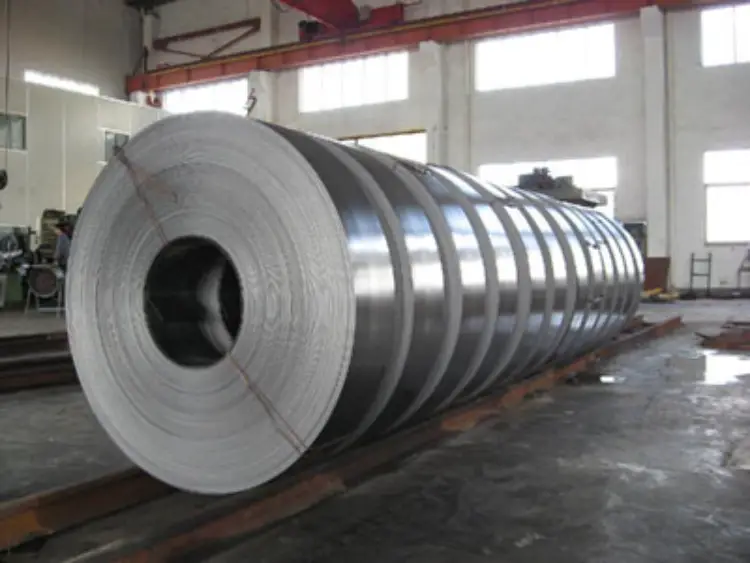
DIN 17102 StE500 Carbon Structural Steel Coil
DIN 17102 StE500 Carbon and Low-alloy High-strength Steel Coil Data
Comprehensive technical specifications for DIN 17102 StE500 fine-grain structural steel: chemical composition, mechanical properties, physical data, and global equivalent grades.
Welding, Hot forming, Cold forming, Bending, Machining, Flame cutting
- Phone : +8618037372205
- Email : [email protected]
- WhatsApp: Contact via Whtsapp
- WeChat: +8618037372205
DIN 17102 StE500 Carbon Structural Steel Coil Introduction
DIN 17102 StE500 is a German-standard normalized fine-grain high-strength structural steel, widely supplied in coil and plate form for heavy-duty welded constructions. It belongs to the category of weldable fine grain structural steels with a minimum yield strength of 500 MPa for thicknesses up to 16 mm.
- Guaranteed mechanical properties through normalized or normalizing rolled delivery condition
- Excellent weldability due to a strictly controlled low carbon equivalent, minimizing the risk of cold cracking
- Fine grain microstructure achieved by the addition of aluminum and micro-alloying elements (Nb, V, Ti), ensuring high toughness and integrity
- Designed for critical applications where high load-bearing capacity, fatigue resistance, and structural safety are paramount
This grade has been officially superseded by the EN 10025-3 standard under the designation S500N, but remains a globally recognized benchmark for high-strength structural engineering.
DIN 17102 StE500 Carbon Structural Steel Coil Chemical Composition
The chemical composition of StE500 is precisely balanced to achieve high yield strength while maintaining excellent weldability and toughness. The low carbon content ensures good low-temperature impact properties and prevents brittle fracture. Fine grain formation is guaranteed by the mandatory addition of aluminum and optional micro-alloying elements such as niobium, vanadium, and titanium. The maximum carbon equivalent value is restricted to provide superior field welding performance, often eliminating the need for complex preheating procedures in thinner sections.
| Chemical Element | Standard Value (wt%) | Remarks |
|---|---|---|
| Carbon (C) | ≤ 0.22 | Critical for weldability control |
| Silicon (Si) | ≤ 0.55 | Deoxidizer and strength enhancer |
| Manganese (Mn) | 1.20 - 1.70 | Primary solid solution strengthener |
| Phosphorus (P) | ≤ 0.035 | Residual element, restricted for toughness |
| Sulfur (S) | ≤ 0.030 | Residual element, restricted for ductility |
| Aluminum (Al total) | ≥ 0.020 | Mandatory for fine grain practice |
| Niobium (Nb) | ≤ 0.05 | Optional; grain refinement and precipitation hardening |
| Vanadium (V) | ≤ 0.15 | Optional; enhances strength at elevated temperatures |
| Titanium (Ti) | ≤ 0.05 | Optional; additional grain boundary pinning |
| Nitrogen (N) | ≤ 0.020 | Controlled for aging resistance |
| Copper (Cu) | ≤ 0.20 | Residual element; limited for surface quality |
| Chromium (Cr) | ≤ 0.30 | Residual element; minor contribution to hardenability |
| Nickel (Ni) | ≤ 0.80 | Residual element; beneficial for toughness |
| Molybdenum (Mo) | ≤ 0.10 | Residual element |
DIN 17102 StE500 Carbon Structural Steel Coil Thermal and Electrical Physical Properties
The physical property constants listed are essential for design calculations involving heat transfer, thermal stress analysis, and structural stiffness. These standard values apply to fine-grain structural steels and remain stable across the normal service temperature range for StE500.
- The thermal expansion coefficient closely matches that of standard construction steel, ensuring reliable hybrid connection designs.
- Thermal conductivity is sufficient for uniform heat distribution during welding preheating.
| Property | Standard Requirement Value | Unit | Test Condition |
|---|---|---|---|
| Density (ρ) | 7.85 | g/cm³ | At 20 °C |
| Modulus of Elasticity (E) | 205 - 210 | GPa | At 20 °C |
| Shear Modulus (G) | ~ 80 | GPa | At 20 °C |
| Poisson's Ratio (ν) | 0.30 | — | Elastic range |
| Thermal Expansion Coeff. (α) | 12.0 × 10⁻⁶ | K⁻¹ | 20 °C to 100 °C |
| Thermal Expansion Coeff. (α) | 13.0 × 10⁻⁶ | K⁻¹ | 20 °C to 200 °C |
| Thermal Expansion Coeff. (α) | 13.5 × 10⁻⁶ | K⁻¹ | 20 °C to 300 °C |
| Thermal Conductivity (λ) | 40 - 50 | W/(m·K) | At 20 °C |
| Specific Heat Capacity (c) | ~ 460 | J/(kg·K) | At 20 °C |
| Electrical Resistivity (ρ_e) | ~ 0.25 | Ω·mm²/m | At 20 °C |
DIN 17102 StE500 Carbon Structural Steel Coil Mechanical Properties
The mechanical properties outlined below are guaranteed for the normalized (+N) or normalizing rolled (+N) delivery condition. These values are critically dependent on the product thickness and the sampling orientation (longitudinal or transverse). The high yield strength of StE500 allows for significant weight reduction in structural designs, while the strict tensile strength range ensures consistent plastic deformation behavior.
- Impact toughness is verified using standard Charpy-V notch specimens at specified test temperatures (+20 °C for the base grade).
- Bending test requirements confirm the material's ability to undergo cold forming without cracking.
| Property | Standard Requirement | Unit | Test Condition / Thickness |
|---|---|---|---|
| Yield Strength (ReH) | ≥ 500 | MPa | t ≤ 16 mm, Transverse |
| Yield Strength (ReH) | ≥ 480 | MPa | 16 mm < t ≤ 35 mm, Transverse |
| Yield Strength (ReH) | ≥ 450 | MPa | 35 mm < t ≤ 50 mm, Transverse |
| Yield Strength (ReH) | ≥ 430 | MPa | 50 mm < t ≤ 70 mm, Transverse |
| Tensile Strength (Rm) | 600 - 750 | MPa | t ≤ 16 mm |
| Tensile Strength (Rm) | 570 - 720 | MPa | 16 mm < t ≤ 35 mm |
| Tensile Strength (Rm) | 550 - 700 | MPa | 35 mm < t ≤ 50 mm |
| Tensile Strength (Rm) | 530 - 680 | MPa | 50 mm < t ≤ 70 mm |
| Elongation after Fracture (A) | ≥ 16 (Long.) / ≥ 14 (Trans.) | % | t ≤ 16 mm, L0=5.65√S0 |
| Elongation after Fracture (A) | ≥ 17 (Long.) / ≥ 15 (Trans.) | % | 16 mm < t ≤ 35 mm, L0=5.65√S0 |
| Elongation after Fracture (A) | ≥ 18 (Long.) / ≥ 16 (Trans.) | % | 35 mm < t ≤ 50 mm, L0=5.65√S0 |
| Elongation after Fracture (A) | ≥ 19 (Long.) / ≥ 17 (Trans.) | % | 50 mm < t ≤ 70 mm, L0=5.65√S0 |
| Impact Energy (KV2) | ≥ 27 | J | Longitudinal, +20 °C, Charpy-V |
| Impact Energy (KV2) | ≥ 27 | J | Transverse, +20 °C, Charpy-V |
| Bend Test | D = 3t, No cracking | ° | 180° bend mandrel, t = thickness |
DIN 17102 StE500 Carbon Structural Steel Coil Completely Equivalent Material Standards and Replaceable Grade Recommendations
| Country / Region | Standard | Grade Designation | Remarks |
|---|---|---|---|
| European Union | EN 10025-3 | S500N | Official superseding standard for DIN 17102 StE500; normalized delivery condition. |
| International (ISO) | ISO 630-3 | S500N | Technically identical composition and mechanical requirements to EN 10025-3. |
| China (PRC) | GB/T 1591-2018 | Q500D | Closest Chinese equivalent for high-strength structural purposes; verify micro-alloying for weldability. |
| United Kingdom | BS EN 10025-3 | S500N | British adoption of the harmonized European standard; fully interchangeable. |
| Italy | UNI EN 10025-3 | S500N | Italian adoption of the EU standard. |
| Japan | JIS G 3106 | SM570 | Comparable strength grade for welded structures; widely used as an Asian pacific equivalent. |
DIN 17102 StE500 Carbon Structural Steel Coil Application Introduction
DIN 17102 StE500 is specifically designed for heavily loaded welded structures where a high pay-load to dead-weight ratio is mandatory. Its excellent combination of high strength, reliable toughness, and good formability makes it a preferred material in civil engineering, renewable energy, and mobile crane manufacturing.
- It is extensively used in dynamic and fatigue-loaded structures.
- This material is highly suitable for CNC thermal cutting and automated welding processes due to its consistent flatness and surface quality.
Product Applications: Wind turbine tubular tower sections and internal platforms, All-terrain and crawler crane telescopic booms and lattice sections, Steel box and truss girders for highway, railway, and pedestrian bridges, Decks, modules, and jacket legs for offshore oil and gas platforms, Vertical storage silos and field-erected welded tanks, Hydroelectric penstocks and pressure shafts
Processed into products: Welded built-up I-beams and H-pillars, Load-bearing flange plates and heavy stiffening ribs, Structural hollow sections (SHS/RHS) and welded tubular chords, Cut and bolted connection brackets and base plates, Support frames for heavy turbines and generators, Revolving platforms and slewing rings for port cranes
Application industries: Wind Power Generation Infrastructure, Heavy Machinery and Crane Manufacturing, Bridge and Highway Engineering, Offshore and Marine Structural Engineering, Pressure Vessel and Bulk Storage Tank Fabrication, Mining and Earth-moving Equipment
DIN 17102 StE500 Carbon Structural Steel Coil Similar / Alternative Material Recommendations
| Country / Region | Standard | Grade Designation | Remarks |
|---|---|---|---|
| Germany | DIN 17102 | StE460 | Lower strength grade (min 460 MPa yield), offering inherently higher ductility and easier formability. |
| European Union | EN 10025-6 | S550Q / S500Q | Quenched and tempered (Q&T) alternative providing higher toughness and through-thickness properties. |
| USA | ASTM A572 / A572M | Grade 65 | HSLA steel with V-Nb micro-alloying, commonly used in as-rolled condition, slightly lower Mn limits. |
| China | GB/T 16270 | Q500D | Quenched and tempered high-strength steel suitable for heavy machinery and severe cold environments. |
| Japan | JIS G 3128 | SHY685 | Higher yield strength option (685 MPa) for weight-critical structures, requiring careful preheating. |
Notes:
DIN 17102 has been formally withdrawn and replaced by the EN 10025 series, but the StE500 designation is still widely used in procurement specifications.
- For welded fabrication, low-hydrogen welding consumables and a strict heat input range are recommended to maintain the heat-affected zone (HAZ) toughness.
- Post-weld heat treatment (PWHT) is generally not required for this grade due to its fine grain stabilized microstructure.
- Ultrasonic testing (UT) to EN 10160 Class S1/E1 is commonly specified for critical loading plates.
- Share



