
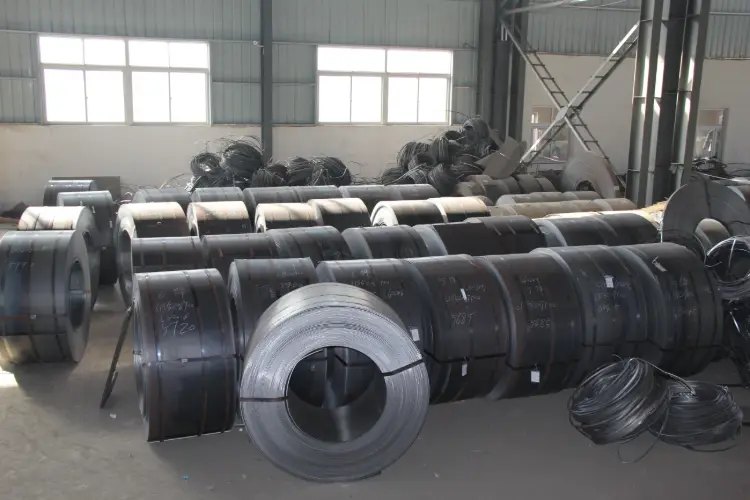
DIN 17102 TStE255 Hot Rolled Steel Coil
DIN 17102 TStE255 Hot Rolled Steel Coil - Weldable Fine-Grain Structural Steel with 255 MPa Yield
Comprehensive material data for TStE255 steel according to DIN 17102, including chemical composition, mechanical properties, physical properties, equivalent grades, and application guide.
Cutting, bending, welding, machining, forming
- Phone : +8618037372205
- Email : [email protected]
- WhatsApp: Contact via Whtsapp
- WeChat: +8618037372205
DIN 17102 TStE255 Hot Rolled Steel Coil Introduction
TStE255 is a weldable fine-grain structural steel defined in the now withdrawn German standard DIN 17102:1978. It is supplied in the normalized or normalized rolled condition. The steel is characterized by a minimum yield strength of 255 MPa for thicknesses up to 16 mm and guaranteed impact toughness at -20°C. Thanks to its fine-grain microstructure obtained through controlled rolling or normalizing, TStE255 offers good weldability, uniform mechanical properties, and resistance to brittle fracture. It is widely used in welded steel structures such as bridges, cranes, storage tanks, and vehicle components. In modern standards, TStE255 has been superseded by grades like EN 10025-3 S275N.
DIN 17102 TStE255 Hot Rolled Steel Coil Chemical Composition
The chemical composition limits for TStE255 according to DIN 17102:1978. The steel is fine-grain treated with sufficient aluminum content and optionally microalloyed with niobium, vanadium, or titanium to ensure grain refinement. Maximum contents of residual elements are controlled to guarantee good weldability.
| Chemical Element | Standard Value (wt%) | Remarks |
|---|---|---|
| Carbon (C) | ≤0.16 | Ladle analysis |
| Silicon (Si) | ≤0.40 | |
| Manganese (Mn) | 0.50 – 1.20 | |
| Phosphorus (P) | ≤0.030 | |
| Sulfur (S) | ≤0.025 | |
| Aluminium total (Al) | ≥0.020 | For fine-grain treatment |
| Niobium (Nb) | ≤0.05 | Optional microalloy |
| Vanadium (V) | ≤0.10 | Optional microalloy |
| Titanium (Ti) | ≤0.03 | Optional microalloy |
| Chromium (Cr) | ≤0.30 | Residual element |
| Nickel (Ni) | ≤0.30 | Residual element |
| Copper (Cu) | ≤0.20 | Residual element |
| Molybdenum (Mo) | ≤0.08 | Residual element |
| Nitrogen (N) | ≤0.020 |
DIN 17102 TStE255 Hot Rolled Steel Coil Thermal and Electrical Physical Properties
Typical physical properties for TStE255 at room temperature (unless otherwise noted). These values are not part of the original DIN 17102 standard but represent commonly accepted data for normalized fine-grain carbon-manganese steel.
| Property | Standard Value | Unit | Test Condition / Remarks |
|---|---|---|---|
| Density (ρ) | 7.85 | g/cm³ | Ambient temperature, typical |
| Elastic Modulus (E) | 210 | GPa | Approximate, for design |
| Shear Modulus (G) | ~80 | GPa | Calculated from E and ν |
| Poisson's Ratio (ν) | 0.3 | — | Typical for steel |
| Thermal Expansion Coefficient (α) | 12.0 × 10⁻⁶ | K⁻¹ | Range 20°C – 100°C |
| Thermal Conductivity (λ) | ~50 | W/(m·K) | At 20°C, typical |
| Specific Heat Capacity | ~460 | J/(kg·K) | Room temperature |
| Electrical Resistivity (ρ_e) | 0.15 – 0.25 | µΩ·m | Typical for carbon steel |
DIN 17102 TStE255 Hot Rolled Steel Coil Mechanical Properties
Mechanical properties of TStE255 in the normalized or normalized rolled condition, as specified in DIN 17102. Yield and tensile strength are given for different thickness ranges. The steel exhibits guaranteed minimum Charpy-V impact energy at -20°C in the longitudinal direction. Bend test requirements ensure sufficient cold formability.
| Property | Standard Requirement | Unit | Test Condition / Remarks |
|---|---|---|---|
| Yield Strength (ReH) | ≥255 ≥245 ≥235 ≥225 ≥215 | MPa | Thickness ≤16 mm Thickness >16 to ≤40 mm Thickness >40 to ≤63 mm Thickness >63 to ≤80 mm Thickness >80 to ≤100 mm |
| Tensile Strength (Rm) | 360 – 480 360 – 480 360 – 480 | MPa | Thickness ≤40 mm Thickness >40 to ≤63 mm Thickness >63 to ≤100 mm |
| Elongation after Fracture (A) | ≥24 ≥23 ≥22 | % | Thickness ≤40 mm, gauge length L₀ = 5.65√S₀ Thickness >40 to ≤63 mm Thickness >63 to ≤100 mm |
| Bend Test (180°) | Mandrel diameter d = 2a Mandrel diameter d = 3a | — | Thickness ≤16 mm, a = specimen thickness Thickness >16 to ≤100 mm |
| Charpy-V Impact Energy (KV) | ≥27 | J | Longitudinal, -20°C, average of 3 tests |
DIN 17102 TStE255 Hot Rolled Steel Coil Fully Equivalent Material Standards and Grade Substitutes
| Country/Region | Standard | Grade | Remarks |
|---|---|---|---|
| Europe | EN 10025-3:2004 | S275N (1.0490) | Direct replacement; normalized fine-grain steel, same yield class |
| International | ISO 4950-2:1995 | E275 D | High yield strength flat steel products, quenched and tempered condition not applicable for direct replacement; normalized equivalent closer to EN S275N |
| Germany | DIN 17102 (historical) | TStE255 | Original grade |
DIN 17102 TStE255 Hot Rolled Steel Coil Application Introduction
TStE255 steel is designed for welded structures operating at ambient and low temperatures where resistance to brittle fracture is important. Typical applications include:
- Bridges and civil engineering structures
- Cranes, heavy machinery, and lifting equipment
- Storage tanks and silos
- Vehicle frames, railway wagons
- Offshore structural components
- Pressure vessels (not intended for elevated temperature)
Product Applications: Hot rolled steel coils, plates, strips, Welded H-beams, I-beams, channels, Welded pipes and hollow sections, Prefabricated structural modules
Processed into products: Bridge girders, box girders, Crane booms, jibs, chassis, Storage tank shells and bottoms, Railcar underframes and bogies, Heavy-duty brackets and mounting plates, Wind turbine tower flanges and door frames (when normalized)
Application industries: Civil engineering and construction, Heavy machinery and equipment manufacturing, Shipbuilding and offshore, Transportation (rail, automotive), Energy (tanks, wind tower components)
DIN 17102 TStE255 Hot Rolled Steel Coil Similar/Closely Matching Alternative Materials
| Country/Region | Standard | Grade | Remarks |
|---|---|---|---|
| Europe | EN 10025-2:2019 | S275J2 (+N) | Not fine-grain treated, but comparable strength and good impact toughness; not direct replacement for welded structures requiring grain refinement |
| Europe | EN 10025-3:2004 | S355N (1.0545) | Higher strength fine-grain steel; may be used in some designs with recalculation |
| USA | ASTM A633 / A633M | Grade C (Type C) | Normalized high-strength low-alloy structural steel; yield strength 345 MPa (higher), similar toughness until -45°C; may be used as higher strength alternative |
| Japan | JIS G 3106 | SM490A (normalized) | Weldable structural steel with comparable mechanical properties; often used in similar applications |
Notes:
Special requirements: This grade may be ordered with additional testing such as ultrasonic inspection, Z-quality for through-thickness properties, or restricted chemistries. The old DIN 17102 is obsolete; for new designs, the equivalent EN 10025-3 S275N should be specified. Always refer to the latest material standard and consult the steel manufacturer for actual properties. Typical welding procedures must take into account the carbon equivalent (CEV ≤ 0.40 typically for these grades).
- Share



