
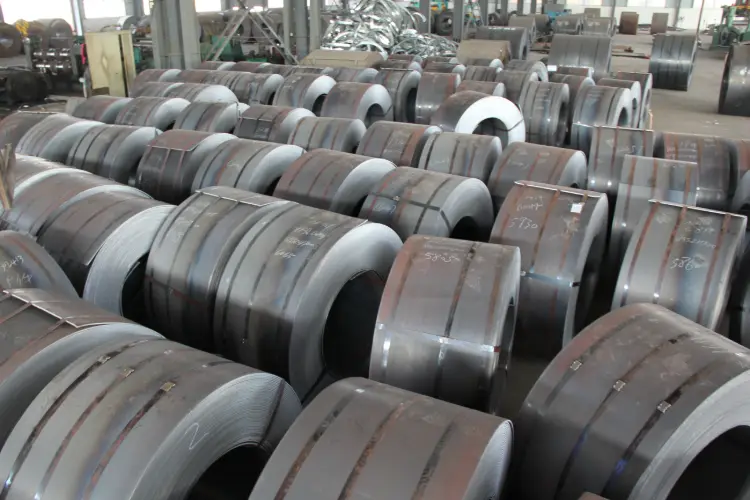
DIN 17102 WStE255 Hot Rolled Steel Coil
DIN 17102 WStE255 Hot Rolled Steel Coil - Weldable Fine-Grain Structural Steel
Comprehensive data for WStE255 steel according to DIN 17102: chemical composition, mechanical properties, physical properties, international equivalents, and application guide.
Hot rolling, normalizing, welding, cold forming (limited), cutting, machining
- Phone : +8618037372205
- Email : [email protected]
- WhatsApp: Contact via Whtsapp
- WeChat: +8618037372205
DIN 17102 WStE255 Hot Rolled Steel Coil Introduction
DIN 17102 WStE255 is a hot-rolled, weldable fine-grain structural steel supplied in the normalized condition. It is designed for welded constructions where high toughness and good weldability are required. The steel features minimum yield strength of 255 MPa, excellent notch toughness down to -20°C, and good formability. Typical applications include:
- Bridges and civil engineering structures
- Pressure vessels and storage tanks
- Heavy machinery and crane construction
- Offshore platforms and shipbuilding
DIN 17102 WStE255 Hot Rolled Steel Coil Chemical Composition , % by Mass
The chemical composition of WStE255 according to DIN 17102 ensures fine-grain structure and good weldability. Elements such as Al, Nb, V, and Ti are controlled for grain refinement. Maximum limits guarantee low carbon equivalent to avoid cold cracking.
- Values represent maximum unless otherwise indicated.
- For product analysis, slight deviations may apply.
| Element | Specified Value (max or range) | Remarks |
|---|---|---|
| C | ≤ 0.20 | |
| Si | ≤ 0.55 | |
| Mn | 0.50 – 1.50 | |
| P | ≤ 0.035 | |
| S | ≤ 0.030 | |
| Al (total) | ≥ 0.020 | Grain-refining element |
| Nb | ≤ 0.05 | Micro-alloying element |
| V | ≤ 0.10 | Micro-alloying element |
| Ti | ≤ 0.03 | Micro-alloying element |
| Cr | ≤ 0.30 | |
| Ni | ≤ 0.30 | |
| Mo | ≤ 0.08 | |
| Cu | ≤ 0.35 | |
| N | ≤ 0.020 |
DIN 17102 WStE255 Hot Rolled Steel Coil Thermal and Electrical Physical Properties
Physical properties are representative for normalized fine-grain carbon-manganese steels. Actual values may vary with temperature and specific composition.
- Density is measured at room temperature.
- Thermal expansion coefficient refers to the range 20–100°C.
| Property | Typical Value | Unit | Test Condition / Temperature |
|---|---|---|---|
| Density (ρ) | 7.85 | g/cm³ | at 20°C |
| Elastic Modulus (E) | 210 | GPa | at 20°C |
| Shear Modulus (G) | ~80 | GPa | at 20°C |
| Poisson's Ratio (ν) | 0.3 | – | at 20°C |
| Thermal Expansion Coefficient (α) | 11.1 × 10⁻⁶ | /K | 20 – 100°C |
| Thermal Conductivity (λ) | 53 | W/(m·K) | at 20°C |
| Specific Heat Capacity | 460 | J/(kg·K) | at 20°C |
| Electrical Resistivity (ρ_e) | 0.13 – 0.17 | μΩ·m | at 20°C |
DIN 17102 WStE255 Hot Rolled Steel Coil Mechanical Properties
Mechanical properties are verified on normalized test pieces. Values depend on product thickness. Below are requirements for thickness ≤ 16 mm according to DIN 17102.
- Impact test temperature: -20°C with minimum 27 J (longitudinal Charpy-V).
- Bend test: c = 0.5a (bend diameter = 0.5 × specimen thickness).
| Property | Specified Value | Unit | Test Condition |
|---|---|---|---|
| Yield Strength (ReH) | ≥ 255 | MPa | thickness ≤ 16 mm |
| Tensile Strength (Rm) | 360 – 470 | MPa | thickness ≤ 16 mm |
| Elongation (A) | ≥ 24 | % | gauge length 5.65√S₀, longitudinal |
| Bend Test | c = 0.5a | – | bend angle 180°, specimen thickness a |
| Impact Energy (KV) at -20°C | ≥ 27 | J | longitudinal Charpy-V notch |
DIN 17102 WStE255 Hot Rolled Steel Coil Direct Equivalent Standards and Substitute Grades
No exact international alternative exists for WStE255. The table lists the closest standardized grades with similar strength and application.
| Country/Region | Standard | Grade | Remarks |
|---|---|---|---|
| Europe | EN 10025-3 | S275N | Higher min. yield (275 MPa); similar application |
| Europe | EN 10149-2 | S260NC | Cold-forming fine-grain steel, close strength |
| Germany (superseded) | DIN 17102 | WStE255 | Original standard, still ordered as per agreement |
DIN 17102 WStE255 Hot Rolled Steel Coil Application Introduction
WStE255 is designed for welded, dynamically loaded structures. Thanks to fine-grain practice, it combines strength, toughness, and excellent weldability even in thick sections. Typical usage areas are listed below.
Product Applications: Welded I-beams and box girders, Storage tanks and silos, Booms and chassis of mobile cranes, Wind turbine towers (base sections), Shipbuilding structural members, Hydraulic cylinder bodies (when formed from plate)
Processed into products: Flanges and webs of girders, Pressure vessel shells and heads, Base frames and bogie frames, Brackets and stiffeners, Truss nodes and gusset plates, Flame-cut parts subject to dynamic loads
Application industries: Bridge construction, Pressure vessel and boiler manufacturing, Offshore and marine engineering, Heavy machinery (excavators, cranes), Steel structures for power plants, Mining and earthmoving equipment
DIN 17102 WStE255 Hot Rolled Steel Coil Similar Materials for Comparison
These steels offer comparable mechanical properties or can be used in similar welded structural applications after engineering evaluation.
| Country/Region | Standard | Grade | Remarks |
|---|---|---|---|
| China | GB/T 1591 | Q275B/C (or Q275NH) | Strength comparable; check toughness requirements |
| Japan | JIS G3106 | SM400A | Lower yield (245 MPa); good weldability |
| USA | ASTM A572 | Grade 42 [290] (or Grade 50) | Slightly higher strength; chemical differences |
| Russia | GOST 19281 | 09G2S | Mn-Si steel, impact properties at -40°C |
Notes:
Additional notes:
- Carbon equivalent (CEV) typically ≤ 0.40 to ensure weldability without preheat under normal conditions.
- Normalizing treatment: heated to 890–940°C and air-cooled.
- For thicknesses > 16 mm, yield strength decreases – consult relevant standard tables.
- When joining dissimilar thicknesses, care must be taken to maintain toughness in the heat-affected zone (HAZ).
- Share



