
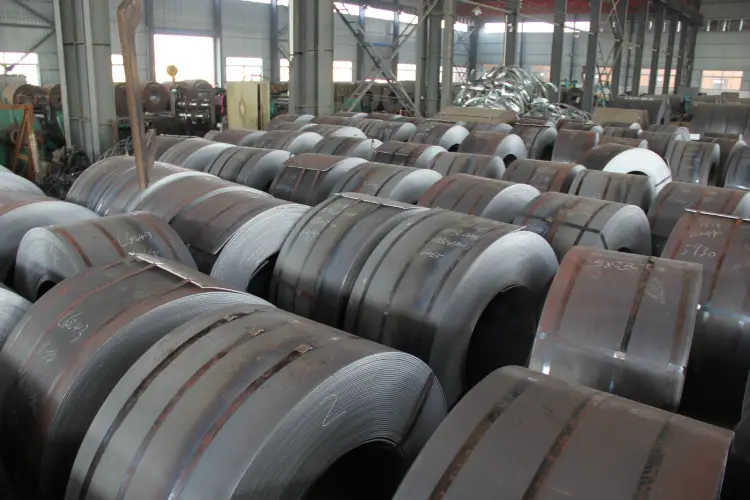
DIN 17102 EStE255 Hot Rolled Steel Coil
DIN 17102 EStE255 Hot Rolled Steel Coil: Technical Data, Properties & Equivalents
Comprehensive technical analysis of DIN 17102 EStE255 hot rolled steel coil, including chemical composition, mechanical and thermal properties, international equivalents, and application guide.
Hot Rolling, Normalizing, Thermomechanical Rolling, Cold Forming, Welding, Machining
- Phone : +8618037372205
- Email : [email protected]
- WhatsApp: Contact via Whtsapp
- WeChat: +8618037372205
DIN 17102 EStE255 Hot Rolled Steel Coil Introduction
The material designated as EStE255 under the German standard DIN 17102 is a hot-rolled, weldable fine-grain structural steel. As a special engineering grade, it is microalloyed to achieve a minimum yield strength of 255 MPa. The primary characteristic of this steel is its combination of high strength, excellent weldability, and guaranteed low-temperature toughness, making it suitable for dynamically stressed welded constructions. The 'E' prefix likely indicates a specific guaranteed minimum impact energy value. Typical applications include heavy-duty steel structures where weight saving and structural integrity are critical, such as bridges, cranes, and offshore components. It is delivered in a thermomechanically rolled or normalized condition to ensure consistent mechanical properties.
DIN 17102 EStE255 Hot Rolled Steel Coil Chemical Composition
The chemical composition for EStE255 is designed for superior weldability and toughness. The steel is fully killed with aluminum and microalloyed with elements such as niobium, vanadium, and titanium to refine grain size. The carbon equivalent (CEV) is controlled to ensure good weldability and is typically less than 0.40. Strict limits on phosphorus and sulfur enhance resistance to brittle fracture and improve lamellar tearing resistance.
| Element | Standard Value (max %) | Remarks |
|---|---|---|
| Carbon (C) | 0.18 | Increases strength; controlled for weldability |
| Silicon (Si) | 0.10 - 0.50 | Deoxidizer; contributes to strength |
| Manganese (Mn) | 0.50 - 1.30 | Enhances strength and toughness; improves hardenability |
| Phosphorus (P) | 0.030 | Impurity; strictly limited for toughness |
| Sulfur (S) | 0.025 | Impurity; minimized for formability and ductility |
| Aluminum (Al) total | ≥ 0.020 | For grain refinement; ensures fine-grain practice |
| Niobium (Nb) | 0.05 | Microalloying element for grain refinement and precipitation strengthening |
| Vanadium (V) | 0.10 | Microalloying element for precipitation strengthening |
| Titanium (Ti) | 0.03 | Microalloying element; forms stable nitrides for grain growth control |
| Nitrogen (N) | 0.020 | Bound by Al, Nb, or Ti to prevent strain aging |
DIN 17102 EStE255 Hot Rolled Steel Coil Thermal and Electrical Physical Properties
Physical properties are typical for low-carbon structural steels. These values are temperature-dependent and are crucial for designing structures exposed to thermal loads or for calculating heat input during welding. The properties are provided for reference at standard conditions only. Variations may occur depending on the final heat treatment and processing condition.
| Property | Standard Requirement Value | Unit | Test Condition |
|---|---|---|---|
| Density (ρ) | 7.85 | kg/dm³ | At ambient temperature (approx. 20°C) |
| Modulus of Elasticity (E) | 210 | GPa | At ambient temperature |
| Shear Modulus (G) | 81 | GPa | At ambient temperature |
| Poisson's Ratio (ν) | 0.3 | - | At ambient temperature |
| Thermal Expansion Coefficient (α) | 12.0 x 10⁻⁶ | K-1 | Between 20 °C and 100 °C |
| Thermal Conductivity (λ) | 54 | W/(m·K) | At ambient temperature |
| Specific Heat Capacity (cp) | 460 | J/(kg·K) | At ambient temperature |
| Electrical Resistivity (ρe) | 0.15 - 0.25 | Ω·mm²/m | At ambient temperature |
DIN 17102 EStE255 Hot Rolled Steel Coil Mechanical Properties
The mechanical properties are guaranteed for a delivery condition of either normalized or thermomechanically rolled. The minimum yield strength is 255 MPa for thicknesses up to 16 mm, decreasing for greater thicknesses. The impact energy values, signified by the 'E' prefix, are tested on longitudinal Charpy V-notch specimens. Typical test temperatures for grade EStE255 may be specified as -20°C, -30°C, or lower, depending on the specific quality code (e.g., N or NL).
| Property | Standard Requirement Value | Unit | Test Condition |
|---|---|---|---|
| Yield Strength (ReH) | min. 255 | MPa | Nominal thickness (t) ≤ 16 mm |
| Yield Strength (ReH) | min. 245 | MPa | 16 mm < t ≤ 40 mm |
| Yield Strength (ReH) | min. 235 | MPa | 40 mm < t ≤ 63 mm |
| Tensile Strength (Rm) | 360 - 480 | MPa | Nominal thickness (t) ≤ 100 mm |
| Elongation (A) | min. 24 | % | Longitudinal, t ≤ 16 mm, L0 = 5.65√S0 |
| Elongation (A) | min. 23 | % | Longitudinal, 16 mm < t ≤ 40 mm |
| Impact Energy (KV) | min. 40 | J | Longitudinal, temperature +20°C |
| Impact Energy (KV) | min. 27 | J | Longitudinal, temperature -20°C (Typical for 'N' grade) |
| Impact Energy (KV) | min. 27 | J | Longitudinal, temperature -30°C (Typical for 'NL' grade) |
| Bend Test (Bend Radius) | No cracks | - | Bend angle 180°, mandrel diameter = 2t (t ≤ 16 mm) |
DIN 17102 EStE255 Hot Rolled Steel Coil Fully Equivalent Material Standards and Substitutable Grades
| Country/Region | Standard | Grade | Remarks |
|---|---|---|---|
| Europe | EN 10113-2 (Withdrawn, replaced by EN 10025-3) | S275N / S275NL | Direct equivalent for normalized fine-grain steel. N for -20°C impact, NL for -50°C. |
| Europe | EN 10025-3 | S275N / S275NL | Current standard replacing EN 10113-2. Closest match in terms of strength and toughness. |
| International | ISO 4951-2 | E275C / E275D | E275C (min. 40J at 0°C) and E275D (min. 47J at -20°C) are functionally equivalent. |
| United Kingdom | BS 4360 (Withdrawn) | 43EE | Former British Standard grade with a minimum yield strength of 275 MPa and guaranteed impact properties. |
DIN 17102 EStE255 Hot Rolled Steel Coil Application Introduction
EStE255 steel, classified under DIN 17102, is engineered for highly stressed welded structures. Its fine-grain microstructure provides a critical balance between high strength and resistance to brittle fracture at low temperatures. Key advantages include:
- Good cold formability for flanging and bending.
- Excellent suitability for all arc welding processes without preheating for smaller thicknesses.
- High safety margin due to guaranteed Charpy impact test values at specified low temperatures.
Product Applications: Welded steel frameworks for industrial buildings and stadiums, Bridges, overpasses, and pedestrian bridges, Mobile crane telescopic booms and chassis, Truck frames and heavy-duty chassis components, Offshore platform substructures and modules, Wind turbine tower sections and transition pieces, Liquefied gas storage tank shells
Processed into products: Welded H-beams and I-beams, Box girder sections for bridge construction, Heavy plate girders, Structural hollow sections (SHS, RHS, CHS), Flanges, stiffeners, and base plates, Shear connectors and gusset plates, Crane runway beams
Application industries: Steel Construction and Civil Engineering, Heavy Machinery and Crane Building, Shipbuilding and Marine Engineering, Vehicle Manufacturing (railway cars, heavy trucks), Offshore and Onshore Wind Energy (towers, foundations), Pressure Vessel and Boiler Manufacturing, Mining Equipment
DIN 17102 EStE255 Hot Rolled Steel Coil Similar/Comparable Substitute Material Recommendations
| Country/Region | Standard | Grade | Remarks |
|---|---|---|---|
| Europe | EN 10025-4 | S275M / S275ML | Thermomechanically rolled version with identical strength. Offers better weldability due to lower carbon equivalent. |
| USA | ASTM A572 | Grade 42 | A columbium-vanadium HSLA steel with a 290 MPa yield strength. More readily available in North America but with different specific toughness guarantees. |
| USA | ASTM A709 | Grade 36T | Structural steel for bridges with minimum yield strength of 250 MPa and enhanced toughness requirements. |
| Japan | JIS G3106 | SM400A/B/C | While the tensile strength range is similar, SM400B (min. 27J at 0°C) is a common structural steel. The EStE255 has stricter toughness and lower temperature requirements. |
| Russia | GOST 19281 | 09G2S (09Г2С) | A silicon-manganese steel with a 245-265 MPa yield strength and good low-temperature toughness, widely used for similar applications. |
Notes:
Important Notice: The designation 'EStE255' is primarily from a withdrawn German standard. The user should verify the exact specification, as a more common and correct designation from DIN 17102 is simply StE255. The prefix 'E' may be a specific in-house specification or a misinterpretation of a stamp indicating a minimum energy value. For new designs, it is highly recommended to specify according to the current European standard EN 10025-3, using the grade S275N or S275NL. Always consult the original inspection certificate (EN 10204 3.1) for the exact chemical composition, mechanical properties, and specified impact test temperature for your specific material lot.
- Share



