
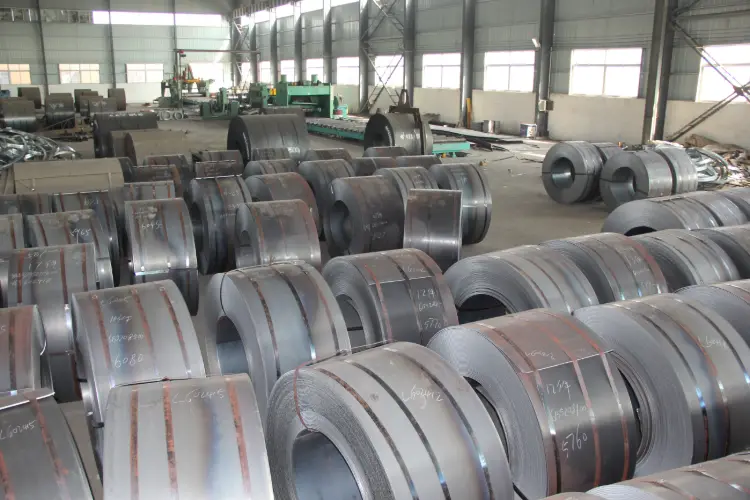
DIN 17102 StE285 Hot Rolled Steel Coil
DIN 17102 StE285 Hot Rolled Steel Coil: Weldable Fine-Grain Structural Steel
Comprehensive material data for StE285 according to DIN 17102. Includes chemical composition, mechanical properties, physical data, and international equivalents for this weldable normalized fine-grain structural steel.
Arc welding, Gas shielded metal arc welding, Manual metal arc welding, Submerged arc welding, Cold forming, Bending, Cutting, Machining
- Phone : +8618037372205
- Email : [email protected]
- WhatsApp: Contact via Whtsapp
- WeChat: +8618037372205
DIN 17102 StE285 Hot Rolled Steel Coil Introduction
StE285 is a weldable fine-grain structural steel specified under the withdrawn German standard DIN 17102. It is supplied in a normalized condition, which ensures a uniform and fine-grained microstructure. This steel grade is characterized by a minimum yield strength of 285 MPa, good weldability suitable for arc welding processes, and high resistance to brittle fracture with guaranteed impact energy down to -20°C (or other temperatures depending on the quality grade). Its typical applications include structural components in steel construction, pressure vessels, and vehicle manufacturing where high reliability and safety are required. The fine-grain structure contributes to superior toughness and strength compared to conventional structural steels like S235JR.
DIN 17102 StE285 Hot Rolled Steel Coil Chemical Composition
The chemical composition of StE285 is designed for good weldability and toughness. A low carbon equivalent (CEV) is crucial. The fine-grain structure is achieved by adding grain-refining elements such as aluminum and/or niobium. The following elemental limits are based on the provisions of the withdrawn standard DIN 17102 for ladle analysis.
| Element | Typical/Maximum Value | Remarks |
|---|---|---|
| Carbon (C) | ≤ 0.18% | Max. for ≤ 16 mm thickness |
| Silicon (Si) | ≤ 0.50% | Deoxidizer |
| Manganese (Mn) | 0.90% - 1.65% | Increases strength and toughness |
| Phosphorus (P) | ≤ 0.030% | For higher quality grade, ≤ 0.025% |
| Sulfur (S) | ≤ 0.025% | For higher quality grade, ≤ 0.015% |
| Nitrogen (N) | ≤ 0.020% | Bound by Al or Nb to form nitrides |
| Aluminum (Al) | ≥ 0.020% | Minimum total or metallic aluminum for grain refinement |
| Niobium (Nb) | ≤ 0.05% | Optional grain-refining microalloying element |
| Vanadium (V) | ≤ 0.15% | Optional microalloying element |
| Titanium (Ti) | ≤ 0.05% | Optional grain-refining element |
| Chromium (Cr) | ≤ 0.30% | Residual element |
| Nickel (Ni) | ≤ 0.30% | Residual element |
| Copper (Cu) | ≤ 0.20% | Residual element |
| Molybdenum (Mo) | ≤ 0.08% | Residual element |
DIN 17102 StE285 Hot Rolled Steel Coil Thermal and Electrical Physical Properties
The following physical properties are typical for a normalized fine-grain structural steel like StE285. These values are not mandated by the material standard but are essential for engineering calculations related to heat transfer, thermal stress analysis, and structural design. They are valid at ambient temperature unless otherwise specified.
| Property | Typical Value | Unit | Test Condition |
|---|---|---|---|
| Density (ρ) | 7.85 | g/cm³ | At 20°C (68°F) |
| Elastic Modulus (E) | 210 | GPa | At 20°C (68°F) |
| Shear Modulus (G) | 81 | GPa | At 20°C (68°F) |
| Poisson's Ratio (ν) | 0.3 | — | At 20°C (68°F) |
| Thermal Expansion Coefficient (α) | 12.0 | 10⁻⁶·K⁻¹ | Between 20°C and 100°C |
| Thermal Expansion Coefficient (α) | 12.2 | 10⁻⁶·K⁻¹ | Between 20°C and 200°C |
| Thermal Expansion Coefficient (α) | 13.1 | 10⁻⁶·K⁻¹ | Between 20°C and 400°C |
| Thermal Conductivity (λ) | 51.0 | W/(m·K) | At 20°C (68°F) |
| Thermal Conductivity (λ) | 48.0 | W/(m·K) | At 200°C (392°F) |
| Specific Heat Capacity (cp) | 460 | J/(kg·K) | At 20°C (68°F) |
| Electrical Resistivity (ρe) | 0.22 | μΩ·m | At 20°C (68°F), typical for mild steels |
DIN 17102 StE285 Hot Rolled Steel Coil Mechanical Properties
Mechanical properties of StE285 are guaranteed for the normalized delivery condition. The values are derived from the standard DIN 17102 and vary depending on the product thickness. The minimum yield strength is a key design parameter. Impact energy values are verified through Charpy-V notch impact tests at specified temperatures, typically -20°C for the basic grade and -50°C for low-temperature application variants.
| Property | Standard Requirement | Unit | Test Condition / Thickness |
|---|---|---|---|
| Yield Strength (ReH) | ≥ 285 | MPa | Nominal thickness (t) ≤ 16 mm |
| Yield Strength (ReH) | ≥ 275 | MPa | 16 mm < t ≤ 35 mm |
| Yield Strength (ReH) | ≥ 265 | MPa | 35 mm < t ≤ 50 mm |
| Yield Strength (ReH) | ≥ 255 | MPa | 50 mm < t ≤ 80 mm |
| Tensile Strength (Rm) | 410 - 560 | MPa | Nominal thickness (t) ≤ 100 mm |
| Elongation after fracture (A) | ≥ 24 | % | Longitudinal, t ≤ 40 mm, L₀=5.65√S₀ |
| Elongation after fracture (A) | ≥ 23 | % | Transverse, t ≤ 40 mm, L₀=5.65√S₀ |
| Bend Test (Mandrel Diameter) | No cracks | — | a = thickness, mandrel dia. = 2.0a, 180° |
| Impact Energy (KV, Longitudinal) | ≥ 31 (min. 24 for single value) | J | Charpy-V, Test Temp. -20°C, t ≥ 10 mm |
| Impact Energy (KV, Transverse) | ≥ 24 (min. 18 for single value) | J | Charpy-V, Test Temp. -20°C, t ≥ 10 mm |
DIN 17102 StE285 Hot Rolled Steel Coil Recommendations for Equivalent Standards and Substitutable Grades
| Country/Region | Standard | Grade | Remarks |
|---|---|---|---|
| European Union | EN 10025-3:2019 | S275N (1.0490) | Direct modern equivalent. Also specify +N for normalized condition. For low-temperature requirements, use S275NL (1.0491). |
| International | ISO 4950-2:1995 | E 275 C | ISO equivalent for high yield strength flat products. Quality class C. |
| United Kingdom | BS 4360:1990 | 43EE | Former British equivalent, now obsolete and fully replaced by EN 10025 grade S275. |
| Japan | JIS G 3136 | SN400B | Similar yield strength level for building structures, but with adjusted compositional limits. |
| USA | ASTM A572/A572M | Grade 42 [290] | A comparable HSLA steel with 290 MPa min yield, but differs in guaranteed temperature impact properties unless Grade 50 with supplementary requirements is specified. |
DIN 17102 StE285 Hot Rolled Steel Coil Application Introduction
The balanced strength-to-toughness ratio and reliable weldability of StE285, along with its fine-grained structure, make it a traditional material of choice for dynamically stressed and safety-critical welded constructions. It is designed to operate reliably at ambient and low-service temperatures. Typical guidance involves preheating for thicker sections before welding, post-weld heat treatment (PWHT) to relieve stresses if required, and ensuring forming is done within recommended cold-bending radii.
Product Applications: Welded Profiles (I-beams, H-beams, box columns), Steel Bridge Girders and Trusses, Storage Tanks and Silos for liquids and solids, Pressure Vessels for moderate pressure and temperature, Vehicle Frame and Chassis Components, Telescopic and Articulated Crane Booms, Water Turbine Spiral Cases and Liners, Structural Parts of Excavators and Loaders, Steel Foundations and Piles
Processed into products: Welded Flanges and Web Plates, Stiffeners and Gusset Plates, Tank Shell Courses and Bottom Plates, Longitudinal and Transversal Box Girder Elements, Outrigger Legs for Mobile Cranes, Heavy-Duty Dump Truck Bodies, Load-Bearing Structural Joints, Base Frames for Industrial Machinery
Application industries: Civil Engineering and Steel Construction, Bridge Building, Pressure Vessel and Tank Manufacturing, Heavy Vehicle Construction (Trucks, Trailers), Crane and Lifting Equipment Manufacturing, Offshore and Shipbuilding (secondary structures), Earth-moving and Agricultural Machinery, Penstock and Pipeline Construction for Water Power Plants
DIN 17102 StE285 Hot Rolled Steel Coil Recommendations for Proximate/Similar Alternative Materials
| Country/Region | Standard | Grade | Remarks |
|---|---|---|---|
| European Union | EN 10025-2:2019 | S275J2+N (1.0145) | Non-alloy structural steel with similar minimum yield strength (275 MPa). Not a fine-grain steel, so it has generally lower toughness and through-thickness properties than StE285. |
| China | GB/T 1591-2018 | Q355D | Higher yield strength (355 MPa min) but very widely used and readily available. For a closer match in strength, the now-obsolete Q275 or Q295 series might be compared, but Q355D is the common modern high-strength choice with guaranteed impact properties at -20°C. |
| Russia | GOST 19281-2014 | 09G2S (09Г2С) | Manganese-silicon steel with a minimum yield strength in the range of 265-345 MPa depending on thickness. A classic steel for welded structures with good toughness. |
| USA | ASTM A633/A633M | Grade C | Normalized high-strength low-alloy structural steel with a specified minimum yield strength of 345 MPa, used in similar applications requiring improved notch toughness at low temperatures. |
Notes:
Technical Note: The standard DIN 17102 has been withdrawn by the standards body DIN and replaced by the European standard EN 10025-3. For new designs, the direct grade S275N (1.0490) or S275NL (1.0491) must be used as per the current state-of-the-art. The maximum carbon equivalent value (CEV) for S275N, necessary to guarantee its characteristic weldability, is typically ≤ 0.40% for thicknesses up to 40 mm, based on the formula CEV = C + Mn/6 + (Cr+Mo+V)/5 + (Ni+Cu)/15. When substituting StE285 with EN 10025-3 grades, always verify the minimum impact energy level required for the specific application, moving from quality N (impact at -20°C) to NL (impact at -50°C) if necessary.
- Share



