
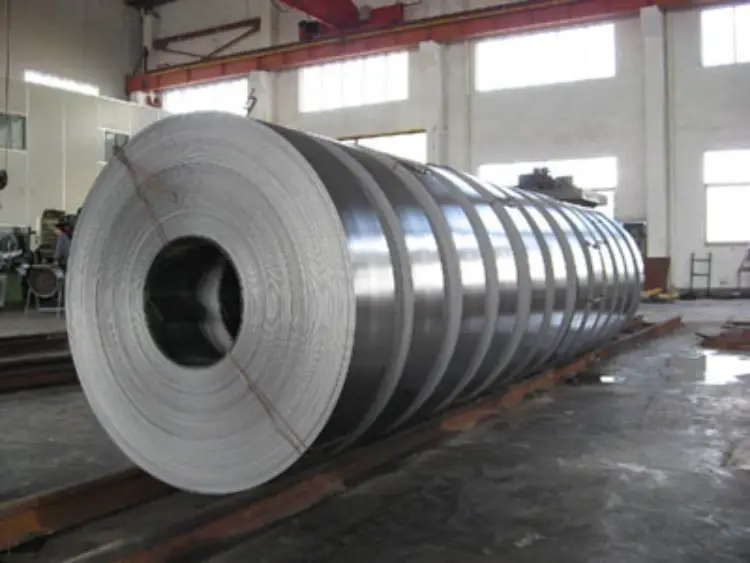
DIN 17102 StE355 Hot Rolled Steel Coil
DIN 17102 StE355 Hot Rolled Steel Coil - Fine Grain Structural Steel Properties
Comprehensive data for StE355 steel according to DIN 17102: chemical composition, mechanical properties, physical parameters, equivalent grades, and application guide.
Welding, forming, machining, cutting, bending
- Phone : +8618037372205
- Email : [email protected]
- WhatsApp: Contact via Whtsapp
- WeChat: +8618037372205
DIN 17102 StE355 Hot Rolled Steel Coil Introduction
DIN 17102 StE355 is a weldable fine-grain structural steel supplied as hot rolled coils. It features a minimum yield strength of 355 MPa, excellent weldability, and good toughness. The fine-grain structure is achieved by aluminum addition and optional microalloying elements (Nb, V, Ti). This steel is used in welded constructions, bridges, storage tanks, and structural engineering, offering consistent mechanical properties and improved resistance to brittle fracture.
DIN 17102 StE355 Hot Rolled Steel Coil Chemical Composition
The composition is designed for fine grain structure and weldability. Aluminum is mandatory for grain refinement. Microalloying elements niobium, vanadium, and titanium may be added to improve strength and toughness. Low carbon ensures good weldability.
| Element | Standard Value (%) | Remarks |
|---|---|---|
| Carbon (C) | ≤ 0.18 | Ladle analysis |
| Silicon (Si) | ≤ 0.50 | Ladle analysis |
| Manganese (Mn) | 1.00 - 1.65 | Ladle analysis |
| Phosphorus (P) | ≤ 0.035 | Ladle analysis |
| Sulfur (S) | ≤ 0.030 | Ladle analysis |
| Aluminum (Al) | ≥ 0.02 | Total aluminum; for grain refinement |
| Niobium (Nb) | ≤ 0.05 | Optional microalloy |
| Vanadium (V) | ≤ 0.10 | Optional microalloy |
| Titanium (Ti) | ≤ 0.20 | Optional microalloy |
DIN 17102 StE355 Hot Rolled Steel Coil Thermal and Electrical Physical Properties
Typical physical properties for StE355 steel at ambient temperature. These values are representative for low-carbon manganese structural steels.
| Property | Typical Value | Unit | Test Condition |
|---|---|---|---|
| Density (ρ) | 7.85 | g/cm³ | 20°C |
| Modulus of Elasticity (E) | 210 | GPa | 20°C |
| Shear Modulus (G) | 81 | GPa | 20°C |
| Poisson's Ratio (ν) | 0.3 | - | 20°C |
| Thermal Expansion Coeff. (α) | 12.0 | 10⁻⁶/K | 20–100°C |
| Thermal Conductivity (λ) | 54 | W/(m·K) | 20°C |
| Specific Heat Capacity | 460 | J/(kg·K) | 20°C |
| Electrical Resistivity (ρ_e) | 0.13 | μΩ·m | 20°C |
DIN 17102 StE355 Hot Rolled Steel Coil Mechanical Properties
Mechanical properties are guaranteed for hot rolled delivery at ambient temperature. Yield and tensile strength decrease with increasing thickness. Standard Charpy impact requirement is at +20°C. Bend test with mandrel diameter twice the thickness.
| Property | Standard Required Value | Unit | Test Condition |
|---|---|---|---|
| Yield Strength (ReH) | ≥ 355 | MPa | t ≤ 16 mm, transverse |
| Yield Strength (ReH) | ≥ 345 | MPa | 16 < t ≤ 40 mm, transverse |
| Yield Strength (ReH) | ≥ 335 | MPa | 40 < t ≤ 63 mm, transverse |
| Yield Strength (ReH) | ≥ 325 | MPa | 63 < t ≤ 80 mm, transverse |
| Yield Strength (ReH) | ≥ 315 | MPa | 80 < t ≤ 100 mm, transverse |
| Tensile Strength (Rm) | 490 - 630 | MPa | t ≤ 100 mm, transverse |
| Elongation (A) | ≥ 20 | % | t ≤ 16 mm, L₀=5.65√S₀ |
| Elongation (A) | ≥ 19 | % | 16 < t ≤ 40 mm, L₀=5.65√S₀ |
| Elongation (A) | ≥ 18 | % | 40 < t ≤ 63 mm, L₀=5.65√S₀ |
| Elongation (A) | ≥ 17 | % | 63 < t ≤ 80 mm, L₀=5.65√S₀ |
| Elongation (A) | ≥ 16 | % | 80 < t ≤ 100 mm, L₀=5.65√S₀ |
| Charpy Impact Energy (KV) | ≥ 27 | J | +20°C, V-notch, longitudinal |
| Bend Test (Mandrel Dia.) | a=2t | Bend angle 180°, t ≤ 100 mm |
DIN 17102 StE355 Hot Rolled Steel Coil Fully Equivalent Material Standards and Substitute Grades
| Country / Region | Standard | Grade | Remarks |
|---|---|---|---|
| Germany | DIN 17102 | StE355 | Original designation |
| EU | EN 10025-3 | S355N | Normalized fine grain steel; identical concept and properties |
| EU | EN 10025-4 | S355M | Thermomechanical rolled fine grain steel; equivalent strength class |
| USA | ASTM A572/A572M | Grade 50 | Similar yield strength; chemistry differs slightly, not classified as fine grain |
| Japan | JIS G 3106 | SM490B | Welded structural steel with comparable yield/tensile; impact at 0°C |
DIN 17102 StE355 Hot Rolled Steel Coil Application Introduction
StE355 is ideal for welded and bolted structures requiring high strength, toughness, and reliability. It is extensively used in civil engineering, bridge building, crane manufacturing, and pressure vessels. The fine grain structure guarantees uniform properties through thickness, making it suitable for demanding static and dynamic loads.
Product Applications: Structural steel beams and columns, Bridge girders and arches, Crane booms and chassis, Storage tanks and silos, Pressure vessel shells, Welded pipes and hollow sections, Vehicle frames
Processed into products: Welded I-beams, Box columns, Flanges and web plates, Bearing plates, Brackets and stiffeners, Tube sheets, Forged rings and flanges, Weldments for heavy machinery
Application industries: Civil Engineering, Bridge Construction, Heavy Machinery, Pressure Vessels, Storage Tanks, Shipbuilding, Structural Engineering, Agricultural Equipment
DIN 17102 StE355 Hot Rolled Steel Coil Recommendations for Similar / Comparable Substitute Materials
| Country / Region | Standard | Grade | Remarks |
|---|---|---|---|
| EU | EN 10025-2 | S355J2 | Non-alloy structural steel; yield 355 MPa; impact -20°C; not fine grained |
| EU | EN 10025-3 | S355NL | Fine grain steel with low-temperature impact at -50°C |
| EU | EN 10025-6 | S460QL | Quenched & tempered high-strength steel; higher strength, good weldability |
| USA | ASTM A572/A572M | Grade 55 | Higher yield (380 MPa) structural steel; not fine grain |
| Japan | JIS G 3106 | SM490YA | Higher yield (365 MPa) welding structural steel |
Notes:
Steel is supplied as hot rolled coil. For enhanced toughness, normalization or thermomechanical treatment may be applied. Welding should follow EN 1011-2 with appropriate preheat and heat input control. StE355 can replace S355N when fine grain practice is needed but low-temperature impact testing is not specified.
- Share



