
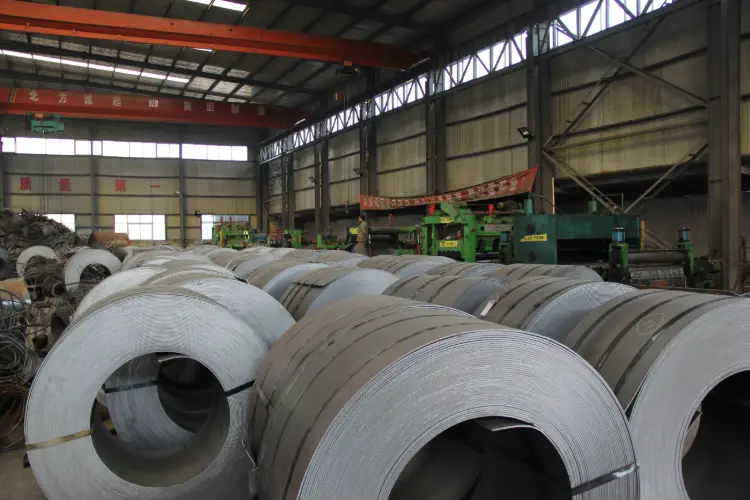
DIN 17102 EStE315 Hot Rolled Steel Coil
DIN 17102 EStE315 Hot Rolled Steel Coil - Weldable Fine Grain Pressure Vessel Steel
Comprehensive data and applications of DIN 17102 EStE315 weldable fine grain structural steel for pressure vessels, including chemical composition, mechanical properties, physical data, and equivalent grades.
Welding, bending, machining, cold forming, hot forming, cutting
- Phone : +8618037372205
- Email : [email protected]
- WhatsApp: Contact via Whtsapp
- WeChat: +8618037372205
DIN 17102 EStE315 Hot Rolled Steel Coil Introduction
EStE315 is a weldable fine grain structural steel defined in the German standard DIN 17102, intended for pressurized components and welded constructions. It features a minimum yield strength of 315 MPa at room temperature and offers excellent weldability, good toughness at low temperatures, and reliable performance under static and dynamic loads. The fine grain structure is achieved through controlled microalloying (e.g., Al, Nb, V, Ti) and normalizing or thermomechanical processing.
- Key properties: high strength-to-weight ratio, good ductility, and notch toughness down to -20 °C.
- Supplied as hot-rolled coils, plates, and strips in normalized or as-rolled condition.
- Suitable for pressure vessels, storage tanks, boilers, and structural components where elevated strength and safety are required.
DIN 17102 EStE315 Hot Rolled Steel Coil Chemical Composition of EStE315
Ladle analysis according to DIN 17102 for weldable fine grain steel grade EStE315. Values represent maximum limits unless a range is given. Microalloying elements (Nb, V, Ti) are added singly or in combination to achieve fine grain structure and required mechanical properties.
- Aluminium is the main grain refiner and also serves as a deoxidant.
- Residual elements such as Cr, Cu, Mo, Ni are typically kept below 0.30% each.
- For thicknesses > 40 mm, slightly higher Mn or lower C may apply; consult the standard for product analysis tolerances.
| Element | Standard Value (mass %) | Remarks |
|---|---|---|
| C (Carbon) | ≤ 0.20 | By ladle analysis; lower C improves weldability and toughness |
| Si (Silicon) | ≤ 0.60 | Deoxidation; higher Si may be used for thicker plates |
| Mn (Manganese) | 0.90 – 1.70 | Essential for strength and toughness; content adapted to thickness |
| P (Phosphorus) | ≤ 0.035 | Maximum limit; lower for vacuum degassed heats |
| S (Sulfur) | ≤ 0.030 | Maximum limit; improved cleanliness reduces anisotropy |
| Al (Aluminium, total) | ≥ 0.020 | Minimum; ensures fine grain structure and full deoxidation |
| N (Nitrogen) | ≤ 0.012 | Bound by Al and microalloys; free N is minimized |
| Nb (Niobium) | ≤ 0.05 | Optional microalloy for grain refinement and precipitation strengthening |
| V (Vanadium) | ≤ 0.10 | Optional microalloy; may be used in place of Nb or Ti |
| Ti (Titanium) | ≤ 0.05 | Optional microalloy; improves toughness and control sulfide shape |
| Cr (Chromium) | ≤ 0.30 | Residual element; not intentionally added |
| Cu (Copper) | ≤ 0.30 | Residual element; may influence hot shortness if high |
| Mo (Molybdenum) | ≤ 0.08 | Residual; beneficial for high-temperature strength if intentionally added |
| Ni (Nickel) | ≤ 0.30 | Residual; can improve low-temperature toughness when intentionally added |
DIN 17102 EStE315 Hot Rolled Steel Coil Physical, Thermal and Electrical Properties
The following physical properties are typical for hot-rolled fine grain carbon-manganese steels like EStE315 at room temperature and through relevant temperature ranges.
- Values are not part of the mandatory standard requirements but are representative for design calculations.
- Thermal conductivity, specific heat, and expansion vary with temperature; ranges given cover 20–300 °C.
- Magnetic properties are ferromagnetic up to the Curie point (~770 °C).
| Property | Typical Value | Unit | Condition / Temperature |
|---|---|---|---|
| Density (ρ) | 7.85 | g/cm³ | At 20 °C |
| Elastic Modulus (E) | 210 | GPa | Room temperature |
| Shear Modulus (G) | 81 | GPa | Room temperature |
| Poisson's Ratio (ν) | 0.3 | — | Room temperature |
| Thermal Expansion Coefficient (α) | 12.0 – 12.5 | 10⁻⁶/K | 20 to 100 °C |
| Thermal Expansion Coefficient (α) | 12.5 – 13.5 | 10⁻⁶/K | 20 to 300 °C |
| Thermal Conductivity (λ) | 51 | W/(m·K) | At 20 °C |
| Thermal Conductivity (λ) | 48 | W/(m·K) | At 200 °C |
| Thermal Conductivity (λ) | 45 | W/(m·K) | At 300 °C |
| Specific Heat Capacity (c) | 460 – 490 | J/(kg·K) | 20 – 300 °C |
| Electrical Resistivity (ρ_e) | 0.15 – 0.25 | μΩ·m | At 20 °C |
DIN 17102 EStE315 Hot Rolled Steel Coil Mechanical Properties of EStE315
Mechanical properties per DIN 17102 for normalized or thermomechanical rolled condition. Values given for thickness ranges commonly supplied as hot-rolled coil/plate.
- Tensile testing performed at room temperature with transverse specimens.
- Impact energy values correspond to KV (Charpy V-notch) at -20 °C for standard EStE315 (quality E); lower temperatures may be agreed.
- Bend test can be performed with mandrel diameter dependent on plate thickness.
- For thicknesses over 40 mm, the yield strength reduces; see table for specific grades.
| Property | Standard Requirement | Unit | Test Condition |
|---|---|---|---|
| Yield Strength (ReH) | ≥ 315 | MPa | Thickness ≤ 16 mm, transverse |
| Yield Strength (ReH) | ≥ 295 | MPa | Thickness 16 < t ≤ 40 mm, transverse |
| Yield Strength (ReH) | ≥ 285 | MPa | Thickness 40 < t ≤ 63 mm, transverse |
| Yield Strength (ReH) | ≥ 275 | MPa | Thickness 63 < t ≤ 80 mm, transverse |
| Tensile Strength (Rm) | 490 – 630 | MPa | All thicknesses up to 80 mm, transverse |
| Elongation (A) | ≥ 22 (%), transverse | % | Thickness ≤ 40 mm, gauge length L0 = 5.65√S0 |
| Elongation (A) | ≥ 20 (%), transverse | % | Thickness 40 < t ≤ 80 mm |
| Bend Test (180° mandrel diameter) | d = 2a | — | Mandrel diameter = 2 × specimen thickness (a ≤ 16 mm) |
| Bend Test (180° mandrel diameter) | d = 3a | — | Mandrel diameter = 3 × specimen thickness (a > 16 mm ≤ 40 mm) |
| Charpy Impact Energy (KV) | ≥ 27 (average), ≥ 20 (single) | J | At -20 °C, transverse, specimen 10×10 mm |
DIN 17102 EStE315 Hot Rolled Steel Coil Full Equivalent Standards and Replaceable Grades
| Country / Region | Standard | Grade | Remarks |
|---|---|---|---|
| Europe | EN 10028-3:2017 | P315NH (1.0435) | Pressure vessel fine grain steel; identical yield and tensile requirements; normalized delivery |
| International (ISO) | ISO 9328-3:2018 | P315NH | Harmonized standard; same chemistry and mechanical limits |
| Germany | DIN 17102 (replaced) | EStE315 | Original standard; identical to EN P315NH for all practical purposes |
| UK | BS EN 10028-3 | P315NH | Adopted EN standard |
| France | NF A36-205 | P315NH | Adopted EN standard |
| Italy | UNI EN 10028-3 | P315NH | Adopted EN standard |
| Japan | JIS G3115:2010 | SPV315 | Similar pressure vessel steel; minor composition differences (e.g., Nb, V limits); equivalent strength and toughness at 0°C, consult for -20°C applications |
| USA | ASTM A516 / A516M | Grade 70 | Not a full equivalent; yield strength ~260 MPa, higher notch toughness; for design substitution, thickness adjustment needed |
DIN 17102 EStE315 Hot Rolled Steel Coil Application Introduction
EStE315 (and its EN equivalent P315NH) is predominantly used in welded pressure vessels, storage tanks, and process equipment where moderate strength, good weldability, and reliable notch toughness are essential.
- It is suitable for operating temperatures down to -20 °C (and lower with additional testing).
- Commonly processed into components via cutting, cold forming, welding, and machining.
- Parts often undergo post-weld heat treatment (PWHT) according to construction codes (e.g., EN 13445, ASME Sec. VIII).
Typical industries and applications:
Product Applications: Pressure vessels (separators, knock-out drums, reactors), Storage tanks for LPG, ammonia, and industrial liquids, Boiler shells and drums, Heat exchanger shells and channel covers, High-pressure piping systems, Wind tower flanges (where toughness is required), Industrial chimneys and stacks
Processed into products: Dished ends and heads (hemispherical, elliptical, torispherical), Shell courses and weld seams, Nozzle reinforcements and flanges, Tube sheets and baffles, Support saddles and lifting lugs, Reinforcing pads, Manways and handholes, Transition pieces and cones
Application industries: Oil and gas (on-shore and off-shore), Chemical and petrochemical, Power generation (boilers, heat recovery steam generators), Process equipment manufacturing, Shipbuilding (as pressure hulls or tanks), Water treatment and storage, General heavy engineering
DIN 17102 EStE315 Hot Rolled Steel Coil Similar / Compatible Alternative Materials
| Country / Region | Standard | Grade | Remarks |
|---|---|---|---|
| Europe | EN 10025-3:2019 | S315N (1.0134) | Structural fine grain steel, similar yield, but not intended for pressure equipment; may need additional toughness verification |
| Europe | EN 10028-3 | P275NH (1.0487) | Lower yield (275 MPa), but similar weldability; may be used for lower design stress |
| Europe | EN 10028-3 | P355NH (1.0473) | Higher yield (355 MPa); can be used for higher pressure loads if re-designed |
| USA | ASTM A516 | Grade 65 | Slightly lower strength but proven toughness; can substitute with increased thickness |
| China | GB/T 3531 | Q345R | Weldable pressure vessel steel with yield ~345 MPa; similar application range; chemistry and strength levels slightly higher |
Notes:
Additional remarks:
- EStE315 is delivered with certificate according to EN 10204-3.1 or 3.2, including chemical and mechanical test results.
- Ultrasonic testing (UT) can be ordered per EN 10160 or other standards.
- For sour service applications (HIC/SSC), special steelmaking practices and testing (e.g., NACE TM0284) may be required.
- Weldability: carbon equivalent CEV typically ≤ 0.43% (max); preheating may be needed for thick sections to avoid cold cracking.
- For detailed design data at elevated temperatures, refer to EN 10028-3 or pressure vessel codes (yield strength reduction factors at elevated temperatures).
- Share



