
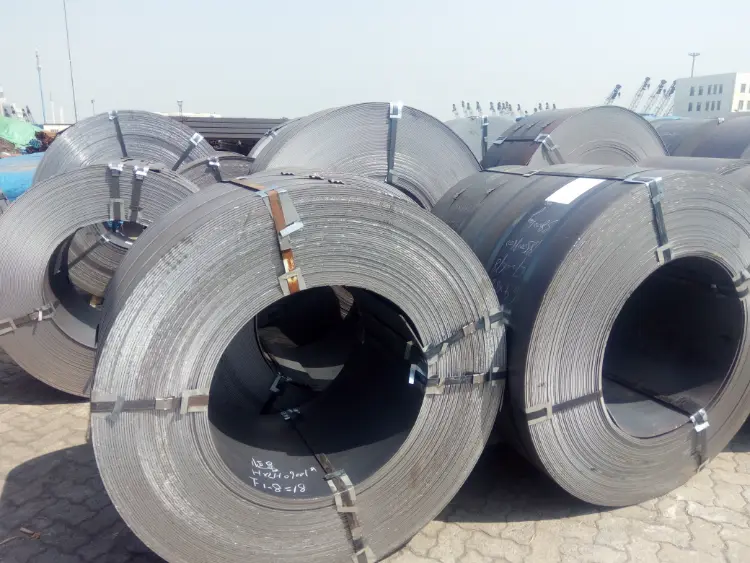
DIN 17102 EStE460 Hot Rolled Steel Coil
DIN 17102 EStE460 Hot Rolled Steel Coil - Normalized Fine-Grain Structural Steel
Comprehensive data on EStE460 hot rolled steel coil under DIN 17102: chemical composition, mechanical and physical properties, international equivalents, and applications in welded structures.
Hot rolling, normalization, welding, cold forming, machining, thermal cutting
- Phone : +8618037372205
- Email : [email protected]
- WhatsApp: Contact via Whtsapp
- WeChat: +8618037372205
DIN 17102 EStE460 Hot Rolled Steel Coil Introduction
DIN 17102 EStE460 is a hot-rolled, normalized fine-grain structural steel designed for outstanding weldability and reliable toughness at low temperatures. The designation EStE460 indicates a special killed fine-grain steel (E = special killed, St = structural steel, E = fine-grain) with a minimum yield strength of 460 MPa in the as-normalized condition. It is primarily supplied in coil and plate form for heavy-duty welded fabrications.
Key characteristics include:
- Uniform fine-grain structure achieved by normalization, providing excellent mechanical properties and notch toughness.
- Guaranteed impact energy at -20°C (longitudinal minimum 40 J for thickness ≤ 60 mm), making it suitable for dynamically loaded and safety-critical structures.
- Low carbon equivalent (CEV typically ≤ 0.45%) to permit reliable cold and hot forming, as well as unrestricted welding without preheating under most shop conditions.
- Good consistency in thickness, flatness, and surface quality typical of hot-rolled coil processing.
Due to its balanced strength-toughness profile, EStE460 is widely specified in European and international engineering projects that require compliance with DIN 17102 or its successor EN 10025-3.
DIN 17102 EStE460 Hot Rolled Steel Coil Chemical Composition
Typical ladle analysis limits according to DIN 17102. The steel is fully killed and fine-grain treated with aluminum and microalloying elements (Nb, V, Ti). The low carbon content and controlled CEV ensure good weldability.
| Element | Standard Value (%) | Remarks |
|---|---|---|
| C | ≤ 0.20 | Max. for thickness ≤ 63 mm; CEV ≤ 0.45 typically |
| Si | ≤ 0.60 | Silicon content may be lower for improved surface quality |
| Mn | 1.00 – 1.70 | Depending on thickness; increases strength and hardenability |
| P | ≤ 0.035 | Lower values achievable in modern steelmaking |
| S | ≤ 0.030 | Controlled for toughness and forming |
| Al (total) | ≥ 0.020 | Required for fine-grain practice |
| Nb | ≤ 0.05 | Microalloying for grain refinement |
| V | ≤ 0.20 | Optional microalloy; may be combined with Nb |
| Ti | ≤ 0.20 | Titanium can be used for additional grain control |
| N | ≤ 0.025 | Residual nitrogen; higher N may be tied up by microalloys |
| Cr | ≤ 0.30 | Residual element |
| Ni | ≤ 0.80 | Residual element |
| Mo | ≤ 0.10 | Residual element |
| Cu | ≤ 0.55 | Residual element; may affect hot shortness |
DIN 17102 EStE460 Hot Rolled Steel Coil Thermal and Electrical Physical Properties
Physical data representative of normalized fine-grain structural steel. Actual values may vary slightly with exact composition and heat treatment. These properties aid in design calculations for thermal expansion, heat transfer, and electrical conductivity.
| Property | Typical Value | Unit | Condition / Temperature |
|---|---|---|---|
| Density (ρ) | 7850 | kg/m³ | 20 °C |
| Modulus of elasticity (E) | 210 | GPa | 20 °C |
| Shear modulus (G) | 81 | GPa | 20 °C (calculated) |
| Poisson's ratio (ν) | 0.3 | - | 20 °C (typical for steel) |
| Thermal expansion (α) | 12.0 x 10⁻⁶ | K⁻¹ | 20 – 100 °C |
| Thermal expansion (α) | 13.0 x 10⁻⁶ | K⁻¹ | 20 – 300 °C |
| Thermal conductivity (λ) | 45 | W/(m·K) | 20 °C |
| Thermal conductivity (λ) | 42 | W/(m·K) | 200 °C |
| Specific heat capacity (cp) | 460 | J/(kg·K) | 20 °C |
| Electrical resistivity (ρₑ) | 0.22 – 0.25 | μΩ·m | 20 °C |
DIN 17102 EStE460 Hot Rolled Steel Coil Mechanical Properties
Minimum specified properties for normalized condition. Values are valid for thickness ranges as per DIN 17102. Impact tests at -20 °C are mandatory.
*Longitudinal testing allowed for coil/plate; transverse values given for critical applications. Bend tests: mandrel diameter 3t (thickness) for elongation verification.
| Property | Standard Requirement | Unit | Test Condition / Thickness |
|---|---|---|---|
| Yield strength (ReH) | ≥ 460 | MPa | t ≤ 16 mm |
| Yield strength (ReH) | ≥ 440 | MPa | 16 < t ≤ 35 mm |
| Yield strength (ReH) | ≥ 430 | MPa | 35 < t ≤ 50 mm |
| Yield strength (ReH) | ≥ 400 | MPa | 50 < t ≤ 63 mm |
| Tensile strength (Rm) | 550 – 720 | MPa | t ≤ 63 mm |
| Elongation after fracture (A5) | ≥ 17 | % | t ≤ 63 mm, longitudinal |
| Bend test | No cracks, d = 3a | 180° bend, a = specimen thickness | |
| Impact energy (KV, longitudinal) | ≥ 40 | J | -20 °C, t ≤ 60 mm |
| Impact energy (KV, transverse) | ≥ 27 | J | -20 °C, t ≤ 60 mm |
DIN 17102 EStE460 Hot Rolled Steel Coil Fully Equivalent Material Standards and Substitute Grades
| Country / Region | Standard | Grade | Remarks |
|---|---|---|---|
| European Union | EN 10025-3:2019 | S460N | Direct replacement for EStE460; identical normalized fine-grain steel with minimum yield 460 MPa, impact at -20°C. |
| European Union (withdrawn) | EN 10113-2:1993 | S460N | Predecessor to EN 10025-3; chemically and mechanically identical. |
| International | ISO 4950-2:1995 | S460N | High yield strength flat steel products, normalized fine-grain. |
DIN 17102 EStE460 Hot Rolled Steel Coil Application Introduction
EStE460 (S460N) is a premium structural steel designed for heavy-duty, welded fabrications where safety and weight savings are critical. Its reliable low-temperature toughness and consistent strength make it ideal for dynamically loaded components and large-scale infrastructure projects.
Product Applications: Welded bridge girders and cross beams, Structural platform decks for offshore installations, Mobile crane telescopic booms and outrigger boxes, Large welded storage tanks and silos, Prefabricated building frames and nodes, Heavy-duty pipe line anchors and supports
Processed into products: Flanges and webs of built-up I‑sections, Stiffened panels and diaphragms, Bearing plates and base plates, Welded tubular connections (CHS, RHS), Milled or machined end connectors for tension members, Cut and formed parts for chassis frames of heavy vehicles
Application industries: Bridge construction (plate girders, box girders, orthotropic decks), Offshore and marine engineering (jacket legs, deck structures, mooring components), Heavy machinery and material handling (crane beams, excavator booms, lifting frames), Pressure vessel and tank manufacturing (cylindrical shells for LPG, ammonia), High-rise and commercial building (columns, trusses, core structures), Wind energy (tower sections, transition pieces)
DIN 17102 EStE460 Hot Rolled Steel Coil Similar / Alternative Materials with Comparable Properties
| Country / Region | Standard | Grade | Remarks |
|---|---|---|---|
| EU | EN 10025-4 | S460M | Thermomechanically rolled fine-grain steel; same strength but less thickness-dependent properties, lower CEV. |
| EU | EN 10025-6 | S460QL | Quenched and tempered steel; higher strength and toughness, but lower weldability without careful procedure. |
| USA | ASTM A572 / A572M | Grade 65 [450] | High-strength low-alloy structural steel; minimum yield 65 ksi (~450 MPa), slightly lower than 460 MPa. Not fine-grain guaranteed. |
| Japan | JIS G 3106 | SM570 | Welded structural steel with min. tensile 570 MPa; yield ~460 MPa, good toughness, but different microalloy design. |
Notes:
DIN 17102 has been officially withdrawn and superseded by EN 10025-3. When ordering EStE460, the designation S460N+AR (as-rolled and normalized) or S460N+N (normalised) should be used. Hot-rolled coil is typically supplied in the +AR condition with a normalizing heat treatment applied by the customer or specified at the mill. For critical welding applications, supplementary HIC or CTOD testing may be agreed. The steel is suitable for galvanizing (zinc coating) and painting without special pretreatment.
- Share



