
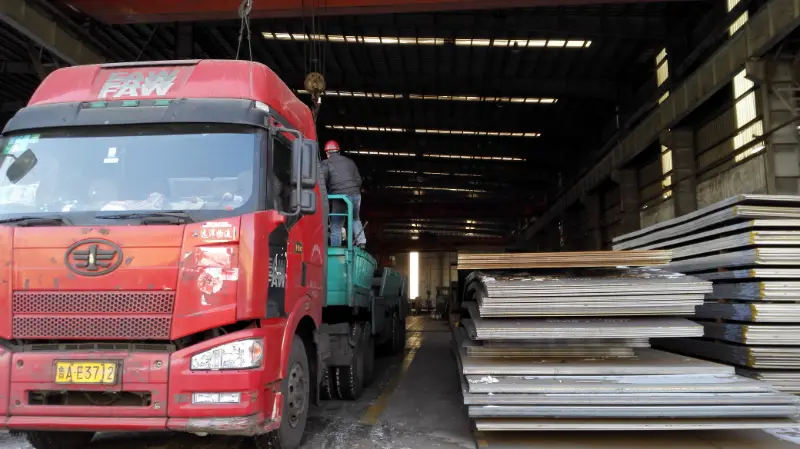
DIN 17102 EStE380 Fine-Grain Structural Steel for Automotive Plates
DIN 17102 EStE380 Fine-Grain Automotive Structural Steel Plate – High Strength Weldable Solutions
Explore DIN 17102 EStE380, a normalized fine-grain structural steel for automobile construction. Provides chemical composition, mechanical properties at various thicknesses, thermal and electrical physical references, and equivalent international grades.
Welding, cold forming, bending, machining, normalizing (if required)
- Phone : +8618037372205
- Email : [email protected]
- WhatsApp: Contact via Whtsapp
- WeChat: +8618037372205
DIN 17102 EStE380 Fine-Grain Structural Steel for Automotive Plates Introduction
DIN 17102 EStE380 (often designated StE380) is a weldable fine-grain structural steel supplied as normalized or normalized rolled plate, wide flat, and sections. It is specifically developed for automobile and general structural applications where a minimum yield strength of 380 MPa (t ≤ 16 mm) and excellent weldability are required.
Key characteristics:
- Fine-grain microstructure achieved through aluminium-killed or microalloyed processing.
- Good combination of strength, toughness, and formability.
- Suitable for cold forming and welding without preheating under normal conditions.
- Available in several impact test quality grades (e.g., 0 °C, -20 °C, -50 °C).
- Thickness range typically up to 70 mm, with guaranteed through-thickness properties.
DIN 17102 EStE380 Fine-Grain Structural Steel for Automotive Plates Chemical Composition
The ladle analysis limits apply to the normalised condition. Fine-grain treatment is ensured by a total aluminium content of ≥ 0.020% or by the use of microalloying elements (Nb, V, Ti) alone or in combination. CEV (Carbon Equivalent) is typically below 0.45% for good weldability.
| Chemical Element | Standard Value (max or range) | Remarks |
|---|---|---|
| C | ≤ 0.20 | |
| Si | ≤ 0.50 | |
| Mn | 0.90 - 1.65 | |
| P | ≤ 0.040 | |
| S | ≤ 0.035 | |
| N | ≤ 0.020 | |
| Al (total) | ≥ 0.020 | Minimum if used for grain refinement |
| Nb | ≤ 0.05* | May be present as grain refining element |
| V | ≤ 0.10* | May be present as grain refining element |
| Ti | ≤ 0.05* | May be present as grain refining element |
| Cr | ≤ 0.30* | Residual |
| Ni | ≤ 0.30* | Residual |
| Mo | ≤ 0.08* | Residual |
| Cu | ≤ 0.35* | Residual |
DIN 17102 EStE380 Fine-Grain Structural Steel for Automotive Plates Thermal and Electrical Physical Properties
These values are typical for fine-grain structural steel similar to StE380 at room temperature unless otherwise noted. They are not specification requirements but are useful for design calculations. Thermal and electrical properties vary with temperature and composition.
| Property | Typical Value | Unit | Test Condition |
|---|---|---|---|
| Density (ρ) | 7.85 | g/cm³ | 20 °C |
| Modulus of Elasticity (E) | 210 | GPa | 20 °C |
| Shear Modulus (G) | 81 | GPa | 20 °C |
| Poisson's Ratio (ν) | 0.3 | 20 °C | |
| Thermal Expansion (α) | 11.7 | 10^(-6)/K | 20 °C - 200 °C |
| Thermal Expansion (α) | 12.5 | 10^(-6)/K | 20 °C - 400 °C |
| Thermal Conductivity (λ) | 52 | W/(m·K) | 20 °C |
| Thermal Conductivity (λ) | 48 | W/(m·K) | 200 °C |
| Specific Heat Capacity (c) | 460 | J/(kg·K) | 20 °C |
| Electrical Resistivity (ρe) | 0.22 | µΩ·m | 20 °C |
DIN 17102 EStE380 Fine-Grain Structural Steel for Automotive Plates Mechanical Properties
Mechanical properties depend on product thickness and the impact test quality grade (e.g., StE380-1: 0 °C; StE380-2: -20 °C; StE380-3: -50 °C). Values below are minimum requirements unless specified as a range. Bending tests with mandrel diameter 3t to 4t (t = thickness) show no cracking. Impact energy (ISO-V) values apply to longitudinal specimens; for transverse specimens values are typically 70% of the longitudinal requirements.
| Property | Required Value | Unit | Test Condition / Thickness |
|---|---|---|---|
| Yield Strength (ReH) | ≥ 380 | MPa | t ≤ 16 mm |
| Yield Strength (ReH) | ≥ 370 | MPa | 16 < t ≤ 35 mm |
| Yield Strength (ReH) | ≥ 360 | MPa | 35 < t ≤ 50 mm |
| Yield Strength (ReH) | ≥ 340 | MPa | 50 < t ≤ 70 mm |
| Tensile Strength (Rm) | 530 - 680 | MPa | all thicknesses |
| Elongation (A5) | ≥ 19 | % | t ≤ 35 mm |
| Elongation (A5) | ≥ 18 | % | 35 < t ≤ 50 mm |
| Elongation (A5) | ≥ 17 | % | 50 < t ≤ 70 mm |
| Impact Energy (KV, LT) | ≥ 27 (average) | J | Grade -1: 0 °C |
| Impact Energy (KV, LT) | ≥ 27 (average) | J | Grade -2: -20 °C |
| Impact Energy (KV, LT) | ≥ 27 (average) | J | Grade -3: -50 °C |
| Bend Test (through 180°) | No cracks | Mandrel diameter 3t (t ≤16 mm), 4t (>16 mm) |
DIN 17102 EStE380 Fine-Grain Structural Steel for Automotive Plates Internationally Equivalent Standards and Direct Substitutes for EStE380
| Country/Region | Standard | Grade | Remarks |
|---|---|---|---|
| Germany | DIN 17102 | StE380 | Original standard, same as EStE380 |
| International | ISO 4950-2:1995 | E380DD | Normalized or controlled rolled; yield 380 MPa min. |
| Europe (withdrawn) | EN 10113-2:1993 | S380N | Previously harmonized European grade, yield 380 MPa |
| Italy | UNI 7382 | FeE380 | Equivalent fine-grain structural steel |
| France (inactive) | NF A36-201 | E380 | Former French equivalent, now superseded |
DIN 17102 EStE380 Fine-Grain Structural Steel for Automotive Plates Application Introduction
EStE380 is primarily used in automotive and heavy vehicle construction where a fine balance between strength, toughness, and weldability is paramount. The normalized fine-grain microstructure ensures reliable performance under dynamic loads and at low ambient temperatures. Cold forming properties are good for bending and moderate deformation, but hot forming above 600 °C should be followed by re-normalising to maintain the guarantee of mechanical properties.
Product Applications: Automobile chassis frames (longitudinal and cross members), Truck side rails and reinforcement profiles, Welded I-beams and box sections for vehicle underbodies, Heavy-duty cantilever beams and support structures, Lifting and hoisting equipment bases, Trailer drawbars and fifth-wheel coupling plates
Processed into products: Longitudinal chassis rails (formed and welded), Cross member stampings with complex bends, Suspension brackets and spring hangers, Axle mounting plates, Rear underrun protection devices, Subframe connectors and gusset plates, Welded fabrications for mobile crane outriggers
Application industries: Automotive (trucks, trailers, buses), Transportation and logistics, Construction machinery (crane booms, chassis), Agricultural equipment, Pressure vessel components (non-code)
DIN 17102 EStE380 Fine-Grain Structural Steel for Automotive Plates Similar/Alternative Materials with Comparable Performance
| Country/Region | Standard | Grade | Remarks |
|---|---|---|---|
| Europe | EN 10025-3 | S355N / S355NL | Lower yield (355 MPa) but similar weldability; may require thicker sections to compensate |
| Europe | EN 10025-4 | S355M / S355ML | Thermomechanically rolled; comparable strength class |
| Europe | EN 10025-3 | S420N / S420NL | Higher yield (420 MPa); can replace StE380 where strength upgrade is acceptable |
| Japan | JIS G 3106 | SM490A/B/C | Yield 325-365 MPa; often used in welded structures, but requires strength verification |
| USA | ASTM A572/A572M | Grade 50 [345] or Grade 55 [380] | Grade 55 yields 380 MPa similar to StE380; check impact test requirements |
| China | GB/T 1591 | Q345D/E or Q390D | Q390 offers min. 380 MPa yield; Q345 is lower strength but widely used for substitution |
Notes:
Welding: EStE380 has very good weldability with low carbon equivalent. Preheating is usually not required for thicknesses below 40 mm if using low-hydrogen processes. For thicker sections or when steel is below +5 °C, a preheat of 50-100 °C is recommended. Post-weld heat treatment is generally not necessary unless required by design codes for stress relief.
Formability: Minimum bending radius of 1.5t to 2t for cold forming; hot forming should be performed at 850-1000 °C followed by normalising.
Corrosion protection: Surface can be supplied as blasted and primer-painted. For outdoor applications, additional coating systems are advised.
Note on designation: The prefix 'E' occasionally indicates electric-arc furnace route; the steel is identical to StE380 in DIN 17102.
- Share



