
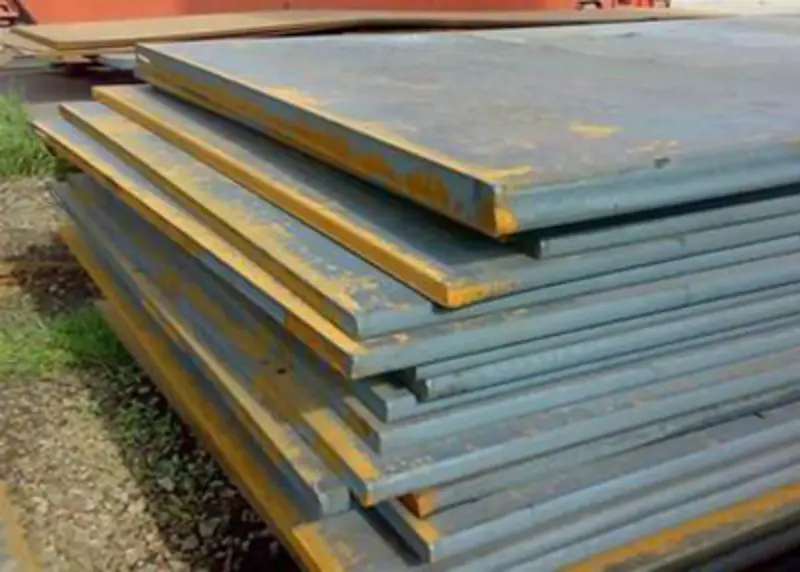
DIN 17102 EStE355 Weldable Fine Grain Structural Steel
DIN 17102 EStE355 Carbon and Low-alloy High-strength Steel Coil – Weldable Normalized Fine Grain Steel
Comprehensive datasheet for EStE355 steel coil according to DIN 17102, including chemical composition, mechanical properties, thermal and electrical properties, equivalent grades, and application guide.
Hot rolling, normalizing, welding, cutting, cold forming, machining
- Phone : +8618037372205
- Email : [email protected]
- WhatsApp: Contact via Whtsapp
- WeChat: +8618037372205
DIN 17102 EStE355 Weldable Fine Grain Structural Steel Introduction
EStE355 is a weldable normalized fine-grain structural steel specified in DIN 17102. It belongs to the carbon and low-alloy high-strength steel category and is supplied as coil, plate, or strip. The steel is microalloyed with niobium, vanadium, and/or titanium to achieve a minimum yield strength of 355 MPa in thicknesses up to 16 mm, combined with excellent toughness at -20 °C. The normalized delivery condition ensures uniform mechanical properties and good weldability.
- High strength with good formability and weldability
- Fine grain structure achieved by controlled rolling and normalizing
- Guaranteed impact toughness at -20 °C (longitudinal)
- Typical applications in welded structures, bridges, and machinery
DIN 17102 EStE355 Weldable Fine Grain Structural Steel Chemical Composition
The chemical composition of EStE355 according to DIN 17102 is designed to ensure fine grain size and high strength through microalloying. Total content of niobium, vanadium, and titanium is controlled to provide grain refinement without impairing weldability. Phosphorus and sulfur are kept low for better toughness and processing behavior.
| Element | Standard Value (%) | Remarks |
|---|---|---|
| Carbon (C) | ≤ 0.20 | Max. for weldability and strength |
| Silicon (Si) | ≤ 0.50 | Deoxidation element |
| Manganese (Mn) | 0.90 – 1.65 | Increases strength and hardenability |
| Phosphorus (P) | ≤ 0.030 | Max. for toughness |
| Sulfur (S) | ≤ 0.025 | Max. for toughness and weldability |
| Aluminium (Altotal) | ≥ 0.020 | Grain refining, deoxidation |
| Niobium (Nb) | ≤ 0.05 | Grain refiner, precipitation hardening |
| Vanadium (V) | ≤ 0.12 | Grain refiner, precipitation hardening |
| Titanium (Ti) | ≤ 0.05 | Grain refiner, nitrogen fixer |
| Chromium (Cr) | ≤ 0.30 | Residual element |
| Nickel (Ni) | ≤ 0.50 | Residual element |
| Copper (Cu) | ≤ 0.35 | Residual element |
| Molybdenum (Mo) | ≤ 0.10 | Residual element |
| Nitrogen (N) | ≤ 0.015 | Controlled for Ti/N balancing |
DIN 17102 EStE355 Weldable Fine Grain Structural Steel Thermal and Electrical Physical Properties
Physical properties of EStE355 are comparable to those of conventional C-Mn structural steels. The values provided are typical for normalized fine-grain steel and can vary slightly depending on the actual chemical composition and heat treatment. These data are suitable for thermal and structural analysis. Thermal conductivity decreases with increasing temperature, while thermal expansion increases.
| Property | Typical Value | Unit | Test Condition / Remarks |
|---|---|---|---|
| Density (ρ) | 7.85 | g/cm³ | At 20 °C |
| Elastic modulus (E) | 210 | GPa | At 20 °C, tensile modulus |
| Shear modulus (G) | ≈ 81 | GPa | Calculated from E and ν |
| Poisson's ratio (ν) | 0.3 | – | Elastic range |
| Thermal expansion coefficient (α) | 11.1 × 10⁻⁶ | 1/K | 20 – 100 °C |
| Thermal expansion coefficient (α) | 12.1 × 10⁻⁶ | 1/K | 20 – 200 °C |
| Thermal expansion coefficient (α) | 12.9 × 10⁻⁶ | 1/K | 20 – 300 °C |
| Thermal conductivity (λ) | 52 | W/(m·K) | At 20 °C |
| Thermal conductivity (λ) | 49 | W/(m·K) | At 200 °C |
| Thermal conductivity (λ) | 46 | W/(m·K) | At 300 °C |
| Specific heat capacity (cp) | 460 | J/(kg·K) | At 20 °C |
| Specific heat capacity (cp) | 500 | J/(kg·K) | At 200 °C |
| Specific heat capacity (cp) | 530 | J/(kg·K) | At 300 °C |
| Electrical resistivity (ρe) | ≈ 0.23 | Ω·mm²/m | At 20 °C |
DIN 17102 EStE355 Weldable Fine Grain Structural Steel Mechanical Properties
The mechanical properties of EStE355 are valid for the normalized condition and test pieces taken in the longitudinal direction. Yield strength values decrease with increasing thickness. Impact toughness is guaranteed at -20 °C with a minimum energy of 27 J (longitudinal, Charpy V-notch). Bending tests are performed at 180° with specified mandrel diameters to verify formability.
| Property | Standard Requirement | Unit | Test Condition / Remarks |
|---|---|---|---|
| Yield strength (ReH) | ≥ 355 | MPa | Thickness t ≤ 16 mm |
| Yield strength (ReH) | ≥ 345 | MPa | 16 mm < t ≤ 35 mm |
| Yield strength (ReH) | ≥ 335 | MPa | 35 mm < t ≤ 50 mm |
| Yield strength (ReH) | ≥ 325 | MPa | 50 mm < t ≤ 70 mm |
| Yield strength (ReH) | ≥ 315 | MPa | 70 mm < t ≤ 100 mm |
| Tensile strength (Rm) | 490 – 630 | MPa | t ≤ 100 mm |
| Elongation after fracture (A) | ≥ 22 | % | t ≤ 16 mm, longitudinal, gauge length L0 = 5.65√S0 |
| Elongation after fracture (A) | ≥ 22 | % | 16 mm < t ≤ 40 mm, longitudinal |
| Elongation after fracture (A) | ≥ 21 | % | 40 mm < t ≤ 63 mm, longitudinal |
| Elongation after fracture (A) | ≥ 20 | % | 63 mm < t ≤ 100 mm, longitudinal |
| Charpy-V impact energy (KV) | ≥ 27 | J | At -20 °C, longitudinal, standard 10×10 mm specimen |
| Bend test (180° bend, mandrel diameter) | 2 t | – | t ≤ 16 mm, longitudinal specimen |
| Bend test (180° bend, mandrel diameter) | 3 t | – | 16 mm < t ≤ 100 mm |
DIN 17102 EStE355 Weldable Fine Grain Structural Steel Completely Equivalent Material Standards and Substitute Grades
| Country / Region | Standard | Grade | Remarks |
|---|---|---|---|
| European Union | EN 10025-3:2004 | S355N (1.0545) | Direct replacement, normalized fine grain steel, -20 °C impact |
| International | ISO 630-3:2012 | E355C | Equivalent normalized steel, similar requirements |
| France (historical) | NF A 35-503 (obsolete) | E355 R | Historical standard with comparable properties |
DIN 17102 EStE355 Weldable Fine Grain Structural Steel Application Introduction
EStE355 steel coil is widely used in welded structures where a combination of high strength, good toughness, and reliable weldability is required. The normalized condition ensures homogeneous mechanical properties and facilitates forming and welding. Typical application areas include heavy machinery, civil engineering, and transport equipment.
Product Applications: Welded I-beams and box columns, Bridge girders and deck plates, Offshore platform structural modules, Pressure vessel shells, Wind tower tubular sections, Crane booms and jibs, Earthmoving equipment frames
Processed into products: Structural stiffeners and gussets, Flanges and support brackets, Chassis frames for heavy vehicles, Welded pipe fittings and flanges, Bearing plates and base plates, Reinforcement ribs for machinery housings
Application industries: Civil engineering and construction, Bridge building, Offshore and marine engineering, Heavy machinery manufacturing, Energy sector (wind turbine towers, pressure vessels), Transportation (railway, automotive frames)
DIN 17102 EStE355 Weldable Fine Grain Structural Steel Similar / Comparable Materials as Alternatives
| Country / Region | Standard | Grade | Remarks |
|---|---|---|---|
| USA | ASTM A572/A572M | Grade 50 [345] (Type 1) | Min. yield 345 MPa, slightly lower strength; check CEV and toughness |
| Japan | JIS G3106 | SM490A | Min. yield 325-355 MPa depending on thickness, 0 °C impact; may need controlled rolling |
| China | GB/T 1591-2018 | Q355D | Yield 355 MPa, -20 °C impact; similar chemistry but check P and S limits |
| Russia | GOST 19281 | 17G1S (17Г1С) | Manganese-silicon steel, yield 355 MPa equivalent, normalized |
| India | IS 2062:2011 | E350 C | Fine grain structural steel, min. yield 350 MPa, impact at -20 °C |
Notes:
- The steel exhibits good weldability with common welding processes (SMAW, GMAW, SAW); preheating is recommended for thicknesses above approx. 40 mm or when the carbon equivalent is high.
- Post-weld stress relieving can be applied at 550 – 620 °C to reduce residual stresses without significantly affecting the mechanical properties.
- Forming operations should preferably be conducted above the nil-ductility transition temperature; cold forming with subsequent stress relieving is possible within the limits of the material's ductility.
- The supplied coil can be cut to length for sheet and plate processing; typical surface condition is as-rolled or descaled.
- For the latest specifications, the superseding standard EN 10025-3 (grade S355N) should be consulted for current requirements and CE marking.
- Share



