
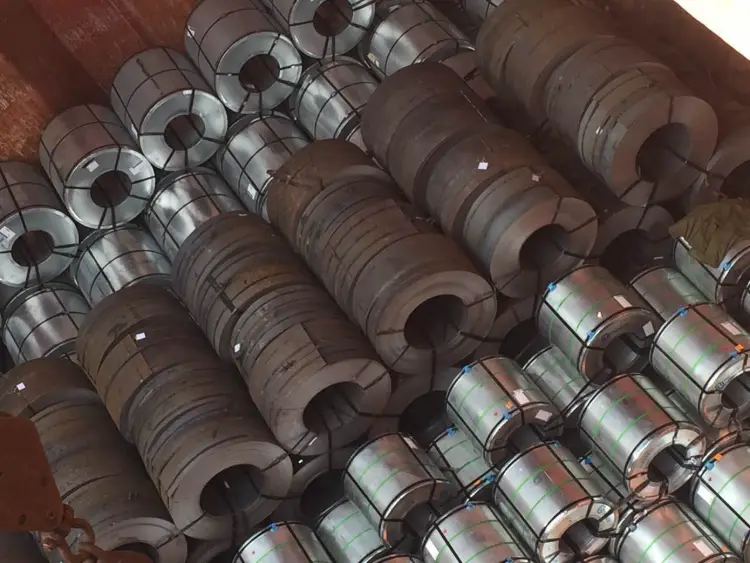
DIN 17102 TStE355 Carbon and Low-alloy High-strength Steel Coil
DIN 17102 TStE355 Normalized Fine-Grain Structural Steel for High-Strength Welded Applications
Comprehensive technical data for TStE355 carbon and low-alloy high-strength steel coil under DIN 17102, including chemical composition, mechanical properties, thermal and electrical physical properties, equivalent grades, and application guidance.
Welding, cold forming, bending, hot-dip galvanizing, machining
- Phone : +8618037372205
- Email : [email protected]
- WhatsApp: Contact via Whtsapp
- WeChat: +8618037372205
DIN 17102 TStE355 Carbon and Low-alloy High-strength Steel Coil Introduction
DIN 17102 TStE355 is a weldable fine-grain structural steel supplied in the normalized condition. It is classified as a carbon and low-alloy high-strength steel coil with a minimum yield strength of 355 MPa for thicknesses up to 16 mm. This grade is designed for welded structures in steel construction, bridge building, pressure vessels, and offshore engineering where excellent toughness at low temperatures and reliable weldability are required. The fine-grain microstructure, achieved through controlled rolling and normalizing, ensures uniform mechanical properties and good resistance to brittle fracture. Typical delivery forms are hot-rolled coils, plates, and wide flats. TStE355 is well-suited for cold forming and hot-dip galvanizing processes.
DIN 17102 TStE355 Carbon and Low-alloy High-strength Steel Coil Chemical Composition
The chemical composition of TStE355 is controlled to ensure fine-grain structure, excellent weldability, and low-temperature toughness. Typical limits according to DIN 17102 are shown below. Elements like Nb, V, and Al are added for grain refinement and precipitation strengthening.
| Element | Standard Value (max, unless range given) | Remarks |
|---|---|---|
| C | ≤0.20 | Higher carbon limited for weldability |
| Si | ≤0.50 | Silicon as deoxidizer |
| Mn | 0.90 – 1.65 | Manganese for strength and toughness |
| P | ≤0.035 | Phosphorus restricted for toughness |
| S | ≤0.030 | Sulfur minimized for cleanliness |
| Al (total) | ≥0.020 | Grain refinement |
| Nb | ≤0.05 | Micro-alloying element |
| V | ≤0.12 | Precipitation strengthening |
| Ti | ≤0.05 | Optional grain refinement |
| Cr | ≤0.30 | Residual element |
| Ni | ≤0.30 | Residual element |
| Mo | ≤0.10 | Residual element |
| Cu | ≤0.35 | Residual element |
| N | ≤0.015 | Nitrogen controlled to avoid aging |
DIN 17102 TStE355 Carbon and Low-alloy High-strength Steel Coil Thermal and Electrical Physical Properties
The following physical properties are typical for low-alloy fine-grain structural steels like TStE355. They may vary slightly depending on exact composition and microstructure. Values are representative for design calculations.
| Property | Typical Value | Unit | Test Condition |
|---|---|---|---|
| Density (ρ) | 7.85 | g/cm³ | At 20 °C |
| Modulus of elasticity (E) | 210 | GPa | At 20 °C |
| Shear modulus (G) | 81 | GPa | At 20 °C |
| Poisson's ratio (ν) | 0.3 | - | At 20 °C |
| Thermal expansion coefficient (α) | 11.1 | 10⁻⁶/K | 20 – 100 °C |
| Thermal expansion coefficient (α) | 11.9 | 10⁻⁶/K | 20 – 200 °C |
| Thermal expansion coefficient (α) | 12.5 | 10⁻⁶/K | 20 – 300 °C |
| Thermal conductivity (λ) | 48 | W/(m·K) | At 20 °C |
| Specific heat capacity (cp) | 470 | J/(kg·K) | At 20 °C |
| Electrical resistivity (ρe) | 0.22 | Ω·mm²/m | At 20 °C |
DIN 17102 TStE355 Carbon and Low-alloy High-strength Steel Coil Mechanical Properties
Mechanical properties are guaranteed in the normalized delivery condition. The minimum yield strength, tensile strength, elongation, and impact energy depend on the product thickness. Charpy-V impact tests are performed at -20 °C for TStE355. Bend tests with specified former diameters must be free of cracks.
| Property | Standard Requirement | Unit | Test Condition |
|---|---|---|---|
| Yield strength (ReH) | ≥355 | MPa | Thickness ≤ 16 mm |
| Yield strength (ReH) | ≥345 | MPa | Thickness > 16 mm to 40 mm |
| Yield strength (ReH) | ≥335 | MPa | Thickness > 40 mm to 63 mm |
| Tensile strength (Rm) | 470 – 630 | MPa | Thickness ≤ 100 mm |
| Elongation (A) | ≥22 | % | Longitudinal, L0 = 5.65√S0, thickness ≤ 16 mm |
| Elongation (A) | ≥21 | % | Longitudinal, L0 = 5.65√S0, thickness > 16 mm to 40 mm |
| Elongation (A) | ≥20 | % | Longitudinal, L0 = 5.65√S0, thickness > 40 mm to 63 mm |
| Impact energy (KV) | ≥27 | J | At -20 °C, longitudinal Charpy-V |
| Bend test (former diameter) | 3a (a ≤ 16 mm) | - | 180° bend, no cracks |
| Bend test (former diameter) | 4a (a > 16 mm to 40 mm) | - | 180° bend, no cracks |
DIN 17102 TStE355 Carbon and Low-alloy High-strength Steel Coil Completely Equivalent Material Standards and Substitute Grades
| Country/Region | Standard | Grade | Remarks |
|---|---|---|---|
| European Union | EN 10025-3 | S355N | Direct equivalent; normalized fine-grain structural steel with same yield class and low-temperature toughness |
| International | ISO 630 | Fe355D | Comparable fine-grain steel, normalized, with similar mechanical properties |
| Germany (obsolete) | DIN 17102 | TStE355 | Original designation, now superseded by EN 10025-3 S355N |
DIN 17102 TStE355 Carbon and Low-alloy High-strength Steel Coil Application Introduction
TStE355 is a versatile high-strength fine-grain structural steel that excels in welded constructions requiring guaranteed toughness and strength. Its normalized delivery condition ensures homogeneous properties and dimensional stability. It can be used in both static and dynamically loaded structures, and is suitable for moderate cold forming and galvanizing. Typical applications span industrial, civil, and offshore engineering.
Product Applications: Welded steel frameworks and structures, High-rise building skeletons, Road and railway bridges, Offshore platform decks and jackets, Storage tanks and pressure vessels, Crane jibs and booms, Truck frames and trailer components
Processed into products: Welded beams, columns, and girders, Flanges and stiffeners, Base plates and gusset plates, Pipe and tubular sections, Load-bearing brackets and supports, Chassis parts for heavy vehicles, Forged and machined structural connectors
Application industries: Civil engineering and construction, Bridge building, Offshore and marine engineering, Pressure vessel and boiler manufacturing, Heavy machinery and crane production, Transportation and vehicle industry
DIN 17102 TStE355 Carbon and Low-alloy High-strength Steel Coil Similar and Alternative Material Recommendations
| Country/Region | Standard | Grade | Remarks |
|---|---|---|---|
| China | GB/T 1591 | Q355D | Similar yield strength; normalized or TMCP; impact test at -20 °C; requires careful comparison of composition and delivery condition |
| Japan | JIS G 3106 | SM490B | Weldable structural steel with min. 325 MPa yield; good toughness; slightly different strength level |
| USA | ASTM A572 | Grade 50 | Similar strength class (345 MPa); not a fine-grain steel, but widely used for structural applications |
| European Union | EN 10025-4 | S355ML | Thermomechanically rolled fine-grain steel with same strength; alternative for thinner sections where TMCP is acceptable |
Notes:
TStE355 is suitable for all common welding processes. Preheating is generally not required for moderate plate thicknesses, but low hydrogen welding consumables are recommended. Post-weld heat treatment (PWHT) may be applied if necessary, but the normalized microstructure provides excellent welding performance. For cold forming, the bending radius should comply with the guaranteed minimum elongation and bend test requirements. This grade is fully killed and fine-grained, meeting the requirements of an Al-fine grain steel.
- Share



