
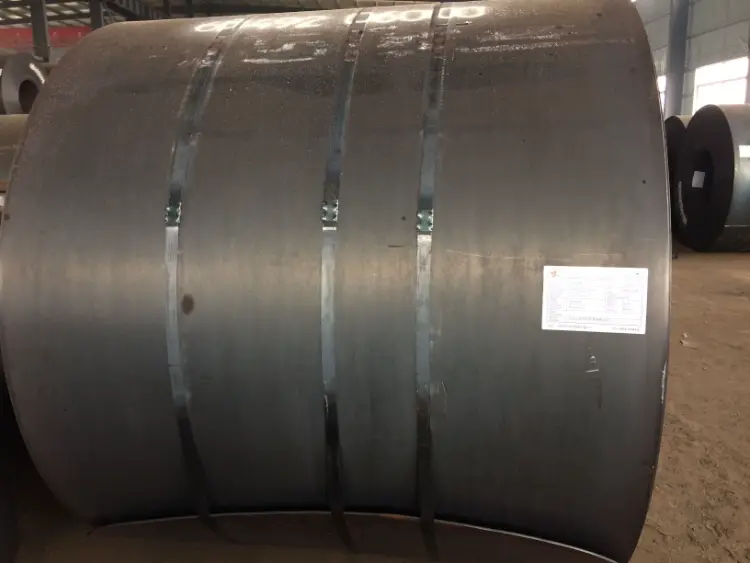
DIN 17102 EStE285 Carbon & Low-Alloy High-Strength Steel Coil
DIN 17102 EStE285 Carbon & Low-Alloy High-Strength Steel Coil - Properties & Equivalent Grades
Comprehensive material data for DIN 17102 EStE285 low-alloy high-strength steel coil, including chemical composition, mechanical and thermal properties, international equivalents, and application guidance.
Hot rolling, normalizing, cold forming, machining, welding
- Phone : +8618037372205
- Email : [email protected]
- WhatsApp: Contact via Whtsapp
- WeChat: +8618037372205
DIN 17102 EStE285 Carbon & Low-Alloy High-Strength Steel Coil Introduction
EStE285 is a fine-grain structural steel specified in the German standard DIN 17102. It belongs to the weldable, normalized low-alloy high-strength steel category, with a minimum yield strength of 285 MPa. The steel is characterized by a fine-grained microstructure, good weldability, and excellent toughness at low temperatures, making it suitable for heavy-duty welded structures such as bridges, buildings, and heavy machinery. The standard DIN 17102 has been replaced by European standards, and EStE285 is closely matched by EN 10025-3 S275N/NL.
DIN 17102 EStE285 Carbon & Low-Alloy High-Strength Steel Coil Chemical Composition
Typical chemical composition limits for EStE285 according to DIN 17102. The steel is fully killed and fine-grain treated. Low carbon content ensures good weldability, while microalloying elements like Nb, V, Ti provide grain refinement and precipitation strengthening.
| Element | Standard Value (max unless range) | Remarks |
|---|---|---|
| C | ≤ 0.18 | |
| Si | ≤ 0.50 | |
| Mn | 1.00 – 1.60 | |
| P | ≤ 0.030 | |
| S | ≤ 0.025 | |
| Al (total) | ≥ 0.020 | Fine-grain treatment |
| Nb | ≤ 0.05 | Optional microalloy |
| V | ≤ 0.10 | Optional microalloy |
| Ti | ≤ 0.03 | Optional microalloy |
| Cr | ≤ 0.30 | Residual |
| Ni | ≤ 0.30 | Residual |
| Cu | ≤ 0.30 | Residual |
| Mo | ≤ 0.08 | Residual |
| N | ≤ 0.015 | Residual |
DIN 17102 EStE285 Carbon & Low-Alloy High-Strength Steel Coil Thermal and Electrical Properties
Typical physical properties for normalized low-alloy structural steel at room temperature, unless specified otherwise. These values are valid for EStE285 grade and are derived from steel family data.
| Property | Typical Value | Unit | Condition / Remarks |
|---|---|---|---|
| Density (ρ) | 7.85 | g/cm³ | 20 °C |
| Elastic modulus (E) | 210 | GPa | 20 °C |
| Shear modulus (G) | 81 | GPa | 20 °C |
| Poisson's ratio (ν) | 0.3 | - | 20 °C |
| Thermal expansion (α) | 12.0 | 10⁻⁶/K | 20 – 100 °C |
| Thermal expansion (α) | 12.5 | 10⁻⁶/K | 20 – 200 °C |
| Thermal expansion (α) | 13.0 | 10⁻⁶/K | 20 – 300 °C |
| Thermal conductivity (λ) | 51 | W/(m·K) | 20 °C |
| Thermal conductivity (λ) | 49 | W/(m·K) | 200 °C |
| Specific heat capacity (cp) | 460 | J/(kg·K) | 20 °C |
| Electrical resistivity (ρe) | 0.25 | µΩ·m | 20 °C |
DIN 17102 EStE285 Carbon & Low-Alloy High-Strength Steel Coil Mechanical Properties
Minimum mechanical properties for EStE285 according to DIN 17102 for thickness ranges ≤ 16 mm. Impact energy applies to the normalized condition (EStE 285 N) with a guaranteed minimum of 27 J at -20 °C. Values for thicker products are subject to adjustment according to the standard.
| Property | Standard Requirement | Unit | Test Condition |
|---|---|---|---|
| Yield strength (ReH) | ≥ 285 | MPa | t ≤ 16 mm, transverse/ longitudinal |
| Yield strength (ReH) | ≥ 275 | MPa | 16 < t ≤ 40 mm |
| Yield strength (ReH) | ≥ 265 | MPa | 40 < t ≤ 63 mm |
| Tensile strength (Rm) | 440 – 560 | MPa | All thicknesses |
| Elongation (A5) | ≥ 22 | % | t ≤ 16 mm, longitudinal, L0=5.65√S0 |
| Elongation (A5) | ≥ 21 | % | 16 < t ≤ 40 mm, longitudinal |
| Elongation (A5) | ≥ 20 | % | 40 < t ≤ 63 mm, longitudinal |
| Bend test (mandrel dia.) | D = 2a | - | t ≤ 16 mm, 180° bend |
| Bend test (mandrel dia.) | D = 3a | - | 16 < t ≤ 40 mm, 180° bend |
| Charpy impact (KV) | ≥ 27 | J | -20 °C, normalized condition |
| Hardness | max 170 | HB | Typical as-delivered |
DIN 17102 EStE285 Carbon & Low-Alloy High-Strength Steel Coil Full Equivalent Standards and Substitute Grades
| Country / Region | Standard | Grade | Remarks |
|---|---|---|---|
| European Union | EN 10025-3 | S275N / S275NL | Direct replacement; EN 10025-3 covers normalized fine-grain steel. |
| United States | ASTM A572 | Grade 42 | Similar strength level; check toughness requirements. |
| United States | ASTM A633 | Grade A | Normalized low-alloy steel with similar tensile properties. |
| Japan | JIS G3106 | SM490A | Comparable strength and weldability; verify impact temperature. |
| International | ISO 630-3 | S275N | Identical to EN S275N. |
DIN 17102 EStE285 Carbon & Low-Alloy High-Strength Steel Coil Application Introduction
EStE285 steel is widely applied for welded and bolted constructions where a combination of strength, toughness, and excellent weldability is required. Typical applications include:
Product Applications: Steel coil and plate for welded I-beams and box girders, Prefabricated steel framework, Crane booms and chassis, Pressure vessel shells, Tanker truck bodies
Processed into products: Main load-bearing beams in buildings, Cross beams for bridges, Chassis frames for heavy trucks, Turret rings for cranes, Wind turbine tower flanges and tubular sections, Weld-in construction anchors
Application industries: Structural engineering, Bridge construction, Heavy machinery and equipment manufacturing, Vehicle and trailer manufacturing, Wind tower and tower building, Offshore and marine structures
DIN 17102 EStE285 Carbon & Low-Alloy High-Strength Steel Coil Similar / Alternative Materials
| Country / Region | Standard | Grade | Remarks |
|---|---|---|---|
| European Union | EN 10025-3 | S355N/NL | Higher strength, but similar toughness and weldability. |
| European Union | EN 10149-2 | S275MC | Thermomechanically rolled, similar yield, thinner gage applications. |
| United States | ASTM A572 | Grade 50 | Higher yield (345 MPa); often used as an upgrade. |
| Japan | JIS G3106 | SM400A/B | Slightly lower strength but widespread structural use. |
| China | GB/T 1591 | Q275B/C/D | Comparable strength, check impact temperature. |
Notes:
- DIN 17102 is officially withdrawn; current projects should reference EN 10025-3 for equivalent normalized fine-grain steels.
- The steel is supplied in the normalized condition (N) unless otherwise agreed.
- For improved cold forming, sub-critically annealed (soft) conditions can be negotiated.
- Carbon equivalent (CEV) is typically ≤ 0.45%, ensuring good weldability without preheat for moderate thicknesses.
- Share



