
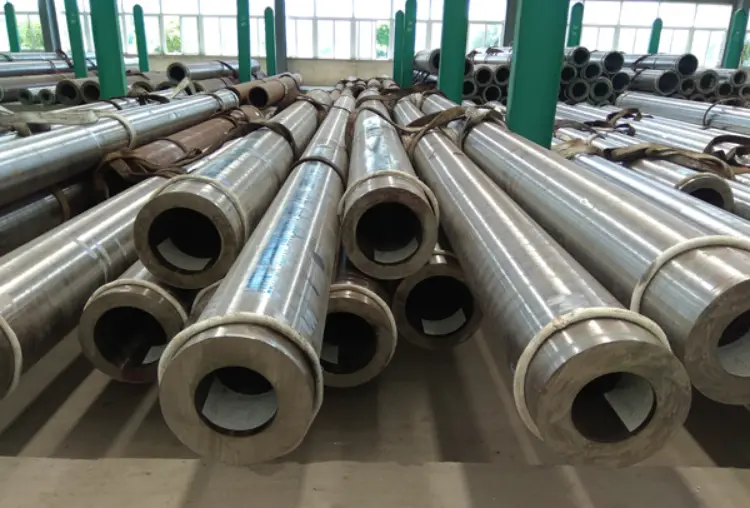
API 2H Grade 2H LSAW Pipe Steel
API 2H Grade 2H LSAW Pipe Steel: Offshore Strength & Toughness
Comprehensive technical analysis of API 2H Grade 2H steel used in LSAW pipes for offshore structures. Includes chemical composition, mechanical and thermal properties, international equivalents, and application guidelines.
LSAW (Longitudinal Submerged Arc Welding) pipe forming, hot rolling, normalizing, thermomechanical rolling (optional)
- Phone : +8618037372205
- Email : [email protected]
- WhatsApp: Contact via Whtsapp
- WeChat: +8618037372205
API 2H Grade 2H LSAW Pipe Steel Introduction
API 2H Grade 2H is a normalized, fine-grain structural steel plate specifically developed for offshore applications. It is primarily used in the fabrication of longitudinal seam submerged arc welded (LSAW) pipes in accordance with API 2B. This grade exhibits a minimum yield strength of 345 MPa (50 ksi), excellent toughness at low temperatures, and good weldability, making it suitable for critical components such as jacket legs, braces, and piles in offshore platforms and marine structures. The balanced microalloying with niobium and vanadium ensures fine grain size and consistent mechanical properties after normalizing, while strict limits on sulfur and phosphorus guarantee high resistance to lamellar tearing.
API 2H Grade 2H LSAW Pipe Steel Chemical Composition
Chemical requirements in accordance with API 2H Grade 2H. Values represent standard heat analysis limits. The steel is microalloyed with Nb and V, and fully killed with aluminum. Residual elements are controlled to ensure weldability and toughness.
| Element | Standard Value (wt%) | Remarks |
|---|---|---|
| Carbon (C) | ≤ 0.18 | - |
| Manganese (Mn) | 0.90 – 1.35 | - |
| Phosphorus (P) | ≤ 0.030 | - |
| Sulfur (S) | ≤ 0.015 | Extra low for improved through-thickness properties |
| Silicon (Si) | 0.15 – 0.40 | - |
| Niobium (Nb) | 0.02 – 0.05 | Grain refining element |
| Vanadium (V) | 0.02 – 0.10 | Grain refining and precipitation strengthening |
| Aluminum total (Al) | ≥ 0.020 | Deoxidation and grain refinement |
| Nitrogen (N) | ≤ 0.012 | Typically limited to avoid strain aging |
| Copper (Cu) | ≤ 0.35 | Residual (if specified) |
| Nickel (Ni) | ≤ 0.40 | Residual (if specified) |
| Chromium (Cr) | ≤ 0.25 | Residual (if specified) |
| Molybdenum (Mo) | ≤ 0.08 | Residual (if specified) |
API 2H Grade 2H LSAW Pipe Steel Thermal and Electrical Physical Properties
The following values are representative for normalized carbon-manganese steel of this grade. They are not specified by API 2H but are derived from published data for similar low-alloy steels. Actual values may vary slightly with exact composition and processing.
| Property | Typical Value | Unit | Test Condition |
|---|---|---|---|
| Density (ρ) | 7.85 | g/cm³ | 20°C |
| Elastic Modulus (E) | 207 | GPa | 20°C |
| Shear Modulus (G) | 80 | GPa | 20°C |
| Poisson's Ratio (ν) | 0.3 | - | 20°C |
| Thermal Expansion (α) | 11.7 | 10⁻⁶/°C | 0–100°C |
| Thermal Conductivity (λ) | 50 | W/m·K | 100°C |
| Specific Heat Capacity (cp) | 480 | J/kg·°C | 20°C |
| Electrical Resistivity (ρe) | 0.20 | µΩ·m | 20°C |
API 2H Grade 2H LSAW Pipe Steel Mechanical Properties
Tensile and impact properties as required by API 2H for Grade 2H. Testing performed on plate specimens sampled in the longitudinal direction. Impact tested per ASTM A6/A6M supplementary requirement S5 at -40°C. Bending test values follow ASTM A6 guidelines.
| Property | Specified Value | Unit | Test Condition |
|---|---|---|---|
| Yield Strength (ReH) | ≥ 345 | MPa | Thickness ≤ 50 mm (2 in.) |
| Tensile Strength (Rm) | 483 – 620 | MPa | Thickness ≤ 50 mm (2 in.) |
| Elongation (A) | ≥ 21 | % | Gauge length 50 mm (2 in.), thickness ≤ 31.8 mm |
| Elongation (A) | ≥ 24 | % | Gauge length 50 mm (2 in.), thickness 31.8–50 mm |
| Charpy Impact Energy (KV) | ≥ 27 | J | Longitudinal, -40°C, average of 3 specimens |
| Charpy Impact, Single Value (min) | ≥ 20 | J | Longitudinal, -40°C |
| Bend Test (180°) | No cracks | - | Mandrel diameter = 3 × thickness (t) |
API 2H Grade 2H LSAW Pipe Steel Direct Equivalent Standards and Substitute Grades
| Country/Region | Standard | Grade | Remarks |
|---|---|---|---|
| Europe | EN 10025-3 | S355NL (1.0546) | Normalized, impact at -50°C, comparable strength and toughness |
| USA (API) | API 2H Annex A | ASTM A572 Gr 50 with S5 | Requires Charpy at -20°F (-29°C) to match impact level; not fully identical |
| Japan | JIS G3106 | SM490B | Normalized, impact at -10°C; suitable for moderate low temperature |
| Russia | GOST 5521 | 09G2S-12 | Impact-tested at -40°C, similar chemical basis |
| China | GB/T 1591 | Q345E | Normalized, impact at -40°C, broadly equivalent for many structural uses |
API 2H Grade 2H LSAW Pipe Steel Application Introduction
API 2H Grade 2H steel in LSAW pipe form is engineered for welded structural applications in harsh marine environments. Its combination of strength, low-temperature toughness, and through-thickness ductility makes it ideal for the following sectors and components.
Product Applications: Longitudinal seam submerged arc welded (LSAW) pipes, Structural hollow sections (jacket legs, braces, piles), Built-up box girders and columns, Transition pieces for wind turbine towers, Mooring and anchoring components
Processed into products: Jacket platform legs, X-braces and K-braces, Pile sleeves and primary piles, Jack-up rig spud cans, Subsea template structures, Deck support frames, Flare booms and bridges
Application industries: Offshore Oil & Gas Exploration and Production, Offshore Wind Energy (Fixed and Floating Foundations), Marine and Coastal Civil Engineering, Shipbuilding and Heavy Fabrication (Secondary Structural Parts)
API 2H Grade 2H LSAW Pipe Steel Materials with Similar Performance
| Country/Region | Standard | Grade | Remarks |
|---|---|---|---|
| USA (API) | API 2H | Grade 2W | Thermomechanically rolled, higher toughness, suitable for weld-critical applications |
| USA (ASTM) | ASTM A709 | Grade 50 (345W) | Bridge steel, available in various toughness levels, similar strength |
| Europe | EN 10025-4 | S355ML | Thermomechanically rolled, improved weldability and lower carbon equivalent |
| International | DNV-OS-B101 | NV S355N | Shipbuilding & offshore steel, normalized, comparable strength and toughness |
| USA (API) | API 2Y | Grade 50 | For tubular joints, high restraint weldability, similar base properties |
Notes:
Supplementary requirements for API 2H Grade 2H often include ultrasonic testing (ASTM A578 Level II), Charpy V-notch testing at lower temperatures (down to -50°C), and restricted chemistry for service in hydrogen sulfide (sour service) per NACE MR0175/ISO 15156. When LSAW pipes are manufactured to API 2B, the weld metal is matched to plate properties using appropriate welding consumables and post-weld heat treatment may be applied to relieve residual stresses. All data given are for the base plate material; actual pipe properties may be slightly reduced due to forming strain (Bauschinger effect) and are verified by production tests.
- Share



