
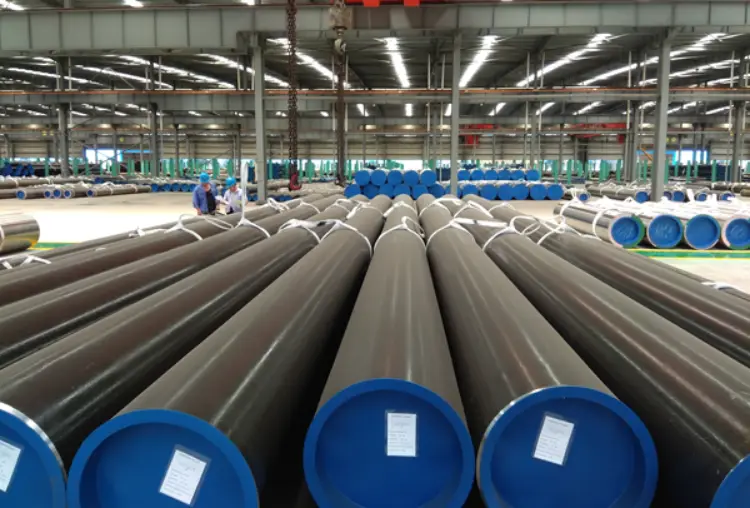
API 2B 2W LSAW Pipe
API 2B Grade 2W LSAW Pipe: Offshore Structural Steel with 50 ksi Yield & Fine Grain Toughness
Comprehensive material data for API 2B Grade 2W LSAW pipe, including chemical composition, mechanical properties, thermal and electrical physical properties, and application guidance for offshore construction.
Shaping of heavy plates by cold forming or press bending, longitudinal seam welding by submerged-arc welding (SAW), followed by controlled cooling or heat treatment (normalizing, normalizing rolling, or TMCP). Pipes may be expanded to improve diameter tolerance and roundness. Supplementary processes include ultrasonic inspection, radiographic testing, and pipe end preparation.
- Phone : +8618037372205
- Email : [email protected]
- WhatsApp: Contact via Whtsapp
- WeChat: +8618037372205
API 2B 2W LSAW Pipe Introduction
API 2B Grade 2W is a fabricated structural steel pipe produced by the longitudinal submerged-arc welding (LSAW) process. It is designed for welded tubular structures in offshore oil and gas production, marine environments, and wind energy foundations. The grade provides a minimum yield strength of 50 ksi (345 MPa) and a minimum tensile strength of 70 ksi (483 MPa), combined with excellent toughness and weldability. It is typically supplied in a normalized, normalized rolled, or thermomechanically controlled processed (TMCP) condition, ensuring fine-grained microstructure and consistent mechanical properties through the wall. The chemistry is restricted by a low carbon equivalent to guarantee field weldability and resistance to hydrogen-induced cracking in service.
API 2B 2W LSAW Pipe Chemical Composition
The heat (ladle) analysis for Grade 2W shall meet the limits shown below. Additional microalloying elements such as Nb, V, or Ti may be added at the manufacturer's discretion to meet the required mechanical properties, provided the specified carbon equivalent is not exceeded. The carbon equivalent CE(IIW) shall not exceed 0.43% or Pcm shall not exceed 0.24% (for wall thickness ≤ 2 in.), ensuring adequate field weldability.
| Element | Required Value (max, unless range) | Remarks |
|---|---|---|
| Carbon (C) | 0.18% | Maximum |
| Manganese (Mn) | 1.00–1.60% | As specified |
| Phosphorus (P) | 0.030% | Maximum |
| Sulfur (S) | 0.030% | Maximum |
| Silicon (Si) | 0.15–0.50% | Range required |
API 2B 2W LSAW Pipe Thermal and Electrical Physical Properties
The data below are typical for low-alloy structural carbon‑manganese steel at room temperature unless otherwise noted. Actual values may vary slightly depending on exact composition and heat treatment. These values are reference for design calculations.
| Property | Typical Value | Unit | Test Condition / Remarks |
|---|---|---|---|
| Density (ρ) | 7.85 | g/cm³ | At 20 °C |
| Elastic Modulus (E) | 205 | GPa | At room temperature |
| Shear Modulus (G) | 80 | GPa | Calculated from E and Poisson's ratio |
| Poisson's Ratio (ν) | 0.30 | – | At room temperature |
| Thermal Expansion Coefficient (α) | 11.7 × 10⁻⁶ | m/(m·°C) | Average, 20 °C to 100 °C |
| Thermal Conductivity (λ) | 50 | W/(m·K) | At 20 °C |
| Specific Heat Capacity (cp) | 460 | J/(kg·K) | At 20 °C |
| Electrical Resistivity (ρe) | 0.15 × 10⁻⁶ | Ω·m | At 20 °C |
API 2B 2W LSAW Pipe Mechanical Properties
The following properties apply to the pipe base metal, tested on specimens taken transverse to the seam. Yield strength and tensile strength are specified for all thicknesses. Elongation requirements vary with wall thickness as tabulated. Bend test is performed on weld and base metal; for Grade 2W the bend mandrel diameter is 2 t (t = specimen thickness) and the bend angle is 180°. Impact toughness requirements (if any) are specified in the purchase order via supplement SR2, SR4, SR5, or similar; without such supplement, no minimum absorbed energy values are mandated by the base standard.
| Property | Required Value | Unit | Test Condition |
|---|---|---|---|
| Yield Strength (ReH) | 345–517 (50–75) | MPa (ksi) | Transverse test, 0.2% offset; pipe body |
| Tensile Strength (Rm) | 483–621 (70–90) | MPa (ksi) | Transverse test; pipe body |
| Elongation (A2″) | 22 min | % | Wall thickness t ≤ 7.94 mm (0.312 in.), gauge length 2 in. (50 mm) |
| Elongation (A2″) | 24 min | % | Wall thickness 7.94 < t ≤ 19.05 mm (0.312–0.750 in.) |
| Elongation (A2″) | 22 min | % | Wall thickness 19.05 < t ≤ 31.75 mm (0.750–1.250 in.) |
| Elongation (A2″) | Decrease 0.5% per 3.18 mm additional, ≥20 | % | Wall thickness > 31.75 mm (1.250 in.) |
| Bend Test (Weld & Base) | No cracks after 180° bend | – | Mandrel diameter = 2t (t = specimen thickness) |
API 2B 2W LSAW Pipe Directly Equivalent Standards and Replacement Grades
| Country/Region | Standard | Grade | Remarks |
|---|---|---|---|
| International | – | – | No other international standard defines an exact duplicate of API 2B Grade 2W. See similar materials for possible substitutes with comparable mechanical properties. |
API 2B 2W LSAW Pipe Application Introduction
API 2B Grade 2W LSAW pipe is engineered for permanent offshore structural applications where high strength, reliable toughness, and excellent weldability are critical. It is widely used in the construction of platforms, subsea structures, and renewable energy foundations. The grade is suitable for both above‑water and submerged components, provided appropriate corrosion protection and coating systems are applied. The typical manufacturing process (cold forming, submerged‑arc welding, and heat treatment) yields deep‑sea‑grade pipes with tight dimensional tolerances and consistent properties.
Product Applications: Offshore platform jackets and legs, Subsea structural braces and conductor guides, Drilling and production conductor casings, Caissons and seawater intake pipes, Wind turbine monopiles and transition pieces, Piles and batter piles for dock and wharf foundations
Processed into products: Jacket leg chords and braces, Conductor and riser guide clamps, Structural nodes and welded tee/k-joints, Pile sleeves and diaphragm stiffeners, Stabbing guides and alignment cones, Tubular sections for mud mats and launch runners
Application industries: Offshore Oil & Gas (fixed platforms, jackets, conductors, piles), Offshore Wind Energy (monopiles, transition pieces, tower foundation structures), Marine Civil Engineering (coastal structures, mooring piles, dock fender systems), Shipbuilding and Heavy Fabrication (structural tubular components)
API 2B 2W LSAW Pipe Similar / Alternative Materials with Comparable Properties
| Country/Region | Standard | Grade | Remarks |
|---|---|---|---|
| USA | ASTM A572 | Grade 50 | Minimum yield 345 MPa, but minimum tensile is 450 MPa (lower than 2W). Requires supplementary toughness requirements for offshore use. |
| USA | API 5L | X52 (L360) | Yield 360 MPa, tensile 460 MPa. Similar strength range but slightly lower tensile; line pipe standard, not always suitable for structural offshore pipe without qualification. |
| Europe | EN 10025‑3 | S355NL | Minimum yield 355 MPa, tensile 470‑630 MPa. Fine‑grain normalized steel; impact test options for low temperature. Lower guaranteed tensile minimum. |
| Europe | EN 10225 | S355G10+N | Offshore structural steel; minimum yield 355 MPa, tensile 470‑630 MPa. Specifically designed for fixed offshore structures, very close in application. |
| Europe | EN 10025‑4 | S460ML | Higher yield (460 MPa), tensile 530‑720 MPa; thermomechanically rolled. Can be considered if higher strength is needed, but weldability and CE require careful evaluation. |
Notes:
Supplementary requirements: The API 2B base specification does not mandate Charpy V‑notch impact testing. When required, the purchaser shall specify a supplement (e.g., SR2, SR4, SR5) defining test temperature and acceptable absorbed energy (commonly 27 J average at ‑40 °C). Non‑destructive examination: Seam weld inspection by ultrasonic or radiographic methods is typically specified; refer to API 2B sections on NDE. Welding consumables: Matching strength electrodes (e.g., E7018 or E71T‑1) are generally acceptable, but welding procedures must consider the actual tensile range (70‑90 ksi) to avoid undermatching.
Dimensional tolerances: API 2B defines allowable variations for diameter, out‑of‑roundness, straightness, and wall thickness; these shall be verified per project specifications.
- Share



