
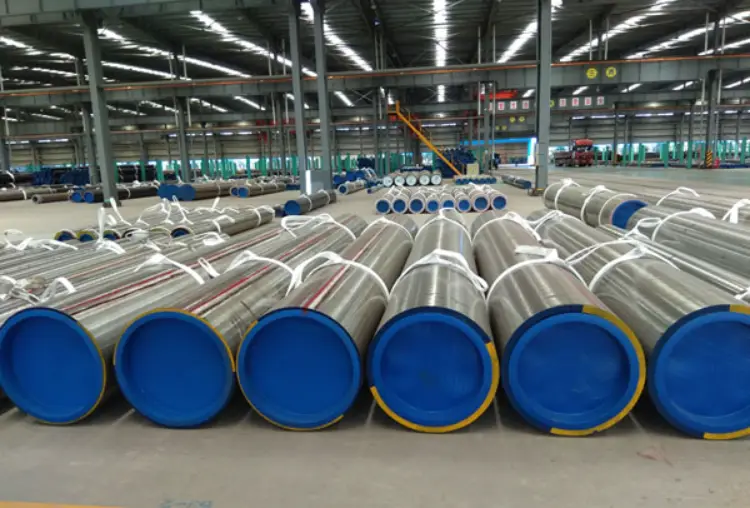
API 5L X80 PSL2 LSAW Pipe
API 5L X80 PSL2 LSAW Pipe: High-Strength Steel for Critical Pipeline Systems
Detailed technical data for API 5L X80 PSL2 LSAW pipe, including chemical composition, mechanical and physical properties, international equivalents, and application guide.
Thermomechanical rolling (TMCP), normalizing, or quench and temper; LSAW welding with multi-wire submerged arc process
- Phone : +8618037372205
- Email : [email protected]
- WhatsApp: Contact via Whtsapp
- WeChat: +8618037372205
API 5L X80 PSL2 LSAW Pipe Introduction
API 5L X80 PSL2 LSAW pipe is a high-strength low-alloy (HSLA) steel designed for long-distance oil and natural gas transportation. Manufactured by longitudinal submerged arc welding (LSAW), it meets the stringent requirements of PSL2 (Product Specification Level 2) under the API 5L standard. It offers excellent strength, toughness, and weldability, with minimum yield strength of 555 MPa (80.5 ksi), enabling operation at high pressures and in harsh environments. The steel undergoes controlled rolling or thermomechanical processing to achieve fine-grained microstructure, providing superior resistance to fracture and fatigue. Typical applications include cross-country pipelines, offshore risers, and high-pressure gas injection lines.
API 5L X80 PSL2 LSAW Pipe Chemical Composition
The chemical composition is based on API 5L PSL2 requirements for X80. Limits are specified to ensure weldability and toughness. Carbon equivalent must be ≤ 0.43% (CEIIW) for thickness ≤ 25 mm;
- CEIIW = C + Mn/6 + (Cr+Mo+V)/5 + (Ni+Cu)/15
Micro-alloying with Nb, V, Ti is used for grain refinement and precipitation strengthening.
| Element | Maximum or Range (%) | Remark |
|---|---|---|
| C | ≤0.12 | Heat analysis; PSL2 limit |
| Mn | ≤1.85 | PSL2 max, typical 1.60-1.85 for X80 |
| P | ≤0.025 | Lower than PSL1 limit of 0.030% |
| S | ≤0.015 | PSL2 maximum for improved toughness |
| Si | ≤0.45 | Typical range 0.10-0.40% |
| V | ≤0.06 | Maximum; often added for strength |
| Nb | ≤0.06 | Maximum; grain refining element |
| Ti | ≤0.06 | Maximum; used for nitrogen binding and grain refinement |
| Cu | ≤0.50 | Added when specified for corrosion resistance |
| Ni | ≤0.50 | Residual/tramp element limit |
| Cr | ≤0.50 | Residual/tramp element limit |
| Mo | ≤0.50 | Residual/tramp element limit |
| N | ≤0.012 | For Ti-treated steels |
| Al (total) | 0.015-0.060 | Grain refining, typical for fine-grain practice |
| CEIIW | ≤0.43 | Carbon equivalent for typical thickness ≤25 mm |
API 5L X80 PSL2 LSAW Pipe Physical Properties
Physical properties are not mandatory in API 5L but are provided as typical reference data for carbon-manganese low-alloy steel. Values may vary slightly with exact composition and heat treatment.
- Density, elastic modulus, and thermal properties are essential for stress analysis and heat transfer calculations.
| Property | Typical Value | Unit | Conditions/Reference |
|---|---|---|---|
| Density (ρ) | 7.85 | g/cm³ | Room temperature |
| Elastic Modulus (E) | 210 | GPa | At 20°C |
| Shear Modulus (G) | 81 | GPa | Calculated from E and ν |
| Poisson's Ratio (ν) | 0.3 | — | Typical for steel |
| Thermal Expansion Coefficient (α) | 11.7 × 10⁻⁶ | 1/K | Mean value 20-100°C; 12.5 × 10⁻⁶ at 20-200°C |
| Thermal Conductivity (λ) | 36 | W/(m·K) | At 20°C; decreases with temperature, ~31 at 300°C |
| Specific Heat Capacity | 480 | J/(kg·K) | At 20-100°C |
| Electrical Resistivity (ρₑ) | 0.18 × 10⁻⁶ | Ω·m | At 20°C |
API 5L X80 PSL2 LSAW Pipe Mechanical Properties
Tensile testing is performed on the pipe body (transverse specimens) per API 5L. Properties are valid for wall thickness up to 25.4 mm (1 inch). Power factor (YS/TS ratio) must be ≤0.93 for PSL2. Charpy V-notch impact tests are conducted at the specified design temperature (commonly -10°C or -20°C) on base metal, weld, and HAZ.
- Minimum average absorbed energy and minimum individual values vary with diameter and grade, but for X80 PSL2 a common requirement is 40 J average / 30 J individual at -20°C for full-size specimens.
| Property | Required Value | Unit | Test Condition |
|---|---|---|---|
| Yield Strength (ReH) | 555 - 705 | MPa | Transverse, pipe body, 0.5% total extension under load |
| Tensile Strength (Rm) | 625 - 825 | MPa | Transverse, pipe body |
| Yield/Tensile Ratio | ≤0.93 | — | Based on actual measured values |
| Elongation (A) | ≥22% (for wall thickness ≤20 mm), higher for thinner wall | % | Gauge length 50 mm, transverse strip test, wall thickness < 25.4 mm |
| Charpy Impact (KV) base metal | ≥40 (average) / ≥30 (single) | J | At -20°C (commonly specified), full-size 10×10 mm specimen |
| Charpy Impact (KV) weld metal | ≥40 (average) / ≥30 (single) | J | At -20°C, full-size specimen |
| Charpy Impact (KV) HAZ | ≥40 (average) / ≥30 (single) | J | At -20°C, full-size specimen |
| Bend Test | No cracks or opening in weld | — | Guided bend, 180° bend, diameter 5× wall thickness for base metal and 6× for weld |
| Hardness | ≤285 HV10 (weld and base metal) | HV10 | Vickers hardness test per API 5L |
API 5L X80 PSL2 LSAW Pipe Exact International Equivalent Standards and Replaceable Grades
| Country/Region | Standard | Grade | Remarks |
|---|---|---|---|
| International | ISO 3183:2019 | L555M (PSL2) or X80M | Identical technical requirements, line pipe for pipeline transportation systems |
| Europe | EN 10208-2:2009 | L555MB | Welded steel pipes for combustible fluids; suffix M indicates TMCP delivery |
| China | GB/T 9711-2017 | L555M/X80M (PSL2) | Petroleum and natural gas industries – steel pipe for pipeline transportation |
| Norway/Offshore | DNV OS-F101:2021 | 555 (SMLS/Weld) PSL2 | Offshore standard for submarine pipeline systems, supplementary requirements possible |
| Canada | CSA Z245.1:2018 | Grade 550 Category II | Category II equivalent to PSL2; for oil and gas pipeline systems |
API 5L X80 PSL2 LSAW Pipe Application Introduction
API 5L X80 PSL2 LSAW pipe is the backbone of modern high-pressure transmission pipelines. Its high strength allows reduction in wall thickness, leading to lower material consumption and transportation costs for long-distance projects.
- Used extensively in onshore and offshore environments where high toughness at low temperatures, good weldability, and resistance to ductile fracture propagation are critical.
- PSL2 ensures stringent chemical and mechanical property control, mandatory notch toughness tests, and NDE of the entire pipe length.
Product Applications: Long-distance oil and gas trunklines, Subsea pipelines and risers, High-pressure gas injection lines, Gas gathering systems, Offshore platform piping
Processed into products: Line pipe for welding into pipeline systems, Pipe bends and elbows (after induction bending), Reducers and tees (fabricated fittings), Riser pipe for offshore structures, Flowline spool pieces, Piling (structural support)
Application industries: Oil and gas exploration and production, Pipeline transportation (onshore and offshore), Energy infrastructure, Petrochemical plant piping (where applicable), High-pressure gas storage and transmission
API 5L X80 PSL2 LSAW Pipe Similar Grades for Potential Substitution
| Country/Region | Standard | Grade | Characteristics and Comparison |
|---|---|---|---|
| API/ISO | API 5L / ISO 3183 | X70 / L485M | Common lower strength alternative; yield strength 485 MPa, better ductility but reduced pressure capacity for a given wall thickness |
| API/ISO | API 5L / ISO 3183 | X80S (sour service) | A sour-service variant of X80 meeting HIC/SSC requirements per NACE MR0175; may be substituted if NACE compliance is needed |
| European | EN 10208-2 | L555QB | Quenched and tempered alternative to TMCP-delivered L555MB, with slightly different toughness/weldability |
| Russian | GOST R 52079-2003 | K65 (strength class 550) | Russian high-strength pipe steel for gas pipelines, comparable to X80 |
Notes:
Supplementary requirements often specified:
- Sour service conformance (HIC, SSC) per NACE MR0175/ISO 15156 – requires additional testing.
- Strain-based design for displacement-controlled loading (e.g., seismic, landslide) may require specific tensile property windows and higher uniform elongation.
- DWTT (Drop Weight Tear Test) for ductile fracture arrest prediction, commonly required for gas pipelines ≥ 85% SMYS.
- CTOD (Crack Tip Opening Displacement) testing for offshore applications to ensure toughness in welds.
- Pipes can be coated externally with 3LPE, 3LPP, or FBE, and internally with liquid epoxy for corrosion protection.
- Share



