
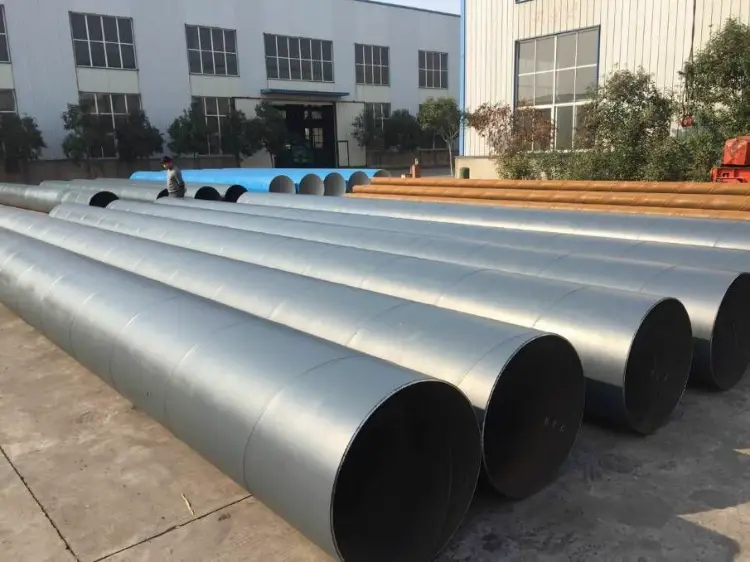
API 5L X70 PSL2 LSAW Line Pipe Steel
API 5L X70 PSL2 LSAW Line Pipe Steel - Comprehensive Material Data
Complete material profile, chemical composition, mechanical and physical properties for API 5L X70 PSL2 steel used in longitudinally submerged arc welded pipes.
Thermomechanical rolling (TMCP) or quenching and tempering (Q&T) for base plate; LSAW welding process with automatic submerged arc welding for longitudinal seam
- Phone : +8618037372205
- Email : [email protected]
- WhatsApp: Contact via Whtsapp
- WeChat: +8618037372205
API 5L X70 PSL2 LSAW Line Pipe Steel Introduction
API 5L X70 PSL2 is a high-strength low‑alloy (HSLA) steel specifically designed for line pipe in the oil and gas industry. It provides a minimum yield strength of 485 MPa (70 ksi) with excellent toughness, weldability, and, when required, resistance to sour service environments. Product Specification Level 2 (PSL2) mandates tighter chemical composition limits, mandatory notch toughness testing, and more stringent mechanical requirements compared to PSL1. The longitudinally submerged arc welded (LSAW) manufacturing method delivers pipes with high dimensional accuracy, consistent wall thickness, and a reliable longitudinal weld seam, making them ideal for large‑diameter, high‑pressure pipelines. The steel is typically produced by thermomechanical controlled processing (TMCP) or quenching and tempering (Q&T), ensuring a fine‑grained microstructure that combines strength and ductility. Typical applications include long‑distance onshore and offshore gas and oil transmission pipelines, where the material's high strength‑to‑weight ratio allows for thinner wall designs and lower installation costs.
API 5L X70 PSL2 LSAW Line Pipe Steel Chemical Composition , PSL2
Chemical composition limits for API 5L X70 PSL2 pipe in product analysis. All values are maximum percent by weight unless a range is given. Carbon equivalent (CE) is controlled to ensure field weldability; PSL2 also limits the sum of vanadium, niobium and titanium. Elements not listed (e.g., Al, N) are permitted within standard residuals.
| Element | Standard Value (max %) | Remarks |
|---|---|---|
| C | 0.12 | Maximum; tighter limit than PSL1 |
| Mn | 1.70 | Maximum |
| Si | 0.45 | Maximum |
| P | 0.025 | Maximum |
| S | 0.015 | Maximum |
| V | 0.05 | Individually limited |
| Nb | 0.05 | Individually limited |
| Ti | 0.06 | Individually limited |
| V+Nb+Ti | 0.15 | Sum of microalloying elements |
| Cu (if added) | 0.50 | Residual or intentional addition |
| Ni (if added) | 0.50 | Residual or intentional addition |
| Cr (if added) | 0.50 | Residual or intentional addition |
| Mo (if added) | 0.50 | Residual or intentional addition |
| CE (Pcm) | 0.22 | PSL2 requirement for C ≤0.12%, typical for offshore/sour service |
API 5L X70 PSL2 LSAW Line Pipe Steel Thermal and Electrical Physical Properties
The physical property values provided are typical for grade X70 steel in the quenched‑and‑tempered or TMCP condition. Actual values may vary slightly with exact chemical composition and heat treatment. These data are suitable for general engineering calculations of thermal expansion, heat transfer, and electrical resistance.
| Property | Typical Value | Unit | Conditions |
|---|---|---|---|
| Density (ρ) | 7850 | kg/m³ | At 20°C |
| Modulus of Elasticity (E) | 205 | GPa | At 20°C |
| Shear Modulus (G) | 80 | GPa | Approximate, at 20°C |
| Poisson's Ratio (ν) | 0.3 | — | At 20°C |
| Thermal Expansion Coefficient (α) | 11.7 × 10⁻⁶ | /°C | 20–100°C |
| Thermal Expansion Coefficient (α) | 12.2 × 10⁻⁶ | /°C | 20–200°C |
| Thermal Expansion Coefficient (α) | 13.0 × 10⁻⁶ | /°C | 20–400°C |
| Thermal Conductivity (λ) | 50 | W/(m·K) | At 20°C |
| Thermal Conductivity (λ) | 45 | W/(m·K) | At 200°C |
| Specific Heat Capacity (cp) | 460 | J/(kg·K) | At 20°C |
| Electrical Resistivity (ρe) | 0.20 × 10⁻⁶ | Ω·m | At 20°C |
API 5L X70 PSL2 LSAW Line Pipe Steel Mechanical Properties
Required tensile and toughness properties for API 5L X70 PSL2 LSAW pipe, based on transverse specimens from the pipe body. Impact test temperature is as specified on the purchase order (commonly 0°C or ‑10°C). For PSL2, a maximum yield‑to‑tensile ratio and hardness limits are often imposed to enhance plastic strain capacity and resistance to cracking.
| Property | Required Value | Unit | Test Conditions |
|---|---|---|---|
| Yield Strength (Rt0.5) | 485–635 (min–max) | MPa | Transverse strip, base metal, ambient temperature |
| Tensile Strength (Rm) | 570–760 (min–max) | MPa | Transverse strip, base metal |
| Rt0.5 / Rm | ≤ 0.93 | — | PSL2, for sour service or by agreement |
| Elongation (A50) – wall ≤10 mm | ≥ 21 | % | 2 in. (50.8 mm) gauge, transverse |
| Elongation (A50) – 10–15 mm wall | ≥ 20 | % | 2 in. gauge, transverse |
| Elongation (A50) – 15–20 mm wall | ≥ 19 | % | 2 in. gauge, transverse |
| Elongation (A50) – wall >20 mm | ≥ 18 | % | 2 in. gauge, transverse; or per API formula |
| Charpy V‑Notch (base metal) | ≥ 27 avg / ≥ 20 single | J | Full‑size, transverse, at specified temp. |
| Charpy V‑Notch (weld & HAZ) | ≥ 40 avg / ≥ 30 single | J | Full‑size, transverse, at same temp. |
| Bend Test | 180° no cracks | — | Mandrel = 3T (T=thickness ≤12.7 mm); larger ratio for thicker |
| Hardness (weld & HAZ) | ≤ 250 HV10 | HV | PSL2 requirement, by agreement |
API 5L X70 PSL2 LSAW Line Pipe Steel Completely Equivalent Material Standards and Substitutable Grades
| Country/Region | Standard | Grade | Remarks |
|---|---|---|---|
| Global / International | ISO 3183:2021 | L485M (PSL2) | Line pipe; L485M for TMCP, L485Q for Q&T |
| European Union | EN 10208‑2 | L485MB | Steel for pipelines for combustible fluids; seamless & welded |
| China | GB/T 9711‑2023 | L485M | PSL2 line pipe, equivalent to API X70 |
| Canada | CSA Z245.1 | Grade 483 Category II | Pipe steel; min YS 483 MPa, close match |
| Russia / CIS | GOST R 52079 | K56 | Strength class K56 (YS ≥ 470 MPa); not exact but often used |
API 5L X70 PSL2 LSAW Line Pipe Steel Application Introduction
API 5L X70 PSL2 LSAW pipes are the backbone of modern high‑pressure, large‑diameter pipeline systems for natural gas, crude oil, and refined products. Their high strength allows for reduced wall thickness, which lowers material costs, weight, and welding time during field installation. The LSAW process ensures tight dimensional tolerances and excellent weld seam quality, critical for automated ring‑welding in the field and for long‑term integrity under harsh conditions. Offshore application in deep‑water risers and flowlines benefits from the material's good toughness at low temperatures and, when specified, resistance to sour service (HIC/SSC). The steel is also used for high‑pressure water transmission and in structural applications where strength and weldability are paramount.
Product Applications: Cross‑country natural gas transmission pipelines, Crude oil trunk lines, Offshore risers and flowlines, Gathering lines in gas fields, Compressor and pumping station piping, Plant/refinery process piping (high strength option)
Processed into products: Straight pipe joints (12 m standard length, beveled ends), Induction bends (hot formed from LSAW pipe), Tee, reducer, and cap fittings (fabricated from plate or forged), Welding neck flanges (forged from similar chemistry), Valve bodies and pig launcher/receiver barrels (forged from matching grade)
Application industries: Oil and gas exploration and production, Pipeline transportation (onshore and offshore), Petrochemical and refining, Offshore engineering and subsea infrastructure, High‑pressure water distribution
API 5L X70 PSL2 LSAW Line Pipe Steel Similar or Alternative Material Recommendations
| Country/Region | Standard | Grade | Remarks |
|---|---|---|---|
| Global | API 5L | X65 (PSL2) | Lower strength (min YS 450 MPa); suitable for less demanding pressure/temperature conditions |
| Global | API 5L | X80 (PSL2) | Higher strength (min YS 555 MPa); enables thinner walls or higher pressures |
| Global | ISO 3183 | L450M (X65 PSL2) | Equivalent to X65, economic alternative where X70 is over‑specified |
| Global | ISO 3183 | L555M (X80 PSL2) | Equivalent to X80, next strength step |
| USA | ASTM A860 | WPHY 70 | Butt‑welding fittings, for use with X70 pipe |
Notes:
PSL2 pipe requires Charpy V‑notch testing on the pipe body and the weld/HAZ at a temperature specified by the purchaser. Hydrostatic testing and full‑length ultrasonic or electromagnetic inspection of the weld seam are mandatory. For sour service (H₂S environments), supplementary requirements such as HIC and SSC tests must be agreed upon. The carbon equivalent (CE or Pcm) must be controlled to ensure field weldability without preheating. Pipes are often supplied with external anti‑corrosion coatings (3LPE, 3LPP, FBE) and, for offshore, with concrete weight coating. Purchasers should specify the desired supplementary requirements in the purchase order.
- Share



