
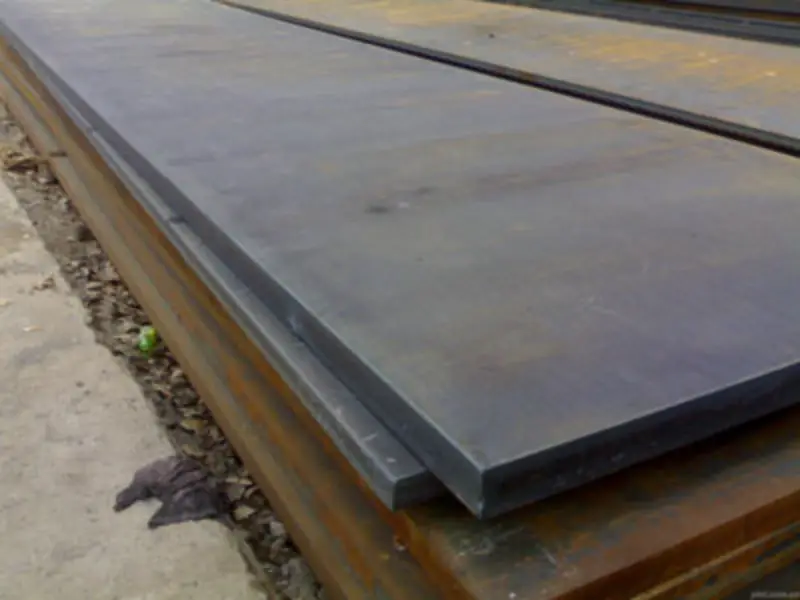
DIN 17102 TStE285 Normalized Fine-Grain Structural Steel
TStE285 High-Strength Fine-Grain Steel Coil DIN 17102 – Properties & Equivalents
Complete material data for TStE285 carbon and low-alloy high-strength steel coil according to DIN 17102: chemical composition, mechanical and physical properties, international equivalents, and application guidance.
Hot rolling, normalizing, thermo-mechanical rolling, cold forming, welding, machining
- Phone : +8618037372205
- Email : [email protected]
- WhatsApp: Contact via Whtsapp
- WeChat: +8618037372205
DIN 17102 TStE285 Normalized Fine-Grain Structural Steel Introduction
TStE285 is a weldable fine-grain structural steel specified in the superseded German standard DIN 17102. It belongs to the carbon and low-alloy high-strength steel group with enhanced toughness, particularly suited for low-temperature service (the "T" designation indicates tested impact properties). The grade is typically supplied as hot-rolled coil, plate, or strip in a normalized or thermo-mechanically rolled condition. It offers a minimum yield strength of 285 MPa (for thickness ≤ 16 mm) and good weldability thanks to a low carbon equivalent. This steel is used extensively in welded structures, pressure vessels, bridges, and offshore engineering where a combination of strength, toughness, and reliability under dynamic loading is required.
DIN 17102 TStE285 Normalized Fine-Grain Structural Steel Chemical Composition
Typical ladle analysis limits according to DIN 17102 for TStE285. Microalloying elements (Nb, V, Ti) may be added singly or in combination to achieve fine-grain strengthening. The carbon equivalent value (CEV) is generally controlled ≤ 0.40 to ensure good weldability.
| Element | Standard Value (max, unless range) | Remarks |
|---|---|---|
| C | ≤ 0.12 | Carbon |
| Si | ≤ 0.50 | Silicon |
| Mn | ≤ 1.50 | Manganese |
| P | ≤ 0.030 | Phosphorus |
| S | ≤ 0.025 | Sulfur |
| Al (total) | ≥ 0.020 | Aluminium (fully killed) |
| Nb | ≤ 0.05 | Niobium (optional) |
| V | ≤ 0.10 | Vanadium (optional) |
| Ti | ≤ 0.05 | Titanium (optional) |
| N | ≤ 0.012 | Nitrogen |
| CEV* | ≤ 0.40 | Carbon Equivalent (typical, by agreement) |
DIN 17102 TStE285 Normalized Fine-Grain Structural Steel Thermal, Electrical and Physical Properties
Nominal physical constants for low-alloy structural steel. These values are not explicitly mandated by DIN 17102 but are representative for TStE285 at room temperature.
| Property | Typical Value | Unit | Test Condition / Remarks |
|---|---|---|---|
| Density (ρ) | 7.85 | g/cm³ | At 20 °C |
| Youngs modulus (E) | 210 | GPa | At 20 °C |
| Shear modulus (G) | approx. 80 | GPa | At 20 °C |
| Poissons ratio (ν) | 0.3 | – | At 20 °C |
| Thermal expansion coefficient (α) | 12.0 × 10⁻⁶ | K⁻¹ | 20 °C to 100 °C |
| Thermal conductivity (λ) | approx. 50 | W/(m·K) | At 20 °C |
| Specific heat capacity (cp) | approx. 460 | J/(kg·K) | At 20 °C |
| Electrical resistivity (ρe) | approx. 0.15 | Ω·mm²/m | At 20 °C |
DIN 17102 TStE285 Normalized Fine-Grain Structural Steel Mechanical Properties
Tensile and impact properties per DIN 17102 for TStE285 in the normalized or thermo-mechanical condition. Values vary with product thickness; multiple rows are provided for the most common thickness ranges.
- Bend test: 180° bending to internal diameter = 2a (a = specimen thickness), no cracks required.
- Impact test: Charpy-V notch (KV2) longitudinal specimens, minimum 27 J at -20 °C.
| Property | Required Value | Unit | Test Condition |
|---|---|---|---|
| Yield strength (ReH) | ≥ 285 | MPa | Thickness ≤ 16 mm |
| Yield strength (ReH) | ≥ 275 | MPa | Thickness > 16 mm and ≤ 40 mm |
| Yield strength (ReH) | ≥ 265 | MPa | Thickness > 40 mm and ≤ 63 mm |
| Tensile strength (Rm) | 400 – 540 | MPa | All thicknesses |
| Elongation after fracture (A5) | ≥ 22 | % | Thickness ≤ 16 mm, longitudinal |
| Elongation after fracture (A5) | ≥ 21 | % | Thickness > 16 mm and ≤ 40 mm |
| Elongation after fracture (A5) | ≥ 20 | % | Thickness > 40 mm and ≤ 63 mm |
| Bend test | No cracks, mandrel dia. 2×t | – | Ambient temperature, bending angle 180° |
| Impact energy (KV2) | ≥ 27 | J | Longitudinal, -20 °C |
DIN 17102 TStE285 Normalized Fine-Grain Structural Steel Directly Equivalent Standards and Substitute Grades
| Country/Region | Standard | Grade | Remarks |
|---|---|---|---|
| Germany / Europe | DIN 17102 (superseded) | TStE285 | Original grade with guaranteed impact properties at -20 °C |
| Europe | EN 10025-3:2019 | S275NL | Closest current equivalent; min. yield 275 MPa (t≤16 mm), impact at -50 °C. Slightly lower strength but improved toughness. |
| Europe | EN 10025-3 | S275N | Similar normalized fine-grain steel; min. yield 275 MPa, impact at -20 °C. Suitable as a direct alternative for many applications. |
| Europe | EN 10113-2 (withdrawn) | S275N | Predecessor of EN 10025-3, historically used as equivalent for StE285 type steels. |
DIN 17102 TStE285 Normalized Fine-Grain Structural Steel Application Introduction
TStE285 (and its modern counterparts such as S275NL) is designed for welded heavy-plate structures requiring proof of toughness at sub-zero temperatures. Its fine-grained microstructure guarantees uniform mechanical properties across the section, making it suitable for static and dynamically loaded components. The material is easily weldable with low preheat requirements thanks to its low carbon equivalent. Typical applications span civil engineering, pressure equipment, marine engineering, and machinery where a combination of strength, ductility, and notch toughness is essential.
Product Applications: Welded bridge girders and box sections, Offshore platform structures (jackets, decks, modules), Pressure vessels and storage spheres (with additional certification), Penstocks and hydraulic pipelines, Ship hulls and deck structures, Tower sections for wind turbines, Heavy-duty crane booms and jibs
Processed into products: Weld preparation components – flanges, webs, stiffeners, Flanged and dished heads for pressure vessels, Supporting brackets and lugs for heavy equipment, Tubular nodes and K-joints in truss structures, Machinery frames and base plates, Guide rails and track supports in cranes, Piling and sheet piling interlocks
Application industries: Construction and civil engineering, Bridge building, Offshore and marine engineering, Pressure vessel and boiler manufacturing, Shipbuilding, Heavy machinery and equipment, Wind energy (tower and foundation structures), Storage tank and silo fabrication
DIN 17102 TStE285 Normalized Fine-Grain Structural Steel Similar / Near-Equivalent Substitute Materials
| Country/Region | Standard | Grade | Remarks |
|---|---|---|---|
| Europe | EN 10025-4 | S275M / S275ML | Thermo-mechanically rolled fine-grain steel with similar strength, good toughness; ML grade has improved low-temperature properties. |
| Europe | EN 10025-2 | S275J2 (+N) | General structural steel, normalized, with impact test at -20 °C. Lower strength (min. 275 MPa) but widely available and cost-effective. |
| USA | ASTM A572/A572M | Grade 50 (Type 1) | High-strength low-alloy structural steel; min. yield 345 MPa (50 ksi) for thickness ≤ 150 mm – possesses higher strength, comparable weldability. |
| USA | ASTM A633/A633M | Grade C | Normalized HSLA steel with min. yield 345 MPa, good toughness down to -30 °C; used in low-temperature structural applications. |
| Japan | JIS G 3106 | SM490B / SM490C | Welded structural steel with min. yield 325 MPa; impact guarantee at 0 °C (B) or -10 °C (C). Slightly higher strength. |
| China | GB/T 1591 | Q345B / Q345D | HSLA structural steel; min. yield 345 MPa (t≤16 mm), impact at 20 °C (B) or -20 °C (D). Higher strength but lower toughness requirements. |
Notes:
Additional remarks:
- DIN 17102 has been officially withdrawn and replaced by the EN 10025 series. For new designs, the European grades S275N/NL or S275M/ML should be specified in accordance with the relevant application standards.
- Impact test temperature for TStE285 is typically -20 °C; the modern S275NL grade provides a guaranteed minimum impact energy of 27 J at -50 °C, offering extended cold-weather capability.
- When substituting with ASTM A572 Gr. 50 or other higher-strength grades, attention must be paid to the increased yield strength which may affect forming and welding procedures.
- The carbon equivalent (CEV) should be agreed upon at the time of order to ensure consistent weldability. Typical CEV values for TStE285 are ≤ 0.40.
- Material can be certified with additional testing (e.g., through-thickness tensile, ultrasonic examination) upon agreement.
- Share



