
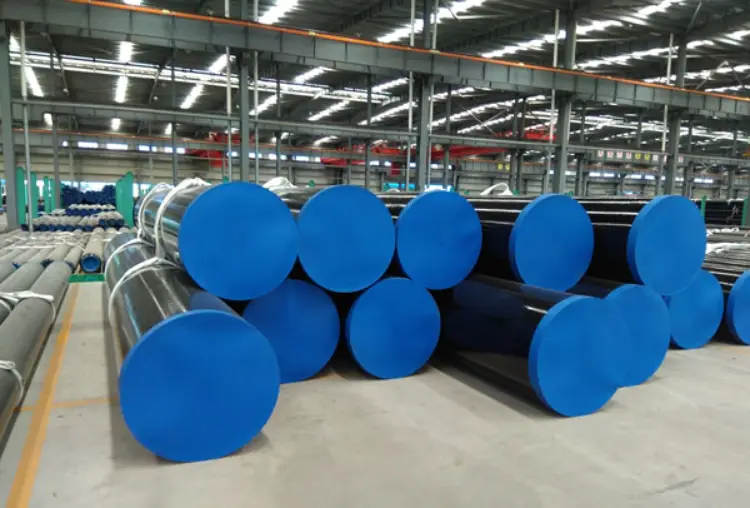
API 5L X65 PSL2 LSAW Line Pipe
API 5L X65 PSL2 LSAW Line Pipe - High-Strength Steel for Critical Pipelines
Detailed material data for API 5L X65 PSL2 LSAW line pipe, including chemical composition, mechanical and thermal properties, international equivalents, and application guidance.
Hot rolling, controlled rolling, thermomechanical controlled processing (TMCP), longitudinal submerged arc welding (LSAW), normalizing or quenching & tempering (optional)
- Phone : +8618037372205
- Email : [email protected]
- WhatsApp: Contact via Whtsapp
- WeChat: +8618037372205
API 5L X65 PSL2 LSAW Line Pipe Introduction
API 5L X65 PSL2 LSAW is a high-strength, low-alloy steel grade primarily used in the oil and gas industry for transportation of hydrocarbons under high pressure and demanding environmental conditions. The designation "X65" indicates a minimum specified yield strength of 65,000 psi (450 MPa), while "PSL2" denotes the stricter Product Specification Level 2 under API 5L, which imposes tighter limits on chemical composition, carbon equivalent, mechanical properties, and non-destructive testing. LSAW (Longitudinal Submerged Arc Welded) refers to the manufacturing process where steel plates or coils are formed and welded longitudinally using submerged arc welding, yielding large-diameter, thick-wall pipes with excellent dimensional precision and weld integrity.
This material is characterized by:
- Excellent strength–toughness balance, even at low temperatures
- Good weldability thanks to low carbon content and controlled microalloying
- High resistance to ductile and brittle fracture propagation
- Suitability for sour service when meeting supplementary requirements (e.g., HIC testing)
- Compliance with international line pipe standards like ISO 3183 and EN 10208-2
Typical delivery condition is thermomechanically controlled processed (TMCP), which refines the grain structure and provides the required combination of strength, toughness, and weldability. The pipes are often supplied with external anti-corrosion coatings (3LPE, FBE) and internal linings to extend service life in corrosive environments.
API 5L X65 PSL2 LSAW Line Pipe Chemical Composition
The chemical composition below reflects the maximum limits for API 5L X65 PSL2 as per API 5L 46th edition. For PSL2, strict control of carbon equivalent (CE) and microalloying elements ensures good weldability and toughness. Actual product analysis may show minor variations within the allowed tolerances.
- Carbon equivalent CE(IIW) = C + Mn/6 + (Cr+Mo+V)/5 + (Ni+Cu)/15, typically max 0.43% for thickness ≤ 25 mm.
- Pcm = C + Si/30 + (Mn+Cu+Cr)/20 + Ni/60 + Mo/15 + V/10 + 5B, typically max 0.25% for sour service applications.
- Aluminum is added for deoxidation and grain refinement; total Al content is usually 0.015–0.060%.
| Element | Typical Maximum (wt%) | Remarks |
|---|---|---|
| C | 0.12 | Lower carbon improves weldability |
| Si | 0.45 | Deoxidizer; typical range 0.10–0.35 |
| Mn | 1.65 | Strength and toughness; may be adjusted depending on thickness |
| P | 0.025 | Strict limit for low-temperature toughness |
| S | 0.015 | Strict limit for HIC resistance |
| V | 0.05 | Microalloying for grain refinement |
| Nb | 0.05 | Microalloying for grain refinement and precipitation strengthening |
| Ti | 0.04 | Nitrogen binding and grain refinement |
| Al (total) | 0.060 (min 0.015) | Fine grain practice |
| N | 0.012 | Max limit; higher values impair strain aging |
| Cu | 0.35 | Residual; may be up to 0.50% for special grades |
| Ni | 0.30 | Residual; improves toughness |
| Cr | 0.30 | Residual; increases hardenability |
| Mo | 0.15 | Residual; for thick sections may be specified |
| B | 0.0005 | Trace; may be used for hardenability control |
| CE(IIW) | 0.43 (typical) | For thickness ≤ 25 mm; higher for thicker pipes |
| Pcm | 0.25 (optional) | Required for sour service or specific customer requirements |
API 5L X65 PSL2 LSAW Line Pipe Physical and Thermal Properties
The following thermophysical and electrical properties are typical for API 5L X65 grade steel (low-alloy C-Mn steel) at room temperature unless otherwise noted. These values are not part of the API 5L specification but are representative for design calculations such as thermal expansion, heat transfer, and electrical conductivity.
- Density is assumed constant over the working temperature range.
- Elastic modulus decreases linearly with temperature (e.g., ~ 200 GPa at 100°C).
- Poisson's ratio remains nearly constant in the elastic range.
| Property | Typical Value | Unit | Reference Condition |
|---|---|---|---|
| Density (ρ) | 7.85 | kg/dm³ | At 20°C |
| Modulus of Elasticity (E) | 205 | GPa | At 20°C, static tensile test |
| Shear Modulus (G) | 80 | GPa | At 20°C, calculated from E and ν |
| Poisson's Ratio (ν) | 0.29 | - | Within elastic limit at 20°C |
| Thermal Expansion Coefficient (α) | 11.7 | 10⁻⁶/K | Between 20°C and 100°C |
| Thermal Conductivity (λ) | 50 | W/(m·K) | At 20°C |
| Specific Heat Capacity (c) | 460 | J/(kg·K) | At 20°C |
| Electrical Resistivity (ρ_e) | 0.16 | µΩ·m | At 20°C |
API 5L X65 PSL2 LSAW Line Pipe Mechanical Properties
The mechanical properties below represent the mandatory requirements for API 5L X65 PSL2 LSAW pipe. Tensile testing is performed transverse to the weld seam (body and weld). Impact toughness is measured using Charpy V-notch specimens; test temperature and energy values are typically agreed upon and often set at -20°C or -40°C for offshore applications. Bend tests or flattening tests are part of pipe qualification but not directly applicable to base metal alone.
- Yield strength (Rt0.5) must be at least 450 MPa and shall not exceed 600 MPa.
- The yield-to-tensile ratio (Rt0.5/Rm) is not mandatory but typically limited to 0.93 for strain-based design.
- Transverse weld tensile strength must meet the same limits as the base metal.
| Property | Required Value | Unit | Condition / Remarks |
|---|---|---|---|
| Yield Strength (Rt0.5) | 450 – 600 | MPa | Transverse direction, 0.5% total extension under load |
| Tensile Strength (Rm) | 535 – 760 | MPa | Transverse direction |
| Yield/Tensile Ratio | ≤ 0.93 (typical) | - | Customer option for strain-based design |
| Elongation (A) | min 22 | % | Standard round specimen, gauge length 50 mm; actually calculated as A = 1940 * (A0)^0.2 / Rm^0.9, but typical min 18–22% |
| Charpy V-notch Impact Energy (base metal) | min 40 (avg) / 30 (single) | J | At -20°C (other temperatures possible); full-size specimens, transverse |
| Charpy V-notch Impact Energy (weld metal & HAZ) | min 40 (avg) / 30 (single) | J | At -20°C (typically same as base metal) |
| Hardness (optional) | max 250 HV10 or 22 HRC | - | For sour service, max 250 HV10 individual |
API 5L X65 PSL2 LSAW Line Pipe Direct Equivalent Standards & Grades for X65 PSL2 LSAW Pipe
| Country/Region | Standard | Grade / Designation | Remarks |
|---|---|---|---|
| International | ISO 3183 | L450 PSL2 | Equivalent to X65 in metric; often dual certified with API 5L |
| Europe | EN 10208-2 | L450MB | Seamless or welded lines with similar requirements; "M" for TMCP delivery |
| Canada | CSA Z245.1 | Grade 448 (or 483) | CSA 483 MPa grade matches X65; PSL2 equivalent to Category II or III |
| DNV (Norway) | DNV-OS-F101 | SAWL 450 | Submarine pipeline standard; impact testing at lower temperatures |
| Australia/New Zealand | AS 2885.1 | API 5L X65 PSL2 | Adopts API 5L directly; additional toughness requirements |
| Russia/CIS | GAZPROM / Transneft | К60 (K60) | Strength class 60 = minimum 588 MPa tensile; equivalent to X65 with national supplements |
| Brazil | Petrobras N-2787 | API 5L X65 PSL2 | Recognizes API 5L with additional sour service constraints |
API 5L X65 PSL2 LSAW Line Pipe Application Introduction
API 5L X65 PSL2 LSAW pipes are the backbone of modern high-pressure pipeline systems. Their balanced strength, toughness, and weldability make them suitable for both onshore and offshore applications, where safety, longevity, and cost-effectiveness are paramount. The material is commonly used for long-distance transmission of natural gas, crude oil, and refined products, and can be adapted for sour service (H₂S-containing) when ordered with additional testing, e.g., HIC/SSC resistance, and controlled hardness. Typical coatings include 3-layer polyethylene (3LPE), fusion-bonded epoxy (FBE), and concrete weight coating for subsea lines.
Product Applications: Cross-country natural gas transmission pipelines, High-pressure oil flowlines and gathering lines, Subsea risers and tie-in spools, Injection pipelines (water, CO₂, chemical), Pipe-in-pipe systems for thermal insulation, Large-diameter casing and conductor pipe
Processed into products: LSAW welded pipes (main line segments), Induction bends and cold-formed elbows, Tee fittings, reducers, and caps (fabricated from plates), Flanges and connectors (welded to pipe ends), Pup pieces and transition pieces, Structural tubular members for jackets and decks
Application industries: Oil & gas upstream (exploration & production), Midstream transportation (pipeline operators), Refining & petrochemical plants, Offshore & subsea engineering, Water transmission (long-distance water lines), Mining & slurry transport
API 5L X65 PSL2 LSAW Line Pipe Similar Materials
| Country/Region | Standard | Grade | Remarks |
|---|---|---|---|
| USA | API 5L | X60 PSL2 | Slightly lower strength (415 MPa min yield); may be upgraded with higher Mn/C content but less stringent CE limits |
| USA | API 5L | X70 PSL2 | Higher strength (485 MPa min yield); for heavier-wall pipes, welding more demanding, often requires preheat |
| USA | ASTM A572 / A709 | Grade 65 (Type 3) | Structural steel with minimum 450 MPa yield; not intended for line pipe, but plate chemistry similar, lacks through-thickness toughness guarantees |
| Europe | EN 10025-4 | S460M/ML | Structural steel TMCP; 460 MPa min yield, similar weldability but not designed for sour gas environment |
| Japan | JIS G 3106 | SM570 | Welded structural steel with min tensile 570 MPa; approximate strength match, but toughness requirements differ |
| China | GB/T 9711 | L450 | Near equivalent to ISO 3183 L450; used in domestic pipeline projects |
| Worldwide | API 5L | X65 PSL1 | PSL1 has relaxed requirements on chemistry and testing; less suitable for critical or low-temperature service |
Notes:
Additional Considerations for API 5L X65 PSL2 LSAW:
- PSL2 requires mandatory non-destructive inspection (UT/RT) of the entire weld seam length.
- For sour service, supplementary requirements (e.g., NACE TM0177/0284) apply: hardness control to max 250 HV10, HIC/SSC testing, and low sulfur content (≤0.002%).
- Typical dimensions cover outer diameters from 16″ to 100″+ with wall thickness up to 50 mm, depending on mill capability.
- The pipe may be supplied with internal epoxy flow coating to reduce friction and corrosion.
- When used offshore, the material is often certified by classification societies (DNV, ABS, etc.) with additional low-temperature impact toughness verification.
- All test certificates and traceability documentation are part of the PSL2 delivery package.
- Share



