
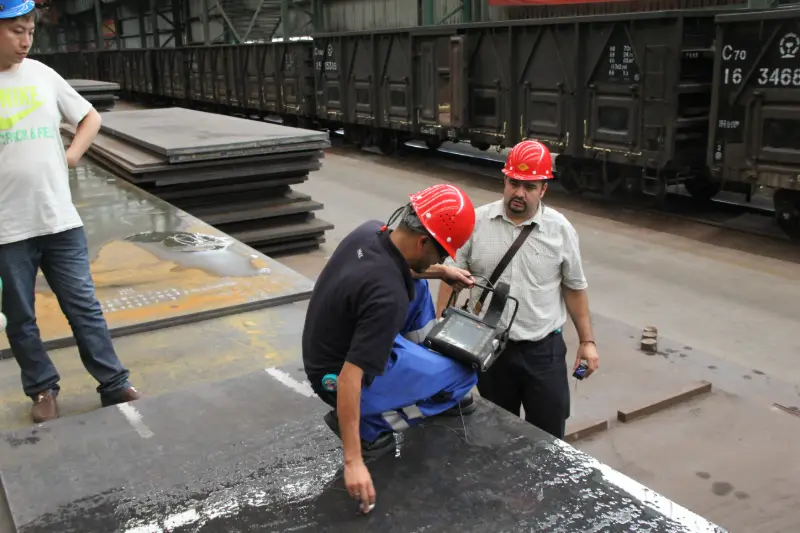
DIN 17100 St37-3 Structural Steel
DIN 17100 St37-3 Structural Steel: Properties, Equivalents & Application Guide
Comprehensive material data for St37-3 steel according to DIN 17100, including chemical composition, mechanical and thermal properties, international equivalents, and application recommendations.
Hot rolling, cold forming, welding, machining, bolting, riveting, and galvanizing
- Phone : +8618037372205
- Email : [email protected]
- WhatsApp: Contact via Whtsapp
- WeChat: +8618037372205
DIN 17100 St37-3 Structural Steel Introduction
DIN 17100 St37-3 is a carbon and low-alloy high-strength structural steel grade originally specified in the withdrawn German standard DIN 17100. It is characterized by a minimum yield strength of 235 MPa and a tensile strength in the range of 360–510 MPa (depending on thickness). The '-3' suffix designates a fully killed fine-grain steel with guaranteed impact toughness of at least 27 J at -20 °C, making it suitable for general structural applications with moderate dynamic loads. Today, St37-3 is effectively superseded by S235J2 (1.0117) under EN 10025-2, but the legacy designation remains widely used in trade and maintenance of existing structures. The steel is typically supplied in hot-rolled condition and can be welded, bolted, and riveted using common fabrication techniques.
- Excellent weldability for its strength class
- Good balance of strength and ductility
- Reliable low-temperature toughness
- Widely available in plates, sections, and coils
DIN 17100 St37-3 Structural Steel Chemical Composition
Chemical requirements for St37-3 in accordance with DIN 17100. The steel is fully killed and deoxidized. Trace elements may be present in small quantities to improve mechanical properties. Note: Values represent ladle analysis maxima unless otherwise specified.
| Chemical Element | Standard Value | Remarks |
|---|---|---|
| Carbon (C) | ≤ 0.17 | Maximum; typical 0.14–0.17 |
| Silicon (Si) | ≤ 0.35 | Typical range 0.15–0.35 for killed steel |
| Manganese (Mn) | ≤ 1.40 | Typical range 0.50–1.20 depending on thickness |
| Phosphorus (P) | ≤ 0.040 | Maximum |
| Sulfur (S) | ≤ 0.040 | Maximum |
| Nitrogen (N) | ≤ 0.009 | Maximum for fine-grain practice |
| Aluminum (Al) | ≥ 0.020 (acid-soluble) | Min. to ensure fully killed condition |
| Copper (Cu) | ≤ 0.55 | Optional; when specified for weather resistance |
| Other elements | by agreement | May include Nb, V, Ti for grain refinement |
DIN 17100 St37-3 Structural Steel Thermal and Electrical Physical Properties
Typical physical properties of low-carbon structural steel applicable to St37-3 at room temperature unless otherwise noted. These values are based on general data for unalloyed steel with similar composition and are provided for design guidance. Note: Properties may vary slightly with actual chemical composition and heat treatment condition.
| Property | Typical Value | Unit | Test Condition |
|---|---|---|---|
| Density (ρ) | 7.85 | g/cm³ | 20 °C |
| Elastic modulus (E) | 210 | GPa | 20 °C |
| Shear modulus (G) | 81 | GPa | 20 °C |
| Poisson's ratio (ν) | 0.3 | - | 20 °C |
| Thermal expansion coefficient (α) | 10.8 | 10⁻⁶/K | 20–100 °C |
| Thermal expansion coefficient (α) | 11.5 | 10⁻⁶/K | 20–200 °C |
| Thermal expansion coefficient (α) | 12.2 | 10⁻⁶/K | 20–300 °C |
| Thermal conductivity (λ) | 50 | W/(m·K) | 20 °C |
| Thermal conductivity (λ) | 48 | W/(m·K) | 100 °C |
| Specific heat capacity (cp) | 460 | J/(kg·K) | 20 °C |
| Specific heat capacity (cp) | 480 | J/(kg·K) | 100 °C |
| Electrical resistivity (ρe) | 0.15 – 0.20 | µΩ·m | 20 °C |
DIN 17100 St37-3 Structural Steel Mechanical Properties
Mechanical properties of St37-3 steel at room temperature as specified in DIN 17100. The values vary with product thickness and testing direction. All values are for longitudinal test pieces unless stated otherwise. Key features: guaranteed impact energy at -20 °C distinguishes it from lower grades.
| Property | Required Value | Unit | Test Condition |
|---|---|---|---|
| Yield Strength (ReH) | ≥ 235 | MPa | Thickness ≤ 16 mm |
| Yield Strength (ReH) | ≥ 225 | MPa | 16 mm < thickness ≤ 40 mm |
| Yield Strength (ReH) | ≥ 215 | MPa | 40 mm < thickness ≤ 63 mm |
| Yield Strength (ReH) | ≥ 195 | MPa | 63 mm < thickness ≤ 80 mm |
| Tensile Strength (Rm) | 360 – 510 | MPa | Thickness ≤ 16 mm |
| Tensile Strength (Rm) | 360 – 510 | MPa | 16 mm < thickness ≤ 40 mm |
| Tensile Strength (Rm) | 360 – 510 | MPa | 40 mm < thickness ≤ 63 mm |
| Tensile Strength (Rm) | 340 – 490 | MPa | 63 mm < thickness ≤ 80 mm |
| Elongation after fracture (A) | ≥ 26 | % | Thickness ≤ 16 mm; gauge length Lo = 5.65√So |
| Elongation after fracture (A) | ≥ 25 | % | 16 mm < thickness ≤ 40 mm |
| Elongation after fracture (A) | ≥ 24 | % | 40 mm < thickness ≤ 63 mm |
| Elongation after fracture (A) | ≥ 23 | % | 63 mm < thickness ≤ 80 mm |
| Charpy impact energy (KV) | ≥ 27 | J | Longitudinal; -20 °C; min. average of 3 tests |
| Bend test (mandrel dia.) | No cracks; mandrel diameter = 1a (a=t) | - | Thickness ≤ 16 mm; 180° bend |
DIN 17100 St37-3 Structural Steel Exact Equivalent Material Standards & Replaceable Grades
| Country/Region | Standard | Grade | Remarks |
|---|---|---|---|
| Europe | EN 10025-2:2004 | S235J2 (1.0117) | Direct successor; same yield and tensile strength, Charpy 27J at -20°C; technically identical. |
| Germany | DIN 17100 | St37-3 | Original grade designation. |
| USA | ASTM A36 / A283M | Grade D or Structural Steel | Comparable strength; yield 250 MPa (≤ 20 mm); Charpy values may differ unless specified. |
| Japan | JIS G3101 | SS400 | Similar strength; no mandatory Charpy toughness unless supplementary requirement agreed. |
| China | GB/T 700 | Q235D | Charpy 27J at -20°C; yield ≥ 235 MPa; Chinese equivalent for low-temperature use. |
| International | ISO 630-2 | S235N | Normalized structural steel with 27J at -20°C; fully equivalent if N condition. |
DIN 17100 St37-3 Structural Steel Application Introduction
St37-3 is a versatile structural steel suitable for a broad spectrum of equipment and infrastructure projects where guaranteed notch toughness at sub‑zero temperatures is required. It is easily fabricated by welding, cutting, and forming, and it can be galvanized or painted for corrosion protection. Typical uses include:
Product Applications: Building frameworks and columns, Pedestrian and road bridges, Liquid storage tanks and water towers, Trailer frames and truck chassis, Agricultural implements (ploughs, cultivators), Conveyor structures and crane beams, Wind tower internal attachments, Industrial flooring and grating
Processed into products: Bolted and welded structural connections, Support brackets and base plates, Stiffeners and diaphragm plates, Machinery housings and frames, Pipe flanges and flanged joints, Excavation bucket shells, Shelving and racking systems, Guardrails and handrail posts
Application industries: Civil engineering and construction, Bridge building, Storage tank and silo manufacturing, Agricultural and forestry machinery, Automotive and railway vehicle components, Offshore structural components (non‑critical), Pipe and pressure vessel fabrication (below code limits), Mining and earth‑moving equipment supports
DIN 17100 St37-3 Structural Steel Similar / Alternative Material Recommendations
| Country/Region | Standard | Grade | Remarks |
|---|---|---|---|
| Europe | EN 10025-2 | S235JR (1.0038) | Lower toughness grade (27J at +20°C); otherwise identical strength; may replace St37-3 where low‑temperature toughness is not mandatory. |
| Europe | EN 10025-2 | S235J0 (1.0114) | Moderate toughness (27J at 0°C); intermediate between JR and J2. |
| Europe | EN 10025-3 | S235NL (1.0356) | Normalized, fine‑grain steel with guaranteed 27J at -50°C; superior to St37-3 for low‑temperature applications. |
| USA | ASTM A572 | Grade 50 | Higher strength (yield 345 MPa); often used as a stronger alternative but requires welding procedure adjustments. |
| Russia | GOST 27772 | C255 | Equivalent to S235J0; -20°C toughness options available by agreement. |
| Brazil | ABNT NBR 7007 | MR-250 | Similar yield strength; Charpy toughness class optional. |
Notes:
Welding: St37-3 can be welded by all common processes, including manual metal arc, MAG, submerged arc, and gas welding. Preheat is generally not necessary for sections up to 30 mm. Low‑hydrogen electrodes are recommended for dynamic loading to avoid cold cracking.
Formability: The grade allows cold bending and limited drawing; for tight radius bends, normalising may be performed.
Surface protection: Can be hot‑dip galvanised or metal sprayed without loss of mechanical properties. Please note that DIN 17100 is officially withdrawn and replaced by EN 10025‑2; for new designs, EN S235J2 should be referenced.
- Share



