
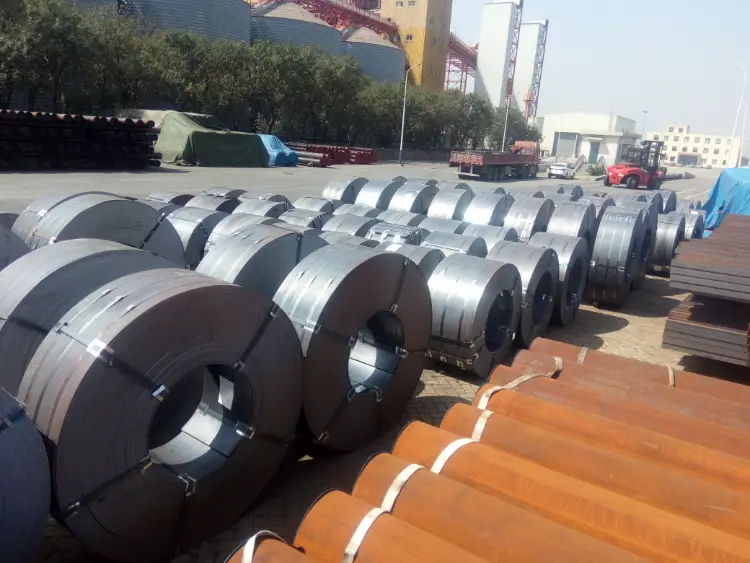
DIN 17100 RSt37-2 Carbon Structural Steel Coil
DIN 17100 RSt37-2 Steel Coil: Equivalent Grades, Properties & Applications
Detailed datasheet of RSt37-2 carbon structural steel: chemical composition, mechanical and physical properties, international equivalents like S235JR, and typical applications in construction and machinery.
Welding, bending, forming, shearing, punching, moderate machining
- Phone : +8618037372205
- Email : [email protected]
- WhatsApp: Contact via Whtsapp
- WeChat: +8618037372205
DIN 17100 RSt37-2 Carbon Structural Steel Coil Introduction
DIN 17100 RSt37-2 is a hot-rolled, low-carbon structural steel supplied in coils, plates, bars, and sections. It belongs to the obsolete German standard DIN 17100 and is now superseded by EN 10025-2 S235JR. The grade is characterized by good weldability, moderate strength, and adequate formability, making it suitable for general structural purposes, light machinery, and welded constructions. As a rimmed steel, it has a relatively low silicon content. Typical delivery condition is as-rolled, without specific impact toughness guarantees. The material can be easily cut, bent, drilled, and welded by conventional methods.
DIN 17100 RSt37-2 Carbon Structural Steel Coil Chemical Composition
The chemical limits for RSt37-2 according to DIN 17100 are listed below. Being a rimmed steel, residual silicon is typically low (≤0.07%) and not specified. Values correspond to the ladle analysis. The grade has been replaced by S235JR, which tightens limits for P and S.
| Element | Max. Value (wt%) | Remarks |
|---|---|---|
| Carbon (C) | 0.17 | For nominal thickness ≤16 mm |
| Manganese (Mn) | 1.40 | For nominal thickness ≤16 mm |
| Phosphorus (P) | 0.045 | Higher than modern EN standards |
| Sulfur (S) | 0.045 | Higher than modern EN standards |
| Nitrogen (N) | 0.009 | No deliberate addition |
DIN 17100 RSt37-2 Carbon Structural Steel Coil Thermal and Electrical Physical Properties
These values represent typical room-temperature physical properties for low-carbon structural steel (density, modulus, thermal expansion, etc.). They are applicable to RSt37-2 unless otherwise stated. Variations may occur depending on specific production conditions.
| Property | Typical Value | Unit | Test Condition |
|---|---|---|---|
| Density, ρ | 7.85 | g/cm³ | At 20 °C |
| Modulus of elasticity, E | 210 | GPa | At 20 °C |
| Shear modulus, G | 80 | GPa | At 20 °C |
| Poisson's ratio, ν | 0.3 | — | At 20 °C |
| Coefficient of thermal expansion, α | 12.0 | 10⁻⁶/K | 20–100 °C |
| Thermal conductivity, λ | ~50 | W/(m·K) | At 20 °C |
| Specific heat capacity, cₚ | ~460 | J/(kg·K) | At 20 °C |
| Electrical resistivity, ρₑ | ~0.16 | μΩ·m | At 20 °C |
DIN 17100 RSt37-2 Carbon Structural Steel Coil Mechanical Properties
Mechanical properties at room temperature for hot-rolled condition. Data based on DIN 17100 for thickness ranges. RSt37-2 does not guarantee impact toughness; the values below refer to tensile and bending tests. Elongation is given for gauge length 5.65√S0 (proportional test piece).
| Property | Required Value | Unit | Test Condition |
|---|---|---|---|
| Yield strength, ReH | ≥235 | MPa | Thickness ≤16 mm |
| Yield strength, ReH | ≥225 | MPa | 16 mm < thickness ≤40 mm |
| Tensile strength, Rm | 360–510 | MPa | Thickness ≤16 mm |
| Tensile strength, Rm | 340–470 | MPa | 16 mm < thickness ≤40 mm |
| Elongation after fracture, A5 | ≥26 | % | Longitudinal, thickness ≤16 mm |
| Elongation after fracture, A5 | ≥25 | % | Longitudinal, 16 mm < thickness ≤40 mm |
| Bend test (mandrel diameter) | 1.5 × thickness | — | 180° bending, no cracks |
| Impact energy, KV (Charpy-V) | Not guaranteed | J | RSt37-2 does not specify impact toughness |
DIN 17100 RSt37-2 Carbon Structural Steel Coil Direct Equivalent Grade Replacements
| Country/Region | Standard | Grade | Remarks |
|---|---|---|---|
| Europe | EN 10025-2 | S235JR | Current standard, direct replacement |
| USA | ASTM A283/A283M | Grade C | Similar tensile requirements, hot-rolled |
| Japan | JIS G3101 | SS400 | General structural rolled steel |
| China | GB/T 700 | Q235B | Closest Chinese carbon structural steel |
DIN 17100 RSt37-2 Carbon Structural Steel Coil Application Introduction
RSt37-2 is a versatile, cost-effective structural material suitable for non-critical load-bearing applications where notch toughness is not a primary requirement. Its excellent weldability and formability enable a wide range of products. Typical applications are listed below.
Product Applications: Steel frameworks and trusses, Light columns and beams, Walkways and railings, Container bodies, Corrugated sheets for roofing, Unpressurized storage tanks, Material handling racks
Processed into products: Mounting brackets and flanges, Machine beds and frames, Supports and stiffeners, Bushings and spacers, Punched or laser-cut parts, Bent plates and sections, Welded subassemblies
Application industries: Construction, Bridge building, General mechanical engineering, Agricultural equipment, Storage systems, Automotive (non-safety parts)
DIN 17100 RSt37-2 Carbon Structural Steel Coil Similar Grade Recommendations
| Country/Region | Standard | Grade | Remarks |
|---|---|---|---|
| Europe | EN 10025-2 | S235J0 / S235J2 | S235JR with improved low-temperature toughness |
| USA | ASTM A36/A36M | K02600 (A36) | Common structural steel, slightly lower min. yield (250 MPa) |
| Germany (old) | DIN 17100 | St37-2 | Original designation, RSt37-2 is the rimmed variant |
| International | ISO 630 | Fe 360 B | Similar strength range for structural steels |
Notes:
RSt37-2 is a rimmed steel grade historically produced without full deoxidation, leading to a relatively clean surface and lower silicon content. For new designs, the fully killed equivalent S235JR (EN 10025-2) is strongly recommended to meet modern quality and toughness requirements. Impact toughness is not guaranteed in the original DIN 17100 specification; if needed, select S235J0 or S235J2.
- Share



