
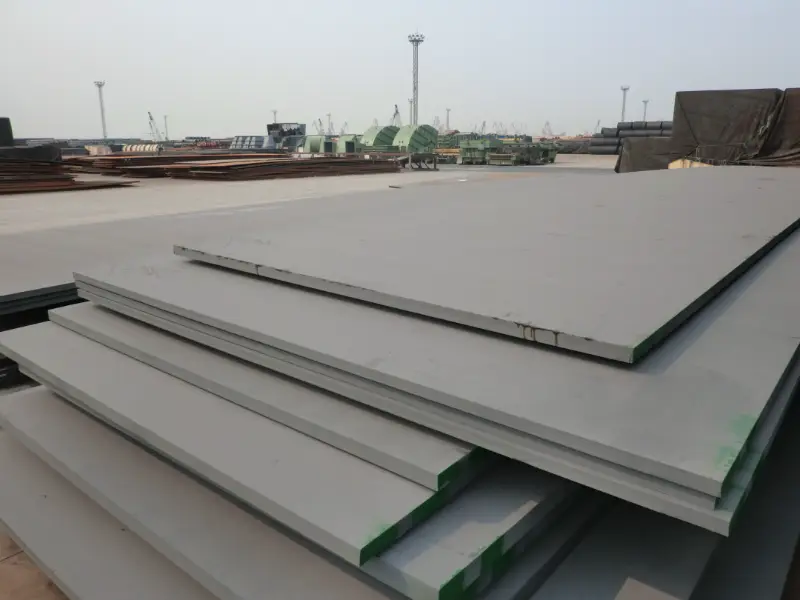
Austenitic XM-19 (UNS S20910) Stainless Steel Plate/Coil
Austenitic XM-19 (UNS S20910) Stainless Steel Plate/Coil - High-Strength Nitrogen-Enhanced Grade
Explore the properties of XM-19 (UNS S20910) stainless steel plate and coil, a high-strength austenitic grade with excellent corrosion resistance and weldability.
Hot rolling, cold rolling, annealing, pickling, cutting, forming, welding, machining
- Phone : +8618037372205
- Email : [email protected]
- WhatsApp: Contact via Whtsapp
- WeChat: +8618037372205
Austenitic XM-19 Stainless Steel Plate/Coil Introduction
UNS S20910, commonly known as XM-19 or Nitronic 50, is a high-nitrogen, high-strength austenitic stainless steel. It offers approximately twice the yield strength of conventional 300-series stainless steels (such as 304 and 316) while maintaining excellent corrosion resistance and toughness. The alloy is fully austenitic and non-magnetic even after severe cold working. Key attributes include:
- Excellent resistance to pitting and crevice corrosion, comparable to or better than Type 316 in many environments.
- High strength in the annealed condition, with the possibility of further increase through cold working.
- Good high-temperature oxidation resistance and cryogenic toughness.
- Outstanding resistance to stress corrosion cracking in chloride environments.
XM-19 is widely used for plates and coils in chemical processing, marine, and high-pressure applications where a combination of strength and corrosion resistance is required.
Austenitic XM-19 Stainless Steel Plate/Coil Chemical Composition
The chemical composition of UNS S20910 (XM-19) as specified in ASTM A240 for plate, sheet, and strip. The alloy is nitrogen-strengthened and contains molybdenum for improved pitting resistance. All values are in maximum weight percent unless a range is indicated.
- Nitrogen significantly raises the yield strength and stabilizes the austenitic structure.
- Niobium and vanadium additions refine grain structure and improve mechanical properties.
| Element | Standard Value | Remarks |
|---|---|---|
| Carbon (C) | 0.06 max | Limits carbide precipitation during welding |
| Manganese (Mn) | 4.0 – 6.0 | Increases nitrogen solubility and strength |
| Phosphorus (P) | 0.040 max | Residual element |
| Sulfur (S) | 0.030 max | Controlled for better machinability (if required) |
| Silicon (Si) | 0.75 max | Deoxidizer; higher levels may affect corrosion resistance |
| Chromium (Cr) | 20.5 – 23.5 | Primary element for corrosion resistance |
| Nickel (Ni) | 11.5 – 13.5 | Maintains austenitic structure and toughness |
| Molybdenum (Mo) | 1.50 – 3.00 | Enhances pitting and crevice corrosion resistance |
| Nitrogen (N) | 0.20 – 0.40 | Key strengthening element; greatly increases yield strength |
| Niobium (Nb) / Columbium (Cb) | 0.10 – 0.30 | Grain refinement and precipitation strengthening |
| Vanadium (V) | 0.10 – 0.30 | Contributes to grain refinement and strength |
| Iron (Fe) | Balance | Remainder |
Austenitic XM-19 Stainless Steel Plate/Coil Thermal and Electrical Physical Properties
Physical properties of XM-19 (UNS S20910) in the annealed condition at room temperature unless otherwise stated. These values are typical for high-nitrogen austenitic stainless steels and may vary slightly depending on exact composition and processing.
- The alloy is non-magnetic in the annealed and lightly cold-worked condition (relative magnetic permeability ≤ 1.01).
- Thermal expansion is similar to other austenitic grades; thermal conductivity is lower than carbon steels.
| Property | Typical Value | Unit | Test Condition / Temperature |
|---|---|---|---|
| Density (ρ) | 7.88 | g/cm³ | Room temperature |
| Modulus of Elasticity (E) | 200 | GPa | Room temperature (tension) |
| Shear Modulus (G) | 77 | GPa | Room temperature |
| Poisson's Ratio (ν) | 0.30 | – | Room temperature |
| Mean Coefficient of Thermal Expansion (α) | 16.2 | µm/m·°C | 20 – 100 °C |
| 16.8 | µm/m·°C | 20 – 300 °C | |
| 17.8 | µm/m·°C | 20 – 500 °C | |
| Thermal Conductivity (λ) | 15 | W/m·K | at 100 °C |
| 17 | W/m·K | at 300 °C | |
| 20 | W/m·K | at 500 °C | |
| Specific Heat Capacity (cp) | 500 | J/kg·K | Room temperature |
| Electrical Resistivity (ρe) | 0.72 | µΩ·m | Room temperature |
Austenitic XM-19 Stainless Steel Plate/Coil Mechanical Properties
Room-temperature tensile properties for solution-annealed XM-19 (UNS S20910) plate according to ASTM A240. The alloy exhibits substantially higher yield strength than standard 300-series austenitic grades. Ductility remains excellent. Hardness values are maximum limits; actual values are usually lower. Testing is performed on longitudinal specimens per ASTM A370.
- The grade can be further strengthened by cold working; cold-drawn bars and heavy cold-worked plate can reach yield strengths above 1000 MPa.
- Notch toughness at cryogenic temperatures is outstanding.
| Property | Standard Requirement (min unless noted) | Unit | Test Condition |
|---|---|---|---|
| Tensile Strength (Rm) | 690 | MPa | Room temperature |
| Yield Strength (ReH, 0.2% offset) | 380 | MPa | Room temperature |
| Elongation (A) in 50 mm | 35 | % | Room temperature |
| Hardness (HBW) | 255 max | HBW | As annealed |
| Hardness (HRB) | 100 max | HRB | As annealed |
| Bend Test (for plate thickness t ≤ 9.5 mm) | 180° bend around diameter = t | – | No cracks |
| Bend Test (for plate thickness 9.5 mm < t ≤ 19 mm) | 180° bend around diameter = 2t | – | No cracks |
Austenitic XM-19 Stainless Steel Plate/Coil Fully Equivalent Material Standards and Substitutable Grade Designations
| Country/Region | Standard | Grade / Designation | Remarks |
|---|---|---|---|
| United States | ASTM A240 / A240M | XM-19 (UNS S20910) | Plate, sheet, strip for pressure vessels and general purposes |
| United States | ASTM A276 / A276M | XM-19 (UNS S20910) | Stainless steel bars and shapes |
| United States | ASTM A479 / A479M | XM-19 (UNS S20910) | Bars and shapes for use in boilers and pressure vessels |
| United States | ASME SA-240 | XM-19 (UNS S20910) | ASME Boiler and Pressure Vessel Code, identical requirements |
| United States | AMS 5764 | – | Aerospace Material Specification for bars and forgings |
| International | ISO 15510:2014 | X2CrNiMnMoN21-16-5-3 | Chemical composition very similar; may be considered functionally equivalent for many applications |
| Germany (EU) | EN 10088-3 (historical) | 1.3964 (X2CrNiMnMoN21-15-4-3) | Close chemical match; often dual-certified with S20910 |
Austenitic XM-19 Stainless Steel Plate/Coil Application Introduction
XM-19 (UNS S20910) is selected when a combination of high strength, excellent corrosion resistance, and non-magnetic properties is needed. It is a workhorse in aggressive chloride-containing environments where 316 stainless steel would be marginal. The alloy can be hot and cold formed, machined (with proper tools), and readily welded using filler metals of matching composition. Typical delivery condition is solution annealed, but cold-worked tempers (e.g., ¼ hard, ½ hard, full hard) are available for springs and high-strength fasteners. It is widely used in shapes such as plate, sheet, coil, bar, and forging stock.
Product Applications: Pressure vessels and storage tanks, Heat exchangers and condensers, Welded pipes and tubes, Fabricated structural components in aggressive atmospheres, Spring stock for corrosive environments, Fasteners (bolts, nuts, studs) for high-pressure flanges, Pump and valve components, Medical implant plates and screws, Cryogenic transfer lines and storage containers
Processed into products: Valve stems, seats, and trim, Pump shafts and sleeves, Offshore platform riser clamps and fittings, Chemical injector nozzles, Marine drive shafts and propeller hubs, Spring washers and disc springs, Hip joint prostheses and bone plates (in specific forms), High-strength studs and tie rods for subsea use, Expansion bellows and flexible hoses, Welded filter screens and demisters
Application industries: Chemical and petrochemical processing, Marine and offshore engineering, Oil and gas production (wellhead components, valves), Power generation (pump shafts, boiler parts), Food and pharmaceutical processing, Cryogenic equipment and liquefied natural gas (LNG) handling, Medical devices (surgical implants, instruments), Aerospace and defense
Austenitic XM-19 Stainless Steel Plate/Coil Similar / Alternative Materials Recommendation
| Country/Region | Standard | Grade | Remarks |
|---|---|---|---|
| United States | ASTM A240 | S31603 (316L) | Standard austenitic grade; lower strength but similar corrosion resistance; often upgraded to XM-19 for strength without sacrificing weldability. |
| United States | ASTM A240 | S21800 (Nitronic 60) | Another nitrogen-strengthened austenitic grade; better galling resistance but slightly lower pitting resistance; used for wear components. |
| United States | ASTM A240 / A789 | S32205 (2205 duplex) | Duplex stainless steel; higher strength than XM-19 (in annealed condition) and good chloride SCC resistance; limited to lower temperature use; magnetism may be a concern. |
| United States | ASTM A240 | S24100 (Nitronic 32) | High-manganese austenitic; very high work-hardening rate; used for springs and cryogenic structures; corrosion resistance lower than XM-19. |
| Germany (EU) | EN 10088-3 | 1.4507 (X2CrNiMoCuWN23-7-4) | Super duplex steel; offers higher strength and pitting resistance than XM-19; suitable for severe seawater service, but with more complex welding requirements. |
Notes:
Welding: XM-19 can be welded by all common methods (GTAW, GMAW, SMAW, SAW). Filler metal of matching composition (ER209, ER219) is recommended to maintain strength and corrosion resistance. Low heat input and interpass temperature < 150°C are advised to avoid sensitization.
Heat treatment: Solution annealing is performed at 1065–1120°C (1950–2050°F) followed by rapid quenching (water or air). Stress relieving at 400–500°C may be applied, but prolonged exposure in the 550–900°C range should be avoided to prevent sigma-phase formation.
Availability: Plate and coil are commonly stocked in thicknesses from 0.3 mm to 50 mm and widths up to 2 m. Custom sizes and cut-to-length service are offered by many suppliers.
Corrosion note: The alloy exhibits excellent resistance to chloride pitting (PREN ≈ 30–34) and is virtually immune to chloride stress corrosion cracking in service up to about 60°C.
- Share



