
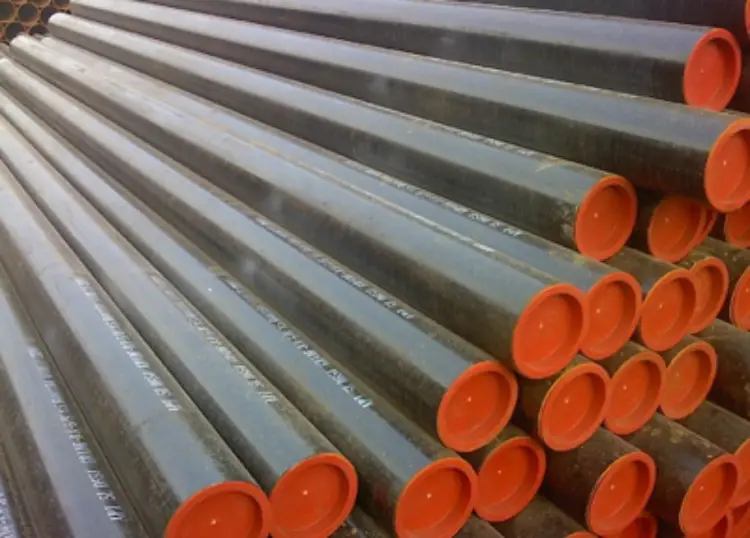
DIN 17100 St37-2 LSAW Pipe
DIN 17100 St37-2 LSAW Pipe: Composition, Strength & Global Equivalents
Comprehensive material analysis of DIN 17100 St37-2 steel for LSAW pipes: chemical composition, mechanical and physical properties, international equivalents, similar grades, and application guidance.
Hot rolling, cold forming, welding (SAW, LSAW), cutting, machining
- Phone : +8618037372205
- Email : [email protected]
- WhatsApp: Contact via Whtsapp
- WeChat: +8618037372205
DIN 17100 St37-2 LSAW Pipe Introduction
St37-2 is a widely used German non-alloy structural steel grade defined in the historical standard DIN 17100 (1980). It corresponds to the modern European grade S235JR per EN 10025-2. The steel offers good weldability, formability, and a minimum yield strength of 235 MPa for thicknesses up to 16 mm. It is commonly delivered in the as-rolled condition and is extensively applied in welded structures, including LSAW (Longitudinal Submerged Arc Welded) pipes for water, oil, and gas transmission.
- Excellent balance of strength and ductility
- Easy to weld, cut, and bend
- Suitable for general structural and pipeline engineering
- Replaced by EN 10025-2 S235JR for new designs
DIN 17100 St37-2 LSAW Pipe Chemical Composition
The chemical requirements for St37-2 are specified in DIN 17100. Values are ladle analysis limits. Thicker products have slightly relaxed Carbon limits. Residual elements like Cu and N are controlled for weldability.
| Element | Standard Value (wt%) | Remarks |
|---|---|---|
| Carbon (C) | ≤0.17 (t≤16mm), ≤0.20 (t>16mm) | Primary strengthening element; low content ensures weldability. |
| Silicon (Si) | ≤0.30 (typical residual) | Not formally specified but controlled for deoxidation. |
| Manganese (Mn) | ≤1.40 | Enhances strength and toughness. |
| Phosphorus (P) | ≤0.045 | Impurity; higher levels reduce toughness. |
| Sulfur (S) | ≤0.045 | Impurity; can cause hot shortness during welding. |
| Nitrogen (N) | ≤0.009 (optional) | Fine-grain/normalized grades may have this limit. |
| Copper (Cu) | ≤0.55 (as residual) | May improve atmospheric corrosion resistance but not required. |
DIN 17100 St37-2 LSAW Pipe Thermal & Electrical Physical Properties
These physical properties are typical for carbon structural steel of this composition at room temperature and may vary slightly with processing and heat treatment.
| Property | Typical Value | Unit | Test Condition |
|---|---|---|---|
| Density (ρ) | 7.85 | g/cm³ | At 20°C |
| Modulus of elasticity (E) | 210 | GPa | At 20°C |
| Shear modulus (G) | 81 | GPa | At 20°C |
| Poisson's ratio (ν) | 0.30 | — | At 20°C |
| Thermal expansion coefficient (α) | 12.0 | 10⁻⁶/K | 20 – 100°C |
| Thermal expansion coefficient (α) | 12.5 | 10⁻⁶/K | 20 – 200°C |
| Thermal conductivity (λ) | 53 | W/(m·K) | At 20°C |
| Thermal conductivity (λ) | 50 | W/(m·K) | At 100°C |
| Specific heat capacity | 460 | J/(kg·K) | At 20°C |
| Electrical resistivity (ρₑ) | 0.16 | Ω·mm²/m | At 20°C |
DIN 17100 St37-2 LSAW Pipe Mechanical Properties
The mechanical properties are guaranteed at ambient temperature and in the as-delivered condition. No impact energy (KV) is required for St37-2. The bend test evaluates formability without cracking.
| Property | Standard Requirement | Unit | Test Condition |
|---|---|---|---|
| Minimum yield strength (ReH) | ≥235 | MPa | Thickness ≤16 mm |
| Minimum yield strength (ReH) | ≥225 | MPa | 16 < t ≤ 40 mm |
| Minimum yield strength (ReH) | ≥215 | MPa | 40 < t ≤ 63 mm |
| Minimum yield strength (ReH) | ≥205 | MPa | 63 < t ≤ 80 mm |
| Minimum yield strength (ReH) | ≥195 | MPa | 80 < t ≤ 100 mm |
| Tensile strength (Rm) | 360 – 510 | MPa | Thickness ≤ 40 mm |
| Tensile strength (Rm) | 340 – 470 | MPa | 40 < t ≤ 100 mm |
| Elongation after fracture (A) | ≥26 | % | Longitudinal, t ≤ 16 mm, L₀ = 5.65√S₀ |
| Elongation after fracture (A) | ≥24 | % | Longitudinal, 16 < t ≤ 40 mm |
| Elongation after fracture (A) | ≥22 | % | Longitudinal, 40 < t ≤ 63 mm |
| Elongation after fracture (A) | ≥21 | % | Longitudinal, 63 < t ≤ 100 mm |
| Bend test (180° bending angle) | d = 0.5a | — | Transverse, t ≤ 16 mm (d: mandrel diameter, a: specimen thickness) |
| Bend test (180° bending angle) | d = a | — | Transverse, 16 < t ≤ 100 mm |
DIN 17100 St37-2 LSAW Pipe Fully Equivalent Material Standards & Substitute Grades
| Country/Region | Standard | Grade | Remarks |
|---|---|---|---|
| Europe | EN 10025-2 | S235JR | Direct successor; same strength and weldability; mandatory for new projects. |
| United States | ASTM A283 / A283M | Grade C | Tensile properties overlap, but yield strength may differ slightly; widely used for structural carbons. |
| Japan | JIS G 3101 | SS400 | Equivalent general structural steel with comparable tensile/yield ranges. |
| China | GB/T 700 | Q235B | Equivalent carbon structural steel; often used for welded structures and pipelines. |
| International | ISO 630-2 | Fe360B | Old ISO designation corresponding to St37-2; replaced by S235JR. |
DIN 17100 St37-2 LSAW Pipe Application Introduction
St37-2 (S235JR) is a versatile structural steel used across multiple industries. Its combination of moderate strength, excellent weldability, and low cost makes it the material of choice for general fabrication, especially in LSAW pipes where long seam welds demand reliable base metal quality.
Product Applications: LSAW pipes for oil, gas, and water, Spiral welded pipes (from strip of same grade), Steel beams, columns, and trusses, Bridges, stadiums, and industrial buildings, Storage tanks and pressure vessels (low pressure), Truck chassis and rail components
Processed into products: Pipe segments and couplings, Flanges and gaskets, Structural profiles (H, I, U sections), Welded joints and stiffeners, Machinery frames and supports, Conveyor systems and hoppers, Earth-moving equipment parts
Application industries: Oil & gas pipeline transmission, Water supply and sewage systems, Structural and civil engineering, Bridge and highway construction, Heavy machinery manufacturing, Shipbuilding and marine structures, Automotive frames and undercarriages
DIN 17100 St37-2 LSAW Pipe Similar/Alternative Material Recommendation
| Country/Region | Standard | Grade | Remarks |
|---|---|---|---|
| Europe | EN 10025-2 | S235J0 | Improved impact toughness (27J at 0°C); suitable when notch toughness is required. |
| Europe | EN 10025-2 | S235J2 | Even better low-temperature toughness (27J at -20°C); ideal for Arctic applications. |
| United States | ASTM A36 / A36M | A36 | Higher carbon content (~0.25% max), yield strength 250 MPa; slightly stronger but similar weldability. |
| China | GB/T 700 | Q235C | Better notch toughness at 0°C; can be an upgraded alternative for critical structures. |
| International | ISO 630-3 | S235J0 | Improved toughness variant, aligned with EN S235J0. |
Notes:
Important note: DIN 17100 was officially superseded by EN 10025-2 in 2004. For all new designs, S235JR should be specified. LSAW pipes manufactured from St37-2 plate or coil inherit the same chemical and mechanical limits. For buried or subsea pipelines, additional requirements (e.g., enhanced toughness, coating, or sour service compliance) must be negotiated. Verify the weld seam properties (HAZ softening) when post-weld heat treatment is applied.
- Share



