
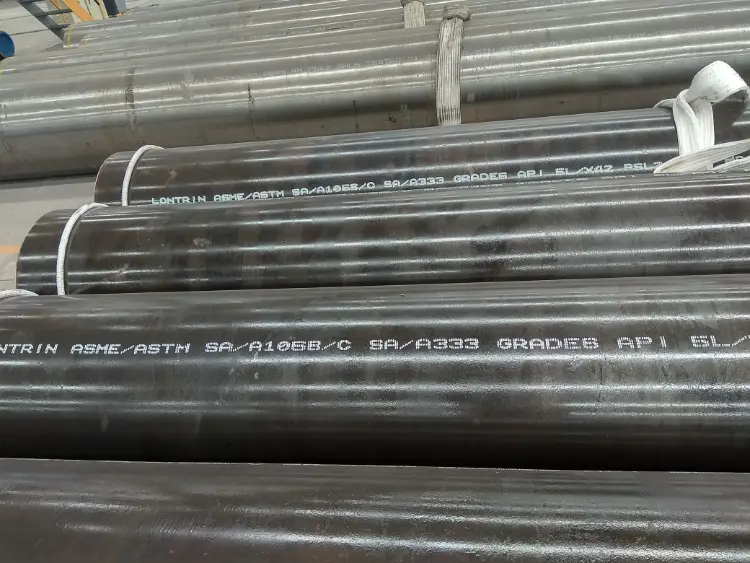
API 5L PSL2 X42N Pipeline Steel
API 5L PSL2 X42N Pipeline Steel: Properties, Equivalents & Application Data
Comprehensive technical data for API 5L PSL2 X42N (L290N) normalized pipeline steel coil per official standards. Includes chemical composition, mechanical properties, and physical performance.
Normalizing rolling, quenching + tempering, cold forming, welding
- Phone : +8618037372205
- Email : [email protected]
- WhatsApp: Contact via Whtsapp
- WeChat: +8618037372205
API 5L PSL2 X42N Pipeline Steel Introduction
API 5L PSL2 X42N (L290N) is a micro-alloyed pipeline steel supplied in normalized condition. It is classified under PSL 2, which mandates stricter requirements for chemical composition, mechanical properties, and non-destructive testing compared to PSL 1. The "N" designation confirms normalizing rolling or an equivalent heat treatment, resulting in a fine-grained, homogeneous microstructure. This delivers an excellent balance of yield strength (minimum 290 MPa), tensile strength, and significantly improved low-temperature toughness. The material excels in fracture arrest performance and crack propagation resistance, making it suitable for both sweet and slightly sour service environments. Its reliable weldability due to a controlled carbon equivalent simplifies field girth welding and fabrication.
API 5L PSL2 X42N Pipeline Steel Chemical Composition
The chemical composition is strictly controlled per API 5L PSL2 to ensure weldability and toughness. The table lists the maximum limits for the normalized grade X42N. Carbon Equivalent (CEIIW) is typically limited to 0.22% for standard wall thickness to prevent cold cracking during welding. Nb, V, or Ti micro-alloying elements are typically added individually or in combination to ensure grain refinement and precipitation strengthening during normalizing.
| Chemical Element | Standard Requirement (Max) | Remarks |
|---|---|---|
| C (Carbon) | 0.17% | Heat analysis limit for grades ≥ L290/X42 but < L360/X52; PSL2 requires 0.22% max for CEV control. |
| Si (Silicon) | 0.40% | Contributes to deoxidation and strength. |
| Mn (Manganese) | 1.20% | Primary solid solution strengthener, crucial for attaining required tensile strength. |
| P (Phosphorus) | 0.025% | Stringently controlled in PSL2 to maximize low-temperature toughness. |
| S (Sulfur) | 0.015% | Reduced sulfur enhances resistance to hydrogen-induced cracking (HIC). |
| V (Vanadium) | 0.05% | Micro-alloying element for grain refinement and precipitation strengthening. |
| Nb (Niobium) | 0.05% | Critical for grain refinement during normalizing, improving strength and toughness. |
| Ti (Titanium) | 0.04% | Forms stable nitrides to prevent grain coarsening and improve toughness. |
| Al (Aluminum) | 0.060% | Total aluminum; acts as a deoxidizer and grain refiner. |
| N (Nitrogen) | 0.012% | Max limit; titanium or vanadium binds nitrogen to prevent aging effects. |
| Cu (Copper) | 0.50% | Residual element limit, provides minor atmospheric corrosion resistance. |
| Ni (Nickel) | 0.50% | Residual element limit, improves toughness. |
| Cr (Chromium) | 0.50% | Residual element limit, increases hardenability and corrosion resistance. |
| Mo (Molybdenum) | 0.50% | Residual element limit, enhances high-temperature strength and hardenability. |
API 5L PSL2 X42N Pipeline Steel Thermal and Electrical Physical Properties
These properties are not mandatory per API 5L specification but are essential for engineering design calculations. Values are typical for low-alloy C-Mn steel with a ferrite-pearlite microstructure at room temperature, unless otherwise noted. The thermal conductivity and specific heat capacity are critical parameters for defining welding preheat procedures and flow assurance models.
| Property | Typical Value | Unit | Test Condition |
|---|---|---|---|
| Density (ρ) | 7.80 | g/cm³ | 20°C |
| Elastic Modulus (E) | 207 | GPa | 20°C |
| Shear Modulus (G) | 80 | GPa | Calculated from E and Poisson's ratio at 20°C |
| Poisson Ratio (ν) | 0.30 | - | 20°C, for standard structural design |
| Thermal Expansion Coefficient (α) | 11.7 × 10⁻⁶ | m/(m·°C) | Average between 20°C and 100°C |
| Thermal Expansion Coefficient (α) | 12.8 × 10⁻⁶ | m/(m·°C) | Average between 20°C and 400°C |
| Thermal Conductivity (λ) | 52 | W/(m·K) | 20°C, typical for low-carbon steel |
| Specific Heat Capacity (cp) | 480 | J/(kg·K) | 20°C |
| Electrical Resistivity (ρe) | 0.22 × 10⁻⁶ | Ω·m | 20°C, for typical C-Mn steel |
API 5L PSL2 X42N Pipeline Steel Mechanical Properties
API 5L PSL2 specifies mandatory values for transverse strip specimens. For the X42N (L290N) grade, the minimum yield strength is 290 MPa. The normalizing heat treatment ensures a low yield-to-tensile (Y/T) ratio, typically below 0.88, which provides excellent plastic deformation capacity and overload margin. Charpy V-notch impact tests are mandatory for all PSL2 steel, with specific energy absorption requirements at 0°C or lower, proving fracture arrest capability.
| Property | Standard Mandatory Value | Unit | Test Condition/Room Temp (unless noted) |
|---|---|---|---|
| Yield Strength (ReH) | 290 - 495 | MPa | Transverse, strip specimen, 0.5% total extension |
| Tensile Strength (Rm) | 415 - 760 | MPa | Transverse, strip specimen, 20°C |
| Yield to Tensile Ratio (ReH/Rm) | 0.93 (Max) | Ratio | Specified for normalized/stress-relieved pipe in PSL2 |
| Elongation (A50mm) | Min 23 | % | Transverse, strip specimen, proportional to area (A50mm) |
| Charpy Impact Energy (KVC) | Min 27 J (Average of 3) | J | 0°C, Transverse, full-size 10x10 mm specimen |
| Charpy Impact Energy (KVC) | Min 20 J (Individual) | J | 0°C, Transverse, full-size 10x10 mm specimen |
| Bend Test | No cracks ≥3mm | - | 180° bend around diameter specified in standard, at 20°C |
| Hardness (HV10) | 250 (Max) | HV | Applies universally for PSL2 carbon steel pipe in sweet service |
API 5L PSL2 X42N Pipeline Steel Fully Equivalent Material Standards and Replaceable Grades
| Country/Region | Standard | Designation | Remarks |
|---|---|---|---|
| International | ISO 3183 | L290N (PSL 2) | Technically identical to API 5L; L290N is the metric designation for the same minimum strength. |
| Europe | EN 10208-2 | L290NB | European standard for steel pipes for combustible fluids. L290NB is equivalent but may have slight differences in CEV limits. |
| Canada | CSA Z245.1 | Grade 290, Category II | Canadian standard for line pipe. Cat II is equivalent to PSL 2; the grade matches 290 MPa yield. |
| Russia | GOST R ISO 3183 | K42 (L290N) | Russian adoption of ISO 3183 standard, directly recognizing the L290N designation. |
| Brazil | ABNT NBR 15752 | L290N | Brazilian standard for pipeline inspection, adheres to ISO 3183 classification. |
API 5L PSL2 X42N Pipeline Steel Application Introduction
API 5L PSL2 X42N (L290N) is the industry workhorse for moderate-pressure fluid transmission. The normalized microstructure guarantees homogeneous mechanical properties in both base metal and heat-affected zone (HAZ), providing superior resistance to hydrogen-induced cracking (HIC) when the chemistry is acidified with low sulfur. This material is a primary choice for gathering lines, distribution networks, and process piping where reliable, leak-before-burst failure modes are required. Its low-temperature toughness makes it suitable for arctic applications, while its stable micro-alloying prevents strength loss during hot bending for pipe fittings.
Product Applications: Line Pipe (seamless, HFW/ERW, SAW): The primary raw form for pipeline construction., Pipe Fittings: Induction bends, tees, reducers, and caps manufactured via hot forming while retaining normalized properties., Pressure Vessel Shells: Rolled and welded cylinders for low-pressure separators and storage., Structural Hollow Sections: Jacket legs and pile guides for offshore platforms exploiting X42N's strength and weldability.
Processed into products: Pipeline segments and tie-in spools for field construction., Pipeline bends (3D, 5D, or cold bends) requiring guaranteed minimum impact toughness., Weldolet, sockolet, and threadolet branch connections forged from equivalent grade., Anchor flanges, insulation joint components, and pig launcher/receiver barrels., Coil-tubing steel strings for well intervention services in mild sour conditions.
Application industries: Oil & Gas Upstream: Gathering lines and flowlines transporting multiphase fluids., Oil & Gas Midstream: Cross-country gas and crude oil transmission pipelines., Petrochemical: Process piping and plant interconnecting pipelines., Geothermal Energy: Brine water re-injection lines requiring moderate corrosion resistance., Water Utilities: Long-distance water transfer mains and penstocks in hydroelectric projects.
API 5L PSL2 X42N Pipeline Steel Similar or Alternative Materials Recommendation
| Country/Region | Standard | Designation | Comparative Analysis |
|---|---|---|---|
| Global (API) | API SPEC 5L | X42NO (PSL2) | Offshore service variant subjected to stricter NDT and testing frequencies. Identical mechanical properties but enhanced quality assurance. |
| Global (API) | API SPEC 5L | X42M (PSL2) | Thermo-mechanically rolled variant. Achieves strength via controlled rolling vs. normalizing. May have higher Y/T ratio and different weld heat-affected zone (HAZ) properties. |
| Europe | EN 10025-3 | S275N / S275NL | Structural fine-grain steel in normalized condition. Lower strength (~275 MPa yield), but similar toughness philosophy. Used in storage tanks and steel structures. |
| China | GB/T 21237 | L290N (X42N) | Chinese national standard for oil and gas pipeline steel. Generally aligns with ISO 3183, but may have proprietary micro-alloying approaches. |
| Japan | JIS G 3106 | SM400B | General structural steel for welded structures. Lower strength requirement and no mandatory PSL2-level toughness, making X42N a superior choice for dynamic/cyclic service. |
Notes:
- Fracture Control: This grade is often specified with Supplementary Requirement SR5 or SR6 in API 5L for fracture arrest toughness (e.g., Battelle Drop Weight Tear Test, BDWTT, ensuring ≥85% shear area at design temperature).
- Sour Service (HIC/SSC): For sour environments containing H2S, the steel must be HIC tested per NACE TM0284. Ordering requires specifying "PSL 2 X42NS" with a maximum hardness of 248 HV10 and strict sulfur ≤0.002% limits to prevent cracking.
- Weldability: The typical Carbon Equivalent (CEIIW) is ≤0.22, ensuring minimal risk of hydrogen-induced cold cracking with appropriate basic welding consumables. Preheat is normally not required for thicknesses under 20 mm if low-hydrogen processes (GMAW, GTAW, SMAW with H4 rods) are used.
- Share



