
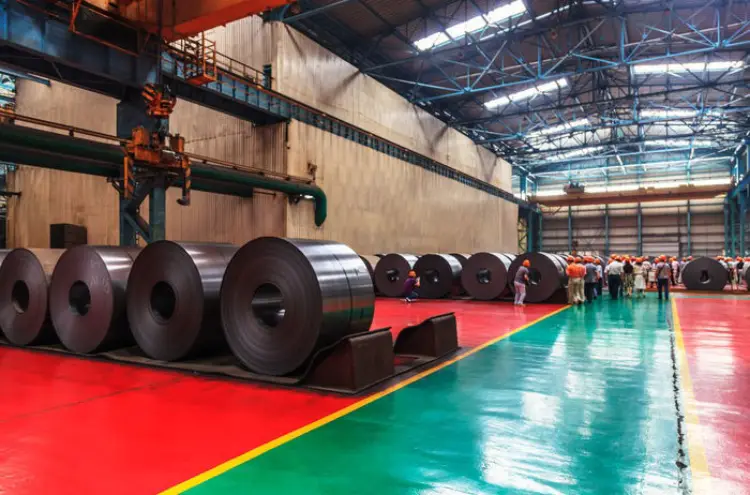
API 5L PSL2 X46N (L320N) Pipeline Steel Coil
API 5L PSL2 X46N (L320N) Pipeline Steel Coil: Properties, Equivalents & Applications
Complete material data for API 5L PSL2 X46N (L320N) pipeline steel coil: chemical composition, mechanical and physical properties, international equivalents, and application guidance for oil & gas transportation.
Thermomechanical controlled rolling, normalizing rolling, or normalizing forming; suitable for cold forming, welding (ERW, SAW), and bending
- Phone : +8618037372205
- Email : [email protected]
- WhatsApp: Contact via Whtsapp
- WeChat: +8618037372205
API 5L PSL2 X46N Pipeline Steel Coil Introduction
API 5L X46N (L320N) is a high-strength low-alloy (HSLA) pipeline steel grade specified under API Specification 5L for line pipe. The 'X46' denotes a minimum yield strength of 46 ksi (320 MPa), and the suffix 'N' indicates that the steel is supplied in a normalized or normalizing rolled condition to achieve refined grain structure and improved toughness. As a PSL2 (Product Specification Level 2) material, X46N meets more stringent requirements for chemical composition, mechanical properties, and non-destructive testing, making it suitable for sour service and demanding environments. The coil form is used for manufacturing longitudinally welded pipes (ERW, HFW) or spiral welded pipes. Key advantages include good weldability, excellent low-temperature toughness, and reliable strength for oil, gas, and water transmission pipelines.
API 5L PSL2 X46N Pipeline Steel Coil Chemical Composition
The following chemical composition limits comply with API 5L PSL2 for grade X46N. Carbon equivalent (CE) and Pcm values are controlled to ensure weldability. For sour service, additional limits on S, P, and inclusion shape control are often applied on a supplementary requirement basis.
| Chemical Element | Standard Value | Remarks |
|---|---|---|
| Carbon (C) | ≤ 0.24% | Max limit for PSL2 |
| Manganese (Mn) | ≤ 1.40% | Max limit for PSL2; higher Mn may be used with appropriate CEQ limits |
| Phosphorus (P) | ≤ 0.025% | PSL2 requirement; lower limit if specified for sour service |
| Sulfur (S) | ≤ 0.015% | PSL2 requirement; often ≤0.003% for HIC-resistant steel |
| Silicon (Si) | ≤ 0.45% | Typical; not always specified as a mandatory element but included in ladle analysis |
| Niobium (Nb) | ≤ 0.05% | Microalloy; combined V+Nb+Ti ≤ 0.15% by heat analysis |
| Vanadium (V) | ≤ 0.05% | Microalloy; see combined limit |
| Titanium (Ti) | ≤ 0.04% | Microalloy; see combined limit |
| Copper (Cu) | ≤ 0.50% | Residual element; lower if specified |
| Nickel (Ni) | ≤ 0.50% | Residual |
| Chromium (Cr) | ≤ 0.50% | Residual |
| Molybdenum (Mo) | ≤ 0.50% | Residual |
| Nitrogen (N) | ≤ 0.012% | Unless agreed otherwise |
| Aluminum (Al) | ≥ 0.020% (total) | Fine grain practice; generally required for normalized steels |
| Carbon Equivalent (CEPcm) | ≤ 0.22% (typical for thickness ≤25mm) | Pcm = C+Si/30+(Mn+Cu+Cr)/20+Ni/60+Mo/15+V/10+5B; commonly limited for weldability |
API 5L PSL2 X46N Pipeline Steel Coil Thermal & Electrical Physical Properties
The following physical constants are nominal for low-alloy pipeline steel at room temperature unless otherwise indicated. These values are used for design calculations such as thermal expansion, heat loss, and cathodic protection.
| Property | Typical Value | Unit | Test Condition / Reference |
|---|---|---|---|
| Density (ρ) | 7.85 | g/cm³ | Room temperature |
| Modulus of Elasticity (E) | 205 – 210 | GPa | Tensile modulus; slight variation with temperature |
| Shear Modulus (G) | 80 – 84 | GPa | Calculated from E and Poisson ratio |
| Poisson's Ratio (ν) | 0.28 – 0.30 | - | Elastic range |
| Thermal Expansion Coefficient (α) | 11.7 – 12.5 (at 0‑100°C) | 10⁻⁶/K | Mean coefficient; increases with temperature |
| Thermal Conductivity (λ) | 45 – 55 | W/(m·K) | At 20°C; decreases with increasing temperature |
| Specific Heat Capacity (c) | 460 – 480 | J/(kg·K) | At room temperature |
| Electrical Resistivity (ρₑ) | 0.14 – 0.18 | µΩ·m | At 20°C; increases with temperature and alloy content |
| Melting Range | ~1480 - 1520 | °C | Approximate solidus/liquidus |
API 5L PSL2 X46N Pipeline Steel Coil Mechanical Properties
Tensile and impact properties as required by API 5L PSL2 for X46N (L320N) pipe body and weld seam. Test specimens are taken transverse to the pipe axis for welded pipe. The values apply at room temperature unless otherwise specified. Impact test temperatures may be customized (e.g., -20°C, -40°C).
| Property | Required Value | Unit | Test Condition / Remarks |
|---|---|---|---|
| Yield Strength (Rt0.5) | 320 – 525 | MPa | Transverse, pipe body. Upper limit per PSL2 Table 2. |
| Tensile Strength (Rm) | 435 – 655 | MPa | Minimum and maximum per PSL2. |
| Yield to Tensile Ratio | ≤ 0.93 | - | Rt0.5/Rm, for PSL2 line pipe (if specified). |
| Elongation (A) | ≥ 22% (for 5.65√S0 gauge) | % | Minimum on 50 mm (2 in) gauge length; proportional to thickness. |
| Elongation (A) | ≥ 18% (for A50) | % | Alternative gauge length, depending on standard |
| Bend Test (Diameter) | No cracks | - | Guided bend test; former diameter 3t for thickness ≤12.7mm (0.5 in). |
| Charpy V-notch Impact (KV) | ≥ 27 J (individual) / ≥ 40 J (average) | J | Full-size specimen, transverse, at 0°C (standard test temperature); customizable to lower temperatures like -20°C, -40°C. |
| Hardness | ≤ 235 HV10 or equivalent (e.g., 22 HRC) | HV10 | Maximum for PSL2 non-sour service; lower for sour service (e.g., 22 HRC). |
API 5L PSL2 X46N Pipeline Steel Coil Internationally Equivalent Standards and Replaceable Grades
| Country / Region | Standard | Grade | Remarks |
|---|---|---|---|
| International | ISO 3183 (PSL2) | L320N | Direct equivalent for normalized line pipe steel; similar chemical and mechanical requirements. |
| Europe | EN 10208-2 | L320NB | Non-alloy normalized steel for gas and oil pipelines; PSL2 equivalent. |
| China | GB/T 9711-2017 (PSL2) | L320N (X46N) | Adopts API 5L; L320N is the same strength designate. |
| United States | API 5L (PSL2) | X46N | Same standard. Also X46Q (quenched and tempered) offers different delivery condition but same strength. |
| Russia / CIS | GOST 31447 (interstate) | K48 (approximate, but K48 is minimum 48 kgf/mm² ~ 470 MPa TS, not exact) | GOST does not have an exact X46 equivalent; typically use API 5L X46N. |
| United States (fittings) | ASTM A860 | WPHY 46 | Butt-welding fittings matching API 5L X46 pipe properties. |
API 5L PSL2 X46N Pipeline Steel Coil Application Introduction
API 5L X46N (L320N) steel coil is ideally suited for manufacturing welded line pipes used in the transportation of oil, gas, and water. Its normalized grain structure offers a balance of strength and ductility, good low-temperature toughness, and reliable weldability in the field. Typical applications and products include:
Product Applications: Longitudinally welded (ERW/HFW) line pipe, Spiral welded (SSAW) large-diameter pipe, Pipeline coatings (3LPE, FBE coated pipe), Pipe fittings (tees, elbows, reducers), Pipeline components (flanges, gaskets)
Processed into products: Line pipe for cross-country oil/gas pipelines, Offshore riser sections (with supplemental HIC testing), Casing and tubing for well construction (when specified as casing grade), Conductor pipes for offshore platforms, Piping spools for midstream gathering systems
Application industries: Oil and Gas (onshore and offshore transmission pipelines), Petrochemical (refinery process piping), Water Transportation (high-pressure water mains), Structural Engineering (piles, construction), Slurry Transport (mining, dredging)
API 5L PSL2 X46N Pipeline Steel Coil Similar / Comparable Alternative Materials
| Country / Region | Standard | Grade | Remarks |
|---|---|---|---|
| International | API 5L PSL2 | X42N (L290N) | Lower strength grade (290 MPa YS) with similar normalized microstructure; can be used in lower pressure or thinner wall designs. |
| International | API 5L PSL2 | X52N (L360N) | Higher strength grade (360 MPa YS) often used as an alternative for higher pressure capability with similar toughness. |
| Europe | EN 10028-3 | P355N | Pressure vessel steel with similar yield strength; normalized, but not a direct pipeline steel; can be used for tanks or larger structures. |
| China | GB/T 9711 | L290N | X42 equivalent; lower strength, but same PSL2 quality level. |
Notes:
- X46N PSL2 coils may be supplied with supplementary requirements such as HIC (Hydrogen Induced Cracking) resistance test (NACE TM0284), SSC (Sulfide Stress Cracking) resistance (NACE MR0175), and DWTT (Drop Weight Tear Test) for arrest properties.
- When ordering, the purchaser should specify coil dimensions (thickness, width), inner/outer diameter limits, and any additional testing (e.g., Charpy V-notch at -20°C).
- For sour service, a maximum hardness of 22 HRC (or 235 HV10) and restricted chemistry (S ≤ 0.003%, Ca treatment) are commonly required.
- The L320N designation is used interchangeably with X46N; 'L' stands for the yield strength in MPa, while 'X' is the ksi-based designation.
- Share



