
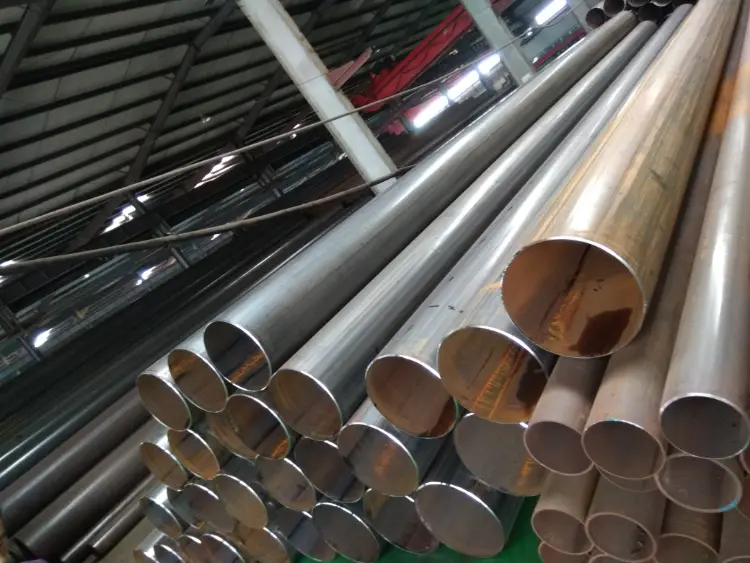
DIN 17100 St44-2 LSAW Pipe
DIN 17100 St44-2 LSAW Pipe - Structural Steel Properties & Equivalents
Comprehensive material data for St44-2 steel according to DIN 17100 standard, used for LSAW pipes, including chemical composition, mechanical properties, thermal and electrical physical properties, equivalent grades and application guide.
Hot rolling, cold forming, bending, welding, machining, normalizing
- Phone : +8618037372205
- Email : [email protected]
- WhatsApp: Contact via Whtsapp
- WeChat: +8618037372205
DIN 17100 St44-2 LSAW Pipe Introduction
St44-2 is a German structural steel grade formerly defined in DIN 17100, widely applied in welded constructions such as LSAW pipes, bridges, building frameworks and general engineering. With a minimum yield strength of 275 MPa for thicknesses up to 16 mm and a tensile strength ranging from 410 to 560 MPa, it offers a balanced combination of strength, ductility and weldability. The steel is supplied in hot‑rolled or normalized condition, suitable for cold forming, machining and arc welding. Although the original standard does not guarantee specified impact energy values, modern equivalents like EN 10025‑2 S275JR provide a Charpy impact requirement of 27 J at +20 °C, making it a reliable choice for load‑bearing structures. Its carbon content is limited to 0.21%, contributing to good toughness and ease of processing.
DIN 17100 St44-2 LSAW Pipe Chemical Composition
Chemical limits according to DIN 17100 for grade St44-2. Values are based on ladle analysis. Silicon is not required by the standard; aluminium, nitrogen and residual elements are not intentionally added but may be present in typical amounts of 0.02–0.06%. Phosphorus and sulphur are limited to ensure good weldability and reduce hot‑shortness. Copper content up to 0.20% may appear as a tramp element.
| Element | Standard value (max) | Remarks |
|---|---|---|
| C | 0.21 | Maximum; for thickness >30 mm, max 0.23 permitted upon agreement |
| Si | - | Not specified; typically 0.10–0.35 for deoxidation |
| Mn | - | Not specified; normally 0.40–1.20, adjusted for thickness |
| P | 0.050 | Maximum |
| S | 0.050 | Maximum |
| N | - | No requirement; typical 0.012 max |
| Al | - | Not required; residual from deoxidation ~0.02–0.06 |
| Cu | - | Not required; background content < 0.20 |
DIN 17100 St44-2 LSAW Pipe Thermal and Electrical Physical Properties
Physical properties are typical for low‑carbon structural steels and can vary with temperature and processing history. Density is taken as 7.85 g/cm³ for weight calculations; elastic modulus decreases gradually with increasing temperature. Thermal expansion coefficient quoted for 20–100 °C range; thermal conductivity at room temperature around 50 W/m·K. Specific heat capacity and electrical resistivity are typical values used for engineering calculations.
| Property | Approximate value | Unit | Test condition / remarks |
|---|---|---|---|
| Density (ρ) | 7.85 | g/cm³ | At 20 °C |
| Elastic modulus (E) | 210 | GPa | At 20 °C |
| Shear modulus (G) | 80 | GPa | At 20 °C, calculated from E and ν |
| Poisson's ratio (ν) | 0.30 | - | At 20 °C |
| Thermal expansion (α) | 12.0 × 10⁻⁶ | 1/K | 20–100 °C |
| Thermal conductivity (λ) | 50 | W/(m·K) | At 20 °C; decreases with increasing temperature |
| Specific heat capacity (c) | 460 | J/(kg·K) | At 20 °C |
| Electrical resistivity (ρₑ) | 0.15 × 10⁻⁶ | Ω·m | At 20 °C; approx. 0.15 μΩ·m |
DIN 17100 St44-2 LSAW Pipe Mechanical Properties
Mechanical properties at room temperature for St44‑2 in as‑rolled condition. The yield strength decreases with increasing product thickness, while tensile range remains constant. Elongation is measured on gauge length A5 (L₀ = 5.65√S₀) for plates; for pipes, transverse elongation may be slightly lower. No Charpy impact requirement is specified in the original standard; this grade is not intended for toughness‑critical applications unless supplementary testing is agreed. Bending test via mandrel diameter up to 180° is typically demanded.
| Property | Standard required value | Unit | Test condition / thickness range |
|---|---|---|---|
| Yield strength (ReH, min) | 275 | MPa | t ≤ 16 mm |
| Yield strength (ReH, min) | 265 | MPa | 16 < t ≤ 40 mm |
| Yield strength (ReH, min) | 255 | MPa | 40 < t ≤ 63 mm |
| Tensile strength (Rm) | 410–560 | MPa | t ≤ 63 mm |
| Elongation (A, min) | 22 | % | t ≤ 16 mm, longitudinal |
| Elongation (A, min) | 22 | % | 16 < t ≤ 40 mm, longitudinal |
| Elongation (A, min) | 21 | % | 40 < t ≤ 63 mm, longitudinal |
| Bending test (mandrel diameter) | 1.0×t | - | t ≤ 16 mm, 180° bend, not cracked |
| Bending test (mandrel diameter) | 1.5×t | - | 16 < t ≤ 63 mm, 180° bend, not cracked |
DIN 17100 St44-2 LSAW Pipe Fully Equivalent Standards and Substitute Grades
| Country/Region | Standard | Grade | Remarks |
|---|---|---|---|
| Europe | EN 10025-2:2004 | S275JR | Direct replacement; adds Charpy impact 27 J at +20 °C, chemical limits adjusted |
| International | ISO 630-2:2011 | S275JR | Equivalent to EN S275JR |
| United Kingdom (obs.) | BS 4360:1990 | 43B | Withdrawn, but historically equivalent (B=JR) |
| China | GB/T 700-2006 | Q275B | Similar properties; impact requirement 20 °C 27 J, tensile range 410–560 MPa, yield ≥275 MPa for t≤16 mm |
DIN 17100 St44-2 LSAW Pipe Application Introduction
St44‑2 (S275JR) is a versatile structural steel suitable for welded, bolted and riveted constructions. Its combination of moderate strength and good formability makes it the material of choice for LSAW pipes, building frames, bridge parts and general machinery. It can be processed by all common workshop methods: flame cutting, plasma cutting, hot and cold forming, and welding with rutile or basic electrodes. In pipeline applications, the steel is typically supplied as LSAW pipes with diameters up to 60 inches or more, fulfilling requirements of API 5L or EN 10208 if compatible. Post‑weld heat treatment is normally not necessary due to the low carbon content.
Product Applications: Longitudinally Submerged Arc Welded (LSAW) pipes, Structural hollow sections (square, rectangular, circular), Hot‑rolled plates and strips for weldments, Steel beams, channels and angles, Fabricated pressure vessel components
Processed into products: Pipe spools and pipeline segments, Bridge girders and stiffeners, Building columns and roof trusses, Brackets, base plates, and support stools, Ship hull plates and bulkheads (secondary structures), Machinery frames and base frames
Application industries: Oil and gas transportation (pipeline systems), Water supply and sewage networks, Construction and civil engineering (steel structures, bridges), Shipbuilding and offshore platforms, Machinery manufacturing and industrial raw material supply, Pressure vessel supports and structural framework
DIN 17100 St44-2 LSAW Pipe Similar/Comparable Substitute Materials
| Country/Region | Standard | Grade | Remarks |
|---|---|---|---|
| United States | ASTM A36/A36M | A36 | Yield 250 MPa, tensile 400–550 MPa; slightly lower strength, widely used structural steel |
| Japan | JIS G3106 | SM400A | Yield 245 MPa, tensile 400–510 MPa; for welded structures, not impact tested |
| China | GB/T 700-2006 | Q235B | Lower strength than St44-2 (yield 235 MPa), but common general structural steel |
| Europe | EN 10025-2:2004 | S235JR | Yield 235 MPa, tensile 360–510 MPa; often used where higher toughness is required but lower strength acceptable |
Notes:
Important note for procurement: DIN 17100 has been officially withdrawn and superseded by EN 10025‑2 for structural steels. St44‑2 should be ordered as S275JR according to EN 10025‑2, optionally with a characteristic impact strength value of 27 J at +20 °C. For LSAW pipe applications, additional requirements such as ultrasonic testing of the weld seam, tight dimensional tolerances, and optional notch toughness at lower temperatures may be specified in the purchase order.
- Share



